
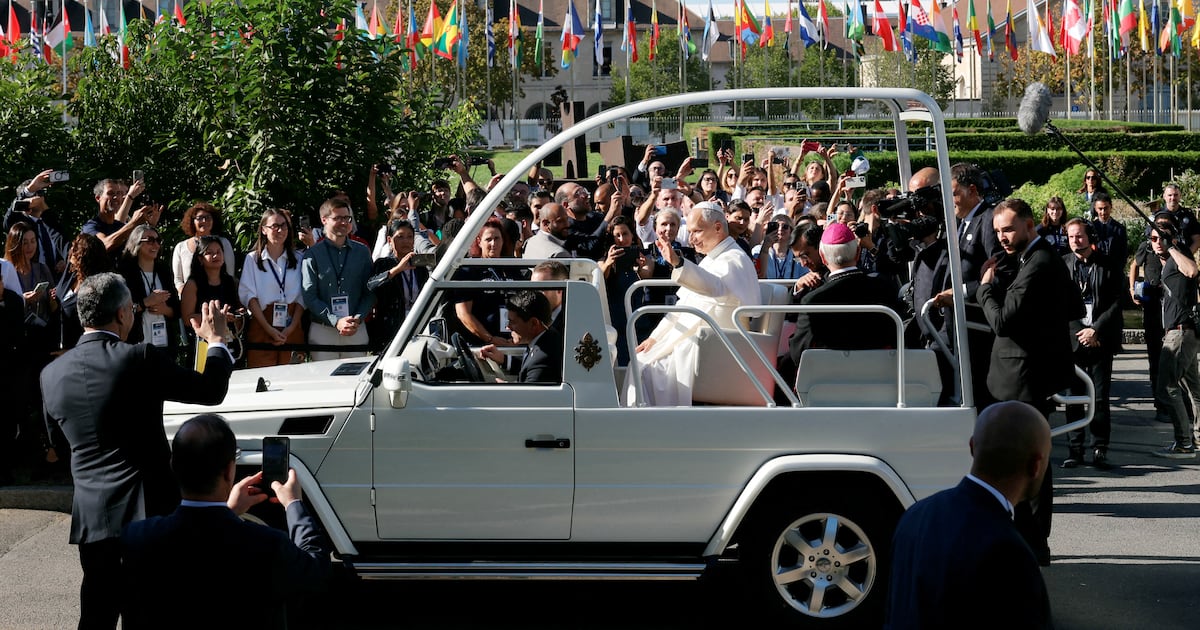
Alone and fleeing scandal, a 23-year-old gave birth in a Catholic mother and baby home close to the US border with Canada in the summer of 1917.She named her little boy “Jean” and chose “Prevost” for his surname: the maiden name of the mother she had left behind in her native France two years earlier, when she boarded a ship from Le Havre to New York.That decision, at the Our Lady of Victory Infant Home in Lackawanna, reverberated down the decades, ultimately determining the surname of her grandson, Robert Francis Prevost, now Pope Leo XIV.“To the best of our knowledge, the pope’s grandparents were never married,” said Sean Daly, a US-French genealogist with France’s family history website Geneanet, whose name reflects his own Irish roots.READ MOREDaly was among a group of people who set about solving the mystery behind the Prevost surname when the pope was elected in May 2025.“Prevost is a French name. But this is weird,” he remembers he and his colleagues thinking. “Because we can’t find a marriage certificate; in fact, we can’t find anything about his grandparents.“It’s because the pope’s grandpa was already married to someone else.”The family secret has been pulled into the spotlight as the pontiff visits his grandmother’s native land of France this weekend, drawing hundreds of thousands to masses at Notre Dame and on the Champs-Élysées before travelling to Lourdes and Metz.The birth certificate of Pope Leo's father, Louis Prevost. Leo probably didn’t know the circumstances of the birth of his uncle Jean in 1917, and his father Louis in 1920, before his election as pope unleashed the curiosity of genealogists worldwide.Researchers at Geneanet soon established that Leo’s French grandmother used two names: Fabre, an assumed name, and Fontaine, her real surname at birth.She was a baker’s daughter, born in the port city of Le Havre, Normandy, in 1894. She had migrated to the United States in 1915 and lived at the Catholic-run Jeanne d’Arc Home for Friendless French Women in New York, where she was listed as a governess.But who was the father of her children, Jean Prevost, and why was he strangely absent from records?Daly discovered that other genealogists had been digging into the same mystery on an online discussion group, The Genealogy Discord.There, some researchers had a theory. The pope’s grandfather Jean Prevost, a language teacher, was associated with the “Riggitano-Prevost School of Languages” in Chicago.Just as the name Jean Prevost began to appear in archival documents, the name of the school’s renowned founder Salvatore Giovanni Riggitano faded out.Some researchers had a theory: were Riggitano and Prevost the same person?The answer was provided by the discovery of two forms filed by Leo’s grandparents in 1940, when the introduction of the Alien Registration Act required all non-US citizens to register with the government.“I entered the United States under the name Salvatore Giovanni Riggitano Alioto” reads the form filed by Leo’s grandfather, which is signed “John Riggitano Prevost”.Suzanne Fontaine and John Prevost's Alien Registration forms reveal the family secret. Both of Pope Leo's grandparents stated the names under which they had entered the US: Suzanne Fontaine and Salvatore Giovanni Riggitano Alioto. The surname they used, 'Prevost', was an assumed identity. Photograph: Sean Daly Pope Leo's grandfather Salvatore Riggitano, who was a well-known teacher of romance languages. Credit - Sean Daly, genealogist with Geneanet He emigrated to the United States from Sicily in 1903, aged 27, in search of opportunities he felt he was blocked from accessing at home.Salvatore Riggitano became known as a prominent teacher of languages, celebrated in Chicago society for his knowledge of European culture.In 1914 he married Daisy Hughes, who was described in a later news report as being “of Irish parentage”. Riggitano was 37, and his bride was 38.It is unclear when and where Riggitano met a young French governess who was 18 years his junior. However, in March 1917, the Quincy Daily Herald of Illinois ran a story with the headline “Riggitano in triangle”.Newspaper coverage of the arrest of Salvatore Riggitano and Suzanne Fontaine, accused of being 'mixed up improperly' and of having 'an illicit relationship' by Riggitano's US-born wife, Daisy née Hughes, who is reported to be 'of Irish parentage'. Photograph: The Genealogy Discord The newspaper reported that Riggitano’s wife Daisy had accused her husband of being “mixed up improperly” with “Suzana Fountan”, and that the accused lovers had both been arrested.Adultery was a crime in Illinois; it remains on the statute today, though unenforced.When released on bail, Fontaine fled to Canada, skipping a court date that had been scheduled for April.“The pope’s grandparents were in a jam. She was pregnant, and at the court appearance a month later, she would be visibly pregnant,” Daly said.“They hatched a plot: you’re going to go off to Canada, where no one can find you, and then you’re going to give birth to the child somewhere where nobody knows us.”Fontaine crossed back into the US from Canada in May, US entry records show, and then travelled to the Our Lady of Victory Infant Home in Lackawanna, not far from the border. Her baby Jean Prevost – the pope’s uncle – was born in the “Infant Home” on July 23rd, 1917, according to a birth certificate that Daly wangled from a civil registrar.“This document shows the parents using their made-up names for the first time. Salvatore Riggitano becomes Jean Prevost.”The couple had another son three years later, in 1920: Louis, the pope’s father.By then, Suzanne “Fabre” was living in Chicago with her children. According to the 1920 census, Riggitano was still living with his wife Daisy at the other end of town.“The conclusion is that the pope’s grandpa led a double life for a few years,” Daly said.Riggitano eventually left his wife Daisy, but there is no evidence they ever divorced. Daisy died in 1939, still calling herself Mrs Riggitano.Mother and baby homes in the US do not always come with the same connotations of trauma that they do in Ireland. The founder of the Our Lady of Victory Infant Home, Fr Nelson Baker, is fondly remembered for his initiatives for the poor and was posthumously given the title “Venerable” by the Church in 2011, a step on the path to sainthood.However, a Facebook page, Our Lady of Victory Infant Home Adoptees, is full of the familiar, painful stories of people seeking family members and struggling to find records.“I was in Father Bakers home for unwed mothers in 1971. I gave birth to my son on November 5th 1971 at our lady of victory hospital. My parents would not let me bring him home as I was only 17,” one post reads. “In Jan 1972 I turned 18, I called the home to tell them I was coming for Christopher. That is when they told me he had been adopted out. I have been searching for him ever since then.”Genealogists published their findings after the pope’s election and, in August 2025, Leo met the host of a popular US genealogy television show.The Pope waves from an open papal vehicle during a papal walkabout in Paris. Photograph: Stéphane Mouchmouche/Hans Lucas/AFP via Getty Images Harvard professor Henry Louis Gates Jr made a presentation to the pontiff about his diverse ancestry, which includes both enslaved black people and slave-owners, and remote connections to Canadian nobility.Christopher White, author of Pope Leo XIV: Inside the Conclave and the Dawn of a New Papacy, says it is “hard to imagine that he hasn’t” reflected on the experience of his grandmother and uncle. Both lived until the then-Robert Francis Prevost was well into adulthood.Leo has not made any public comment on his family story, but a future visit to Ireland could be the moment he does.“I think the pope will visit Ireland. He’s got Irish connections,” White said.“I think it could be a moment of deeper reflection for him, to reflect on his own personal story and tie it to the real wounds and suffering that exist in Ireland and beyond.”
Pope Leo’s family secret: a birth in a mother and baby home
Full Article
Original Source
Read the full article at Irishtimes →KhanList aggregates and links to publicly available news content. We do not host full articles from third-party sources. Always verify important information with original sources.