
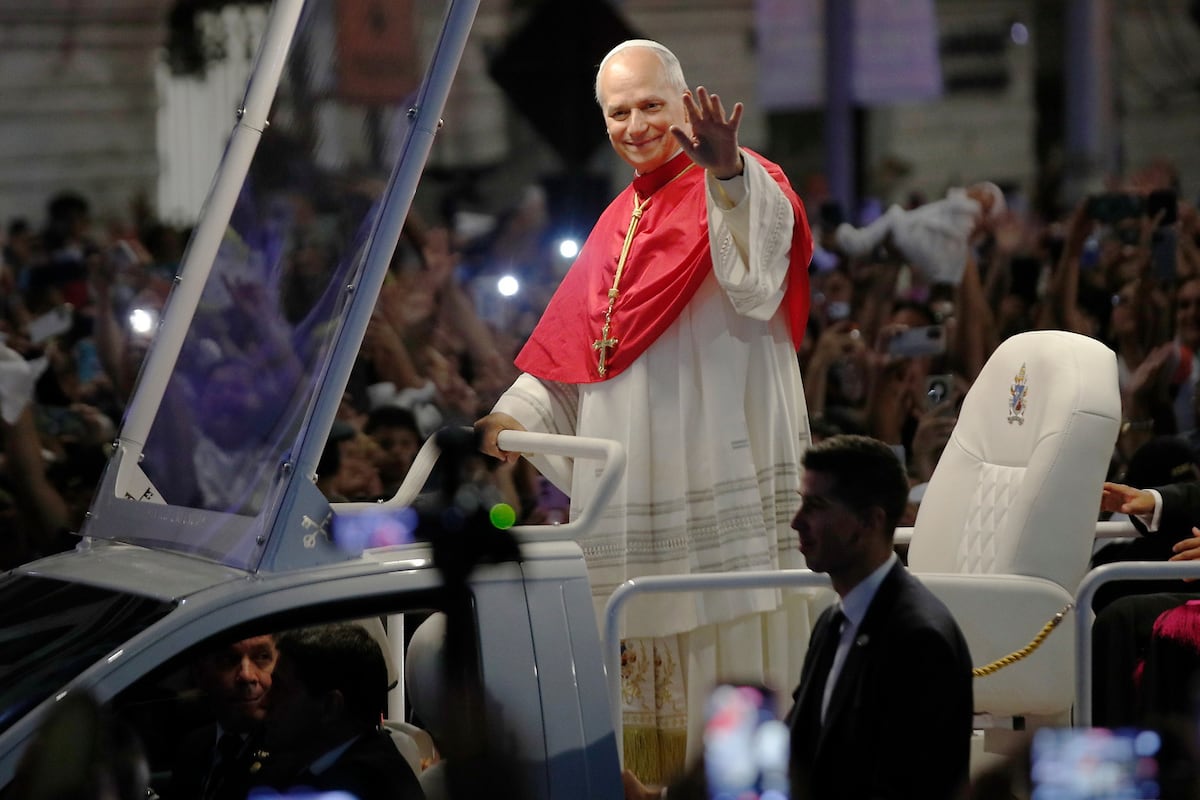
Smiling and visibly moved, Pope Leo XIV on Wednesday returned to Peru, the country where he forged his mission over two decades, where he became a nationalized citizen and which he regards as his ‘homeland’ despite having been born in the United States. On the road from Lima airport, thousands of people waited with their cellphones to capture the moment his black car passed by amid cheers and greetings. He was met on the tarmac by President Keiko Fujimori, a right-wing politician, whom he later met with at the Government Palace in Lima’s historic center.In his first speech in Peru, one of the most Catholic countries in Latin America, Leo XIV highlighted the “special meaning” his return holds for him. “Today I understand how much of this land remains with me and how much of my own history also belongs to you,” he said. He spoke of Peru and its diversity, its wealth and its cultural heritage. But for the first time on this trip to the Americas and after visiting Uruguay and Argentina, he also offered remarks with a geopolitical subtext: “The wars and tensions afflicting so many peoples demand a patient diplomacy that keeps dialogue open, respects international law and seeks agreements that protect people’s lives and dignity,” he said.He appeared to be referring to the United States and the course it has taken with Donald Trump, who is mired in a war he launched against Iran and whose party just suffered a heavy defeat in the midterm elections — in which Pope Leo XIV voted. Calling for respect for international law rather than the rule of the strongest, at a time of fragility for multilateralism, also applies to Putin’s war in Ukraine. “Every nation has legitimate aspirations, but none can consider the fate of others irrelevant,” the Pope said in his first speech in Lima, then urged Peru to “continue contributing to regional and international cooperation and to promote understanding even when positions seem irreconcilable. May we never give up seeking ways to alleviate peoples’ suffering and move toward peace.”On the day he reunited with Peruvians, Leo XIV linked current international events with the realities of a country he knows intimately, including its fractures of inequality, racism and the wounds from human rights violations that still run through it. He is aware of the expectations many have placed on his visit and the hope of being seen and heard, such as the victims of state violence, the human rights violations committed during the internal armed conflict in the 1980s and 1990s, the disappeared, and those who experienced repression during the protests of 2022 and 2023 who appealed to him in their fight against impunity. The Pope also addressed the recent past: “Peru has also gone through difficult moments that have tested coexistence among its people. The events of the past deserve to be dealt with justice and sensitivity, leaving room for concord to grow and for differences to be faced with respect.”The Pope spoke these words beside the daughter of Alberto Fujimori, the autocrat who was convicted of serious human rights violations and whose legacy Keiko embraced during the campaign in which she won the June election. In 2017 Alberto Fujimori received a humanitarian pardon and was released from prison. The pontiff — who was bishop of Chiclayo at the time and known by his civilian name, Robert Prevost — criticized that Fujimori had apologized for his crimes only “in a generic way if some have felt offended.” “Perhaps it would be far more effective to ask forgiveness personally for some of the great injustices that were committed and for which he was tried and sentenced,” Prevost said; he had also gathered signatures to establish the Truth and Reconciliation Commission in the late 1990s.The current president has just completed one hundred days in office with very low approval ratings and her tough-on-crime rhetoric at its height. She also made a speech, in which she spoke about the gaps that still divide the country. “You know better than anyone the soul of the Peruvian people, you have shared the tables of our families and have witnessed our immense capacity to overcome adversity. But to move forward, Peru needs to reconcile. No country can live imprisoned by its wounds,” she said. “Peru needs to live in peace with its past to embrace its future.”On the eve of the Pope’s arrival in Lima, victims of state violence and human rights violations sent a letter saying that “some people within the Church make decisions so that our stories will not reach you.” Elisabeth Santisteban, 52, is one of the signatories. She is hurt that Leo XIV’s schedule in Lima leaves no room for them to speak to him directly. Her brother died in 2023 in the repression of a protest against former president Dina Boluarte’s government when he was struck in the head by a tear-gas canister fired at point-blank range by a police officer. At least 50 people were killed by the disproportionate use of force. Boluarte was also in the theater listening to the Pope’s words.Nearly four years later there has not even been a hearing in Santisteban’s case. Leo XIV’s remarks take on special significance in a country where the president’s party in recent years has promoted laws criticized as favoring impunity for the military and for police officers accused of human rights violations. The Pope also said that “democratic life requires recognizing that no one can be treated as a problem, but as a person with dignity” and urged institutions to cultivate “honesty, uprightness and a willingness to listen for the good of the country.”Sign up for our weekly newsletter to get more English-language news coverage from EL PAÍS USA Edition
Pope Leo XIV in Lima: ‘Wars demand diplomacy that respects international law’
Full Article
Original Source
Read the full article at English →KhanList aggregates and links to publicly available news content. We do not host full articles from third-party sources. Always verify important information with original sources.