
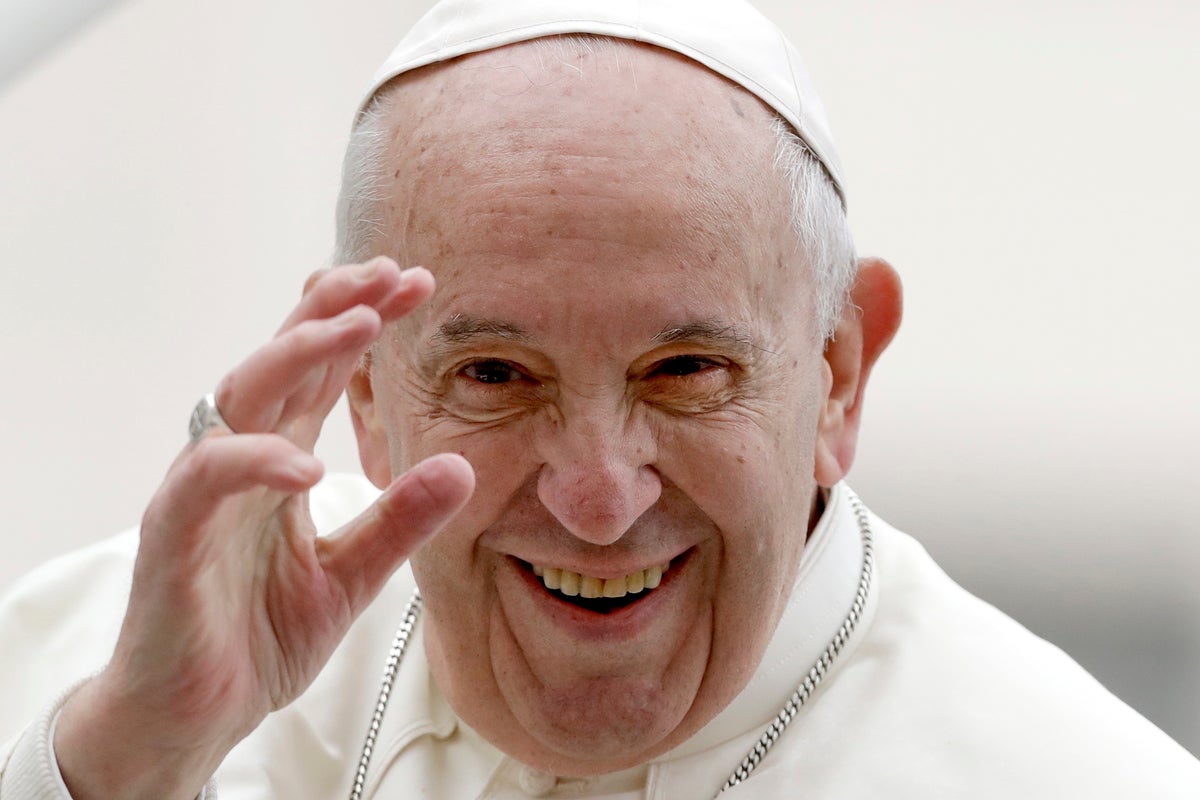
The late Pope Francis suffered a profound spiritual crisis in 2021 and experienced three encounters with the Devil, according to excerpts of his private diary published by the Vatican.The Private Diary of Pope Francis was published worldwide in several languages on Tuesday. The last pope to have diaries published posthumously was John XXIII, who died in 1963.The text offers a deeply personal view into the mind and heart of the Argentine pope, who led the Church for 12 years until his death in April 2025, revealing his innermost fears, insecurities, dreams and temptations that he kept hidden from the world. It shows him as incredibly hard on himself, lamenting his own sense of worthlessness and shame, and his utter trust in God to lead him, even from the depths of despair.Totalling 160 pages, the book was curated by one of Francis’ closest aides, Cardinal Víctor Manuel Fernández, the Argentine theologian who heads the Vatican’s doctrine office. Cardinal Jorge Mario Bergoglio, who later became Pope Francis (AP)Fernández is listed as the author, as his comments contextualise Francis’ diary entries.Written in a leather-bound calendar used as a notebook, it starts in December 1992, when Jorge Mario Bergoglio was auxiliary bishop of Buenos Aires. It continues through his time as cardinal archbishop of the Argentine capital and finally pope. The last entry is August 18, 2024, about eight months before his death aged 88.Spiritual torments and encounters with the DevilThe most moving sections are Francis’ revelations of his own spiritual torments and what he described as visceral, tangible, seemingly terrifying encounters with the Devil. Two occurred when he was in Buenos Aires, and the third after his disastrous 2018 trip to Chile.“A few days after returning to Rome, I was in a meeting. I saw him and heard his voice, triumphant, possessing everything. ‘Now I’ve gotten everything I wanted,’” Francis quoted the Devil as saying in a January 24, 2021 entry. “Just as I can’t forget his eyes from the previous two, in this case, I can’t forget the powerful raspiness of his voice.”During the January 2018 Chile trip, Francis created an uproar for discrediting victims of Chile's most notorious abuser. After journalists challenged him during the in-flight news conference returning home, Francis commissioned an investigation and realised that the victims were right, that he was wrong and had been misled by the Chilean hierarchy.Pope Francis, flanked by his spokesperson, Greg Burke, speaks with journalists in 2018 (AP)“Devastated because of the situation in Chile and the dialogue with the journalists on the airplane,” Francis would write later. “I became aware of how serious the problem was. … It was hard for me to admit what happened in Chile; I didn’t think it was so serious.” Francis wrote on June 7, 2018, a few months after he returned, that he “saw the entrance to Hell. I peeked in to look a little, and it terrified me.""I grabbed the Rosary as a weapon," Francis wrote, referring to Catholic prayer beads. "I thank the Lord for this help."In July and August of 2018, as he dealt with the fallout, he wrote: “What shame and evil this has brought on the church!” and “Once more the gates of Hell. … May holiness and conversion abound in the midst of so many scandals.”But Francis’ spiritual crisis wouldn’t come until 2021.A spiritual crisis in 2021 to 2022The book dates the onset of the crisis to January 24, 2021. The day before, Francis cancelled several upcoming public appearances due to what the Vatican said was a resurgence of his sciatica. Fernández reveals, however, that Francis was suffering from “insupportable” pain from an intestinal problem that, in July 2021, would land Francis in the hospital for 10 days for surgery to remove 33 centimetres (13 inches) of his colon.In January 2021, while the world was still in the throes of the COVID-19 pandemic, the Vatican was in utter upheaval over a massive financial investigation that Francis had authorised.A few months earlier, in September 2020, Francis had fired a one-time close collaborator, Cardinal Angelo Becciu, convinced Becciu had embezzled money from the Holy See. The scandal — and Francis’ belief that a web of corruption had engulfed the Vatican’s Secretariat of State — led to an unprecedented Vatican investigation and years of legal proceedings through which Francis sought to show his willingness to crack down on financial misconduct.The book was curated by one of Francis’ closest aides, Cardinal Víctor Manuel Fernández (AP)The trial resulted in some convictions, including against Becciu, but much of the prosecutors' theory of a vast conspiracy of corruption was thrown out. The appeals process is ongoing, with Francis' own role in the investigation a key question for the defence. There is no mention of the trial in Fernández’ text, though he hints at it by revealing Francis’ later musings that the 2021-2022 spiritual crisis was “mixed with governance issues, pressure regarding decisions to make, and aridity and desolation.”In the end, Fernández writes that the crisis was primarily related to Francis’ exercise of power, the temptation to omnipotence and the belief that he was above the world. It’s a vice Francis admitted to publicly in 2013, in his first interview as pope, when he acknowledged a tendency to wield power in an “authoritarian” way.It is significant that Francis was tormented by something his critics often faulted him for: an authoritarian, go-it-alone governing style in an absolute monarch and supreme leader of the world’s 1.4 billion Catholics.Vatican Pope Francis' Diary (AP)For Francis, the temptation to omnipotence was the Devil tempting him to “reductive curiosity,” or believing he alone could solve everyone’s problems, and essentially thinking of himself as God.By December 30, 2022, Francis had apparently overcome the crisis by entrusting himself to God. Fernández writes that by then, Francis realised that what began on January 24, 2021, “was a powerful invitation from the Lord to become aware of an accumulation of interior darkness that he had to overcome so he could be free.”Fernández notes that the final two major teaching documents of Francis’ life, a 2023 text on confidence in God’s merciful love, and a 2024 encyclical on Christ’s human and divine love, are deeply spiritual texts borne out of the crisis. They differ in tone and content from the texts often associated with his pontificate.Most confidential parts in codeWhile the book reveals some of Francis' innermost thoughts, Fernández says Francis wrote his most confidential thoughts in an indecipherable code, which is not reproduced.The reader is also left wondering what Fernández left out of his selection of diary entries, and what more context he could have provided as one of Francis' most trusted advisers.Pope Francis' Personal Diary by Víctor Manuel Fernández at a bookstore in Rome (AP)Fernández writes that the diary includes hardly any information about church matters, and is truly a spiritual repository. He said he omitted entries affecting third parties, though he does include some of Francis' personal musings, including about then-Cardinal Robert Prevost, who in May 2025 was elected Francis' successor and became Pope Leo XIV: “A great pastor, a generous missionary and an irreproachable man.”As for his own election as pope, Francis made one simple entry in July 2013, more than four months after he became pontiff. "They elected me pope on March 13," he wrote.Francis also offered kind thoughts about Guinean Cardinal Robert Sarah and German Cardinal Gerhard Muller, two of his most vocal critics. He said Sarah had "a refined spiritual sensitivity" and that Muller "seems aggressive, but he's a good man", according to Fernandez.Pope Leo approves the workFernández said Francis had shown him the diary during one of their meetings and told him, “From this, you will all see,” essentially entrusting the writings to him after his death on April 21, 2025. Fernández said he mentioned the writings to Leo a few weeks after his election.“I added that I wished to study these materials — to make them known and interpret the exact meaning of their contents,” Fernández wrote. “The Holy Father showed intense interest."The posthumous publication of popes’ innermost spiritual musings is not unusual.Pope John XXIII’s autobiography, Journal of a Soul, was published by his secretary in 1960. St. John Paul II had wanted his personal notes burned after his death, but his secretary defied his wishes and had the writings published in 2014.
Pope Francis describes encounters with the Devil in private diary entries: ‘I can’t forget his eyes’
Full Article
Original Source
Read the full article at Independent →KhanList aggregates and links to publicly available news content. We do not host full articles from third-party sources. Always verify important information with original sources.