
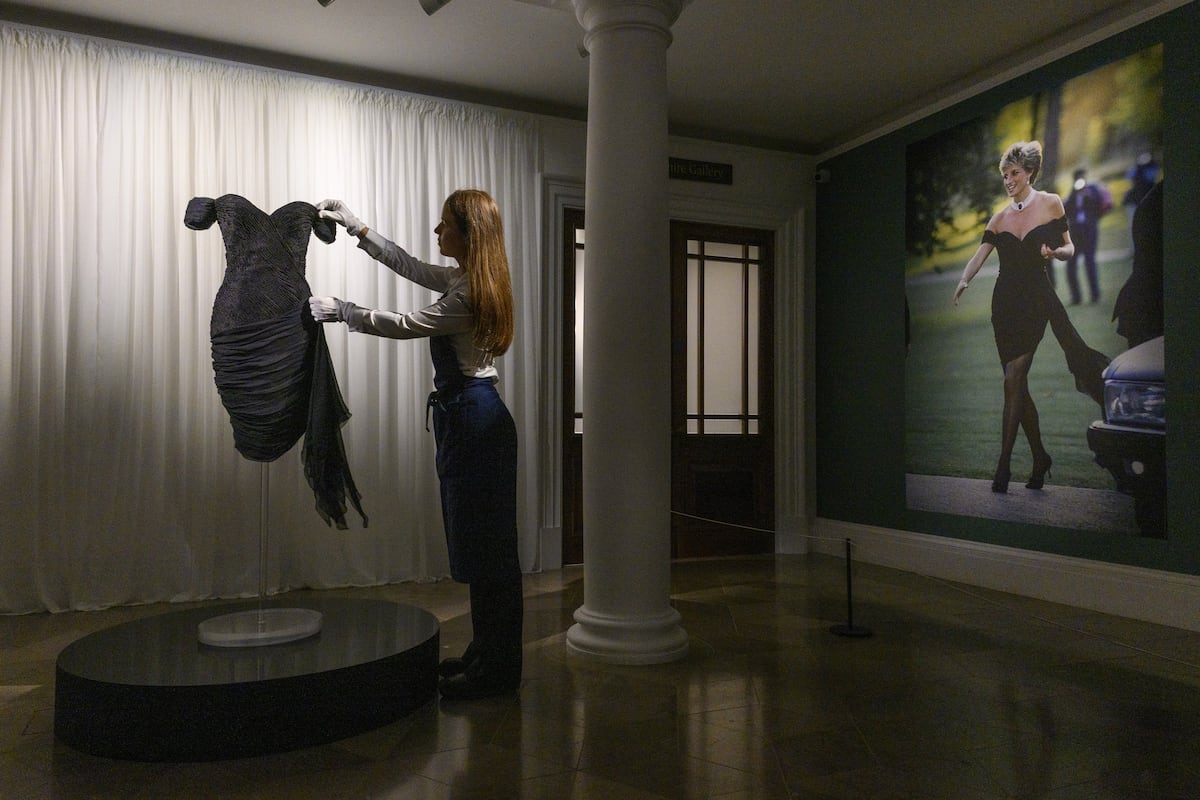
Few stars manage to keep shining after their death, and of all of them Marilyn Monroe is perhaps the one who continues to inspire the greatest fascination. That enduring appeal is reflected in the success of auctions featuring all manner of items connected to her life. Almost everything associated with Monroe has been sold, and just when it seemed there was nothing left to auction off, a set of frying pans, a compact of rouge and a bra surfaced, all fetching astonishing sums at the auction organized by Julien’s Auctions in Los Angeles last June to mark the centenary of the late actress’s birth. While Monroe may be the most emblematic, she is just one example of how the market for celebrities’ personal belongings is booming, attracting devoted fans with the means to spend tens of thousands of dollars on everything from something as mundane as a coffee maker, such as David Lynch’s, which sold for $35,000 in June 2025, to one-of-a-kind items such as the script for the penultimate episode of Friends that belonged to Matthew Perry and was sold for $75,000 this summer at a charity auction benefiting the actor’s namesake foundation, which focuses on recovery from substance abuse.Within its Popular Culture category, the legendary Christie’s, whose origins date back to 1766, has sold such iconic pieces as Eric Clapton’s Blackie guitar and the original script of Breakfast at Tiffany’s, once owned by Audrey Hepburn. Among its most notable achievements in recent years was the sale of what remains the most expensive work of 20th-century art, Andy Warhol’s portrait of Marilyn Monroe, Shot Sage Blue Marilyn, which fetched $195 million in 2022. Although this was a work of art rather than a personal belonging, the staggering price nevertheless reflects the enduring fascination certain figures continue to inspire.María García Yelo, CEO of Christie’s in Spain, attributes the success of items linked to the worlds of film, music and entertainment to their ability to provide “a tangible connection to the people and moments that have shaped popular culture.” She offers an anecdote that illustrates their “emotional power”: “During the 2006 auction of Princess Margaret’s belongings, an elderly woman arrived with money her husband had given her for their wedding anniversary, intent on buying one of the pieces,” she recalls. “Although she was outbid again and again, she did not give up until she finally managed to acquire an umbrella that had belonged to Princess Margaret. By then, many in the room already knew of her story and her deep admiration for the princess. When the hammer fell in her favor, the room broke into applause.”Among items associated with royal families, jewelry attracts particular interest because it combines history, luxury and celebrity. And some of the buyers are well-known celebrities themselves. For example, Elizabeth Taylor and Joan Collins bid on pieces owned by Wallis Simpson in the late 1980s. More recently, Kim Kardashian paid £163,800 (about $198,000 at the time) at a Sotheby’s auction in 2023 to acquire the late Princess Diana’s Attallah Cross, a diamond-and-amethyst pendant that the reality TV star has since worn on several occasions. On December 9, Sotheby’s will auction the iconic “revenge dress” worn by Princess Diana, which is expected to fetch between €130,000 and €258,000 ($145,000 and $288,000).“A piece with a documented history, or one that belonged to a prominent figure, carries added value that goes beyond its material worth,” explains Alfonso Mato Yllera, CEO of Ansorena, one of Spain’s most emblematic jewelry houses and also a specialist in auctions. (The company recently made headlines after being tasked with appraising jewelry seized from former Spanish prime minister José Luis Rodríguez Zapatero.)“That provenance captures the interest of collectors and the general public alike, generates greater anticipation and often drives the final price well above the initial estimate. That is why we take such care with the research and documentation of each story,” he adds.Everyday objects from extraordinary livesThe eclectic catalogs of auction houses specializing in popular culture, such as Heritage Auctions, the aforementioned Julien’s Auctions and Profiles in History, reflect the growing demand for celebrity memorabilia.Journalist María Estévez, who has lived in Los Angeles for two decades and is the author of Esto es Hollywood (This Is Hollywood), traces the origins of the business to the landmark sale conducted by Metro-Goldwyn-Mayer in the 1970s, when the studio disposed of thousands of items used in its films. In fact, pieces from that sale can still be found at some specialist auction houses today.Estévez, who believes these auctions have expanded dramatically over the past 20 years, also points to the 2017 sale organized by the heirs of Debbie Reynolds and Carrie Fisher, both of whom died in 2016 and were passionate collectors of Hollywood memorabilia. The collection, comprising more than 1,500 items and larger than the holdings of many museums, included such iconic pieces as Carrie Fisher’s director’s chair from Return of the Jedi (1983) and one of Reynolds’s dresses from Singin’ in the Rain (1952).Today, sales are no longer limited to movie props or belongings of major stars. Virtually any personal object with even a tenuous connection to a celebrity can find a buyer. Freddie Mercury’s mustache comb, which sold for nearly $189,000; writer Joan Didion’s collection of pebbles and seashells, which fetched $7,000; and Kurt Cobain’s cardigan, which sold for $334,000, are just a few examples. The closer an item comes to a celebrity’s private life, the greater its value tends to be, a phenomenon that becomes even more pronounced when the celebrity died young.Although one might assume that, in a globalized world, the market is fairly homogeneous, Darren Julien, CEO of Julien’s Auctions, revealed in an interview with Arts & Collections that different regions often have distinct tastes.“You’ll sometimes see certain celebrities sell well in France; certain bidders come out of Germany,” he said. “Usually Asia and Russia like western pop culture. When we did Cher’s auction, most of the bidders came out of the United States and the U.K. But each celebrity is different. You can’t really tell, sometimes, until you make the announcement.”He continued: “When we did the Michael Jackson auction, we toured it to China and Japan, because he is hugely popular in Asia. Even though he is popular all over the world, China and Japan just have a huge infatuation with Michael Jackson.”In a separate interview with The New Yorker, the auctioneer also touched on the moral dilemmas surrounding particularly sensitive sales. He recalled declining to sell a record that John Lennon had signed for Mark David Chapman, the man who later killed him. He chose not to handle the sale, although another company eventually auctioned the item for $1.5 million. He also revealed that he withdrew the bed in which Michael Jackson died from one of his auction catalogs at the request of the singer’s family. What he did sell, however, were Truman Capote’s ashes.Behind every sale, especially when it involves objects of major historical significance, intense public interest or exceptional rarity, there are months of preparation. Specialists must verify an item’s authenticity and determine its starting price. But how does an object end up in the hands of an auction house in the first place?There is no single answer. In the case of Christie’s, María García Yelo explains that “the objects featured in our catalogs usually come through clients, collectors and families with whom we have built long-standing relationships and who trust Christie’s to bring their pieces to the global market.”In the case of companies that only auction celebrity memorabilia, commercial relationships are often built not only with consignors but sometimes with the celebrities themselves. As the sector has become more visible, auction houses also receive tips and direct offers from potential sellers. Some of the items included in Julien’s Auctions’ 2024 sale of Kurt Cobain memorabilia, for example, came from a fellow patient at the late musician’s rehabilitation clinic. Active searches and scouting efforts in all sorts of places are also common.In addition, until relatively recently, auctions of personal belongings were generally associated with a celebrity’s death, a divorce or financial hardship. That perception has changed, and auctions of possessions belonging to living celebrities are now commonplace. Indeed, the founder of Julien’s Auctions has emphasized this point. As he explained in his interview with The New Yorker, he actively encourages stars to recognize the financial potential of these sales:“We encourage, we educate them: ‘When you get done with the concert, put the jeans, the shirt, the shoes in a bag with the date and the city to put in the archives, because that could be $10,000, $20,000, $30,000,” he said. “It’s like printing money for a lot of these celebrities.”Estévez links the success of pop-culture auctions to the rise of modern fandom. In recent years, partly due to the false sense of closeness that social media creates between celebrities and their audiences, fan communities have become highly visible, and not always for positive reasons.“Feeding fandom is part of what has created this craze for collecting pieces from actors, characters, films... There are so many fandoms that you have to enter that world to understand why those prices are paid,” the journalist says. “There is a lot of business built around these objects; it is not just collectors buying them, it does not work only that way,” says Estévez, adding that some buyers acquire items with the intention of reselling them later once their value has increased. There are even companies dedicated solely to this kind of trading.There is no doubt that this market generates significant sums of money, particularly in the United States, which accounts for the bulk of sales and remains the epicenter of mass-market pop culture. Yet, viewed in the broader context of the auction industry, celebrity memorabilia is not the category that generates the highest revenues. It can, however, serve as a gateway for new buyers.García Yelo puts it this way: “While the sale of items linked to famous cultural figures usually generates considerable media attention, it does not reach the highest figures at auction, unlike 20th- and 21st-century art or exceptional, rare jewels. Nonetheless, these sales play an important role that transcends their economic results: they attract a broader — often younger — audience and introduce new collectors to the world of auctions and collecting.”Sign up for our weekly newsletter to get more English-language news coverage from EL PAÍS USA Edition
Pop culture up for auction: The booming multimillion-dollar business of selling celebrities’ personal belongings
Full Article
Original Source
Read the full article at English →KhanList aggregates and links to publicly available news content. We do not host full articles from third-party sources. Always verify important information with original sources.