
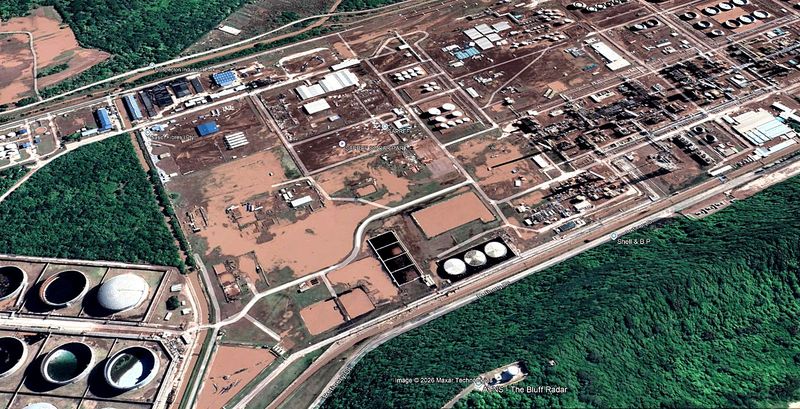
For nearly 60 years, the Sapref fuel refinery pumped several tons of sulphur dioxide and other more noxious chemicals into the atmosphere above Durban daily.Established and run jointly run by the Dutch and British oil giants Shell and BP since 1963, the refinery processed up to 180,000 barrels of crude oil daily until it was abandoned in April 2022, when floodwaters swamped the site and tipped over some of the fuel storage tanks.But the 2022 closure was simply the final straw in the steady demise of the ageing refinery, whose owners had already signalled their intention to shut it down before it was swamped by floodwaters and abandoned.Fuel tanks at the Sapref refinery lean precariously after floodwaters surged through the refinery site near the now canalised uMlazi River. (Photo: Twitter / X) Now, after purchasing the mothballed refinery for just one rand in 2024, the state-owned Central Energy Fund, with support from Mineral and Petroleum Resources Minister Gwede Mantashe, is proposing a R117-billion investment (mainly from state funds) – to revive and expand what is now known as the South African National Petroleum Company (SANPC) refinery.If Mantashe’s grand renaissance dream comes to fruition, the Central Energy Fund plans to recommission the refinery in three stages, ultimately doubling and then more than trebling its previous capacity to about 400,000 barrels and then 650,000 barrels per day.Mineral and Petroleum Resources Minister Gwede Mantashe is seeking R117-billion in funding from the National Treasury to revive the Sapref oil refinery in Durban and transform it into one of the continent’s largest fuel refineries. (Photo: Gallo Images / Sharon Seretlo) While the Central Energy Fund insists that the refinery’s redevelopment will be “commercially disciplined, technically credible and financially sustainable”, critics fear the venture is more likely to saddle taxpayers with an expensive white elephant.SA National Energy Association director Dave Wright told Engineering News that buying such an old refinery could cost taxpayers more than it’s worth to keep operating, leaving the country with a stranded asset in about 10 to 15 years.Money and governance issues aside, nearby community groups also fear that restarting and then expanding production would exacerbate the human disease burden from a multitude of chemical pollution sources in the South Durban industrial area. This industrial zone (along with storage facilities in the Island View area of Durban harbour) directly adjoins several predominantly poor or lower income residential areas, including Merebank, Wentworth, Umlazi, Bluff and Isipingo.Bongani Mthembu, air quality and health officer at the South Durban Community Environmental Alliance (SDCEA), says alliance members raised several concerns at a “stakeholder engagement” meeting with Central Energy Fund officials on 14 July.They pointed to a series of health studies by the University of KwaZulu-Natal and the University of Michigan in 2007 demonstrating a substantially higher rate of asthma in children living close to both the Sapref and Engen refineries, when compared with children living in northern Durban.Bongani Mthembu, air quality and health officer at the South Durban Community Environmental Alliance. (Photo: SDCEA) The studies also identified significant community exposures to benzene, a cancer-causing pollutant and constituent of petrol, in the airborne fumes in the city’s southern industrial area.Exposure to airborne pollution was bound to increase dramatically if the SANPC refinery expanded, says Mthembu, adding that the South Durban Community Environmental Alliance had repeatedly raised concerns about the reliability of industry and government air pollution monitoring stations in the area.A further worry is the legacy of underground fuel leaks and contamination associated with the old Sapref refinery. One example was the 2001 leakage of nearly a million litres of petrol from rusty pipelines, directly beneath scores of homes in the Bluff and Wentworth areas, several of which had to be evacuated for months while the spill was remediated by Sapref.The Department of Forestry, Fisheries and the Environment has also confirmed that the SANPC site has been registered on the national Contaminated Land Register in terms of the Waste Act.In response to recent queries from Daily Maverick, the Department of Forestry, Fisheries and the Environment stated that it and the minister had been notified officially about the contamination in a letter dated 18 October 2024.However, it noted that remediation of the site began at some point before 2014, in terms of a directive issued by the Department of Water and Sanitation.“The monitoring and management of contamination at the site remains ongoing,” the department said, adding that an independent environmental consultant had been appointed previously by Sapref to undertake site assessments and contamination monitoring at the site.“This approach is consistent with the polluter-pays principle... whereby the responsible party bears the costs associated with the assessment, monitoring, and management of contamination.”A Sapref media release detailing some of the damage to the 60-year-old refinery as a result of flooding. (Source: Sapref) According to the Waste Act notification, the Central Energy Fund was now regarded as “the party responsible for the ongoing monitoring and management of contamination at the site”.The Department of Forestry, Fisheries and the Environment has also underlined the legal requirement of the Central Energy Fund to undertake an environmental impact assessment (EIA) for any listed activities associated with the proposed redevelopment and expansion of the refinery.“Compliance with these requirements will ensure that the potential environmental impacts of the proposed development are adequately assessed and that interested and affected parties are afforded an opportunity to participate in the decision-making process.”However, the South Durban Community Environmental Alliance is insisting on a comprehensive, independently verified environmental and health impact assessment, also covering the extent of soil and groundwater contamination; risks to nearby residents; potential impacts to the marine environment and longer-term human health impacts. It is also demanding a site visit to verify reports of significant corrosion, blockages and contamination. Referring to the “clean break” or voetstoots terms of the sale to the Central Energy Fund in 2024, the alliance says it remains “strongly opposed to any arrangement that transfers historical environmental liabilities to the state or, ultimately, the public without first establishing the full extent of the contamination and determining appropriate responsibility for remediation”.In a letter to the alliance on 27 May, SANPC refinery MD Sesakho Magadla avers that: “As the CEF [Central Energy Fund], we are fully responsible for liabilities arising from the asset as of the transfer date to CEF of 01 December 2024 and any liability arising from the operation of the asset post 01 December 2024 will accordingly be attributable to CEF. All historic Operator liabilities are to be dealt with (sic) the previous Operator.” South African National Petroleum Company refinery MD Sesakho Magadla. (Photo: Africa Energy Week website) Yet, according to a series of investigative reports by Open Secrets, it seems to be too late for that. Open Secrets noted that the sale was based on a “clean break” agreement and that while the bargain basement sale price of one rand might look good on paper, it mostly fails to account for the high costs of recommissioning the moribund refinery – and the legacy of cleaning up contamination and ultimately decommissioning the site.University of KwaZulu-Natal environmental law expert Professor Michael Kidd says national environmental and waste legislation was designed to cater for scenarios of significantly contaminated sites.Likely pollutionHowever, considering the likely pollution of the Sapref site over six decades, it appeared that the Central Energy Fund had gone in to the “clean break” deal either oblivious to, or not caring about, future liability under waste legislation.“It might be that they either don’t care or they might feel that they have political or institutional strength, but it would not be a good legal argument to suggest that the site is already contaminated (so let’s allow operations to continue and worry about the contamination later)... it could be that they feel beyond the magnifying glass of the compliance authorities.” (Graphics: Supplied / Open Secrets) The Central Energy Fund has declined to respond to several written queries by Daily Maverick sent on 18 September.In an apparent reference to the Open Secrets investigation series, Central Energy Fund spokesperson Jacky Mashapu said: “As a group, we are not going make further commentary on the issues you raised. These issues were ventilated at the time of the purchase of this asset.” (Graphics: Supplied / Open Secrets) There are also two further, climate-related, risks attached to the controversial sale, says David Hallowes, a researcher at the groundWork environmental justice group.Firstly, the vastly increased carbon emissions from an expanded fuel refinery would sharply undermine the government’s “net zero” transport emissions pathway, making it likely that the new government refinery would be rendered a stranded asset by 2045, if not sooner.Secondly, he cites research by Wits University climatology professor Francois Engelbrecht and the geographic location of the refinery on a reclaimed floodplain near the mouth of the now canalised uMlazi River.“Engelbrecht shows that, in the warmer world of the 2040s, a weather event similar to the April 2022 floods in KwaZulu-Natal would dump twice as much rain. So rebuilding Sapref in the same spot is not a good move,” said Hallowes. DM
POLLUTION LEGACY: State refinery ‘renaissance’ plan raises fresh questions over pollution, health and taxpayer risk
Full Article
Original Source
Read the full article at Dailymaverick →KhanList aggregates and links to publicly available news content. We do not host full articles from third-party sources. Always verify important information with original sources.