
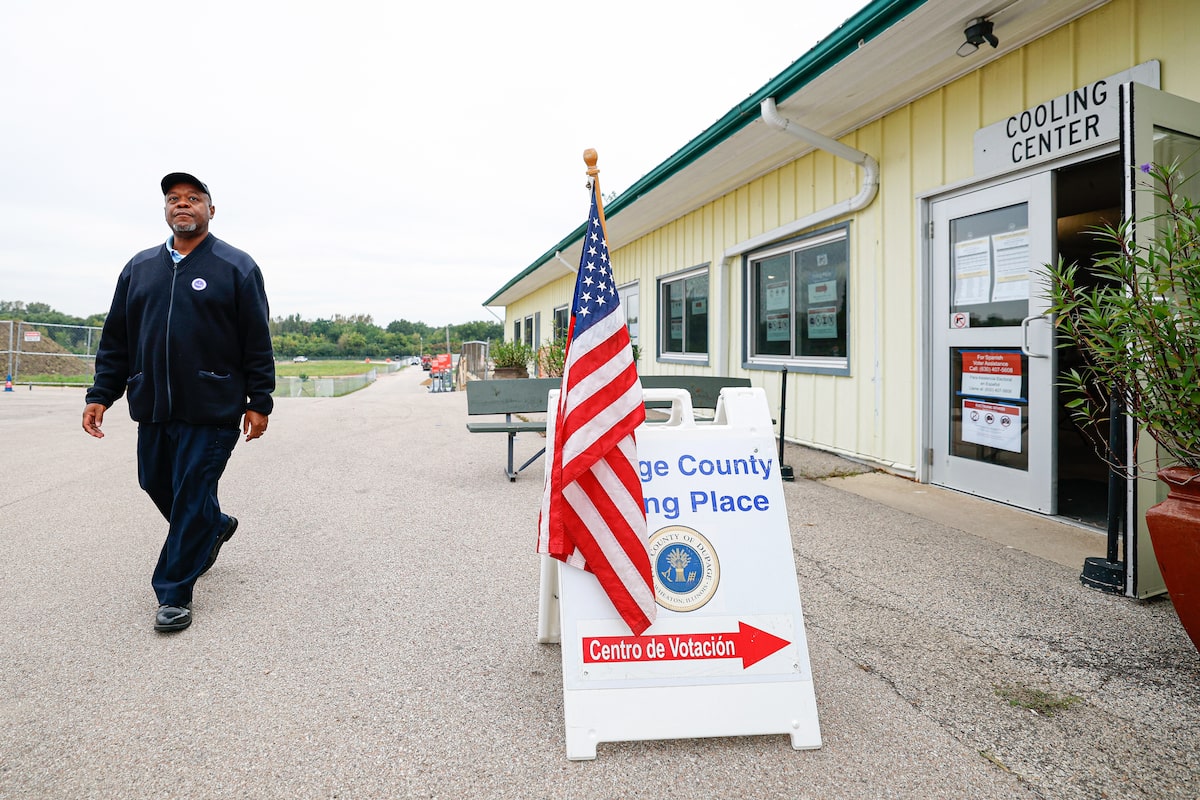
Open this photo in gallery:A man departs a polling place at DuPage Event Center and Fairgrounds after voting on the second day of early voting ahead of the midterm elections, in Wheaton, Illinois, Sept. 25.KAMIL KRZACZYNSKI/AFP/Getty ImagesThere’s a lot at stake in the U.S. congressional midterm elections next month. President Donald Trump has never faced Democratic majorities in both chambers of Congress or even a Democratic-majority Senate, but polls show the party in a strong position to win at least the House of Representatives and perhaps both. So a lot could change. Congress could actually return to oversight and reassert its authority on tariffs, war powers and spending. Impeachment hearings and a trial for Mr. Trump surely become likely, although removing him from office would require Republican senators to abandon him en masse. With a big Democratic wave, long-term and consequential Democratic majorities become possible. After Mr. Trump’s first term, Joe Biden’s presidency showed that healthy democratic norms will not automatically return when Mr. Trump leaves office. An ambitious Democratic president in 2029 could try to fix institutional sources of democratic backsliding but would need working majorities. With enough senators, Democrats could end the Senate filibuster, add the District of Columbia and Puerto Rico as new (heavily Democratic) states, fill future Supreme Court vacancies and reform and expand the court, pass a new Voting Rights Act and a national right to abortion access law and introduce election reforms for the House of Representatives. Polls show a Democratic sweep as increasingly likely based on many contributing factors. In 2024, Mr. Trump did well among Hispanic voters, but they’ve soured on him. That will cost Republicans, especially in Texas and Florida. Plus, there’s the usual midterm swing against the president’s party, the unpopular Iran war, gas prices, some dreadful Republican candidates chosen by primary voters (see Texas) and Mr. Trump’s unpopularity, especially on key issues such as affordability, according to a recent Strength In Numbers/Verasight report.Analysis: In the U.S. midterms’ murky math, economic distress is the only clear variableDemocrats need to flip only three seats to take back the House, and forecasts have them doing that handily, winning roughly 235 of the chamber’s 435 seats, with a simple majority requiring 218. It could be even more lopsided: In some states, such as Texas, gerrymanders have spread Republican voters too thinly to survive a big blue wave – another Trump-led campaign strategy that may backfire.For a bare Senate majority of 51, Democrats need four seats held by Republicans while hanging on to the ones they currently have. Some key races (with Sept. 24 polling aggregates) are in the usual toss-up states such as Georgia (Democrat leading by eight percentage points), Maine (D +0.8), Michigan (D +2.7) and North Carolina (D +8.6), but many are reliably Republican: Alaska (D +2.6), Iowa (D +1.7), Ohio (D +4.1) and Texas (D +3.1). Even Kansas (R +0.7) and Nebraska (Ind +1.1) are conceivable Republican losses. Open this photo in gallery:U.S. President Donald Trump participates in a midterm election rally for Oklahoma Republican gubernatorial candidate Mike Mazzei at the Choctaw Event Center in Durant, Oct. 1.Jonathan Ernst/ReutersPolls and pollsters take a beating largely because we expect too much from them. How can we go awry when reading them? A Sept. 17-20 Ipsos poll shows the Republicans in trouble, with Mr. Trump’s approval rating at 32 per cent, which is below George W. Bush’s in 2006, when the Republicans lost six Senate seats, 31 House seats and the majority in both chambers.But there’s a lot of uncertainty when it comes to what Trump disapprovers – including the 22 per cent of his voters who now disapprove of him − will do, according to an Economist/YouGov poll. In 2016 and 2024, non-MAGA Republicans stuck with their party and gave Mr. Trump his victories. If the election were held today, Republicans are at about 43 per cent on the “generic ballot,” indicating that many will vote Republican again. Still, non-MAGA Republicans and Republican-leaning Independents are a big portion of the “don’t knows” regarding their 2026 choice. Very few will vote Democrat, and some will stay home or vote for a third party, but there are still unknowns and undecideds. Polls cannot capture the fact that elections activate partisanship. The most powerful forces in American politics are partisanship (attachment to your party) and negative partisanship (animosity toward the opposition). It’s hard to overstate how little the actual candidates matter to Americans’ voting choices. The closer election day gets, the more voters’ partisan identities kick in and override candidate preferences or dissatisfaction with the president. Opinion: Has America completely lost its mind? The midterms will tellThe most significant example was the 2016 presidential race. We should not forget that Mr. Trump did not win the Republican primaries easily that year. Republicans’ hesitancy showed up in polls throughout the year as Hillary Clinton maintained a 6- to 8-per-cent lead. But Republicans always gravitate toward their own party, and late-breaking news about the FBI investigating Ms. Clinton’s e-mails gave them an out. Seeing an (R) and (D) on their ballots, they knew which party was theirs and which one they hated. Republican leaders are counting on partisanship kicking in again this year, but polls won’t capture it. To illustrate, imagine a poll in the Texas Senate race is perfectly accurate today. The sample perfectly represents the population, and everyone honestly reports both their likelihood of voting and for whom they plan to vote. That sample includes some unhappy Republicans and independents who say they’ll vote for the Democrat, James Talarico. But there are five weeks to go. An avalanche of campaign ads is warning that Democrats are bringing socialism to America. Watching Fox News we hear things like the RNC chair saying: “This is not your grandparents’ Democrat Party. They want to get rid of Thanksgiving. They want to get rid of July 4th.” About US$100-million will be spent arguing it’s Us versus Them. Can we really trust a Republican disapprover to follow through on what they’ve told a pollster? The act of voting is a different exercise than answering a survey. You can honestly tell a pollster you are unhappy with your party, president or candidate in the hopes of sending them all a message. But partisanship can overtake all that. Completing a ballot is an expression of identity and, to predict voting in polarized America, partisanship is a stronger identity than gender, education, religion or even race.Polls can underestimate incumbents, too. Yes, polls can show voters’ frustration, but the factors that got a person elected last time usually still hold. For example, the last 10 polls in Maine in 2020 showed Susan Collins behind, but late-breaking voters gave her an 8.6-percentage-point win. She’s hoping for the same this fall.Meanwhile, pollsters try to identify likely voters for their models. That can exclude respondents who usually skip congressional elections. But with 52-per-cent strong disapproval of Mr. Trump overall, intense negative partisanship among Democrats and 75-per-cent disapproval among independents, anger will motivate many unlikely voters to get out and vote this time. Polls tell us a lot, but they cannot capture the forces that move conflicted individual voters in the final days of a campaign. Allow for a margin of error on that, too. Both an anti-incumbent wave (see 1974, 1986, 2006, 2010) and surprising incumbent resilience (see 1998, 2002, 2018) are still possible. For now, the Democrats are in a solid position. But five weeks can be an eternity in U.S. politics, so stay tuned.Matthew Lebo is a professor and the director of the Centre for Computational and Quantitative Social Science at Western University.
Polling shows Democrats ahead as the midterms approach, but polls cannot capture the partisanship of elections
Full Article
Original Source
Read the full article at Theglobeandmail →KhanList aggregates and links to publicly available news content. We do not host full articles from third-party sources. Always verify important information with original sources.