
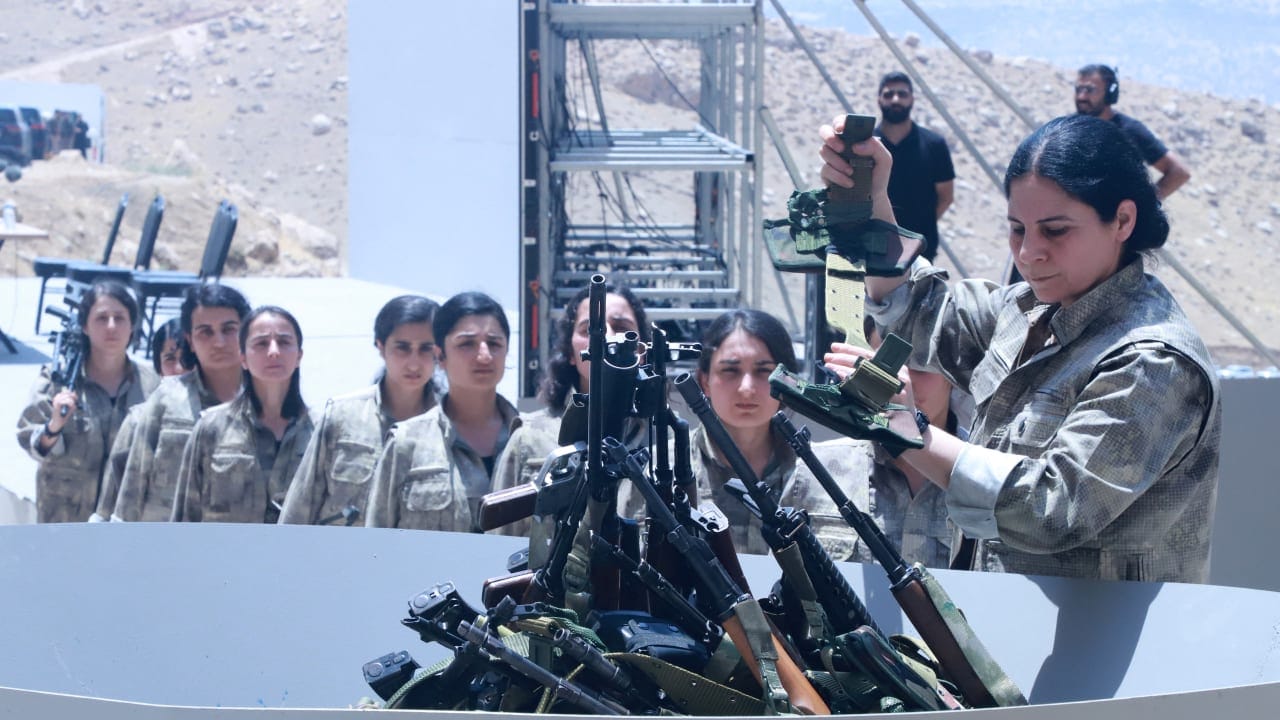
Jerusalem Post/Middle East“The first decision of the PUK leadership following this thing [parliament reactivation] is that we will immediately withdraw from this failed government," Bafel Talabani, leader of PUK said.Follow us on GoogleFighters with the Kurdistan Workers' Party (PKK) line up to put their weapons into a pit during a ceremony in Sulaimaniyah, in Iraq's autonomous Kurdistan region.(photo credit: Shwan MOHAMMED / AFP via Getty Images)NOVEMBER 7, 2026 01:40There are concerns that a new political crisis in the Kurdistan Region of northern Iraq may be brewing. This is not a new phenomenon. The region has been divided for decades. However, a lot is at stake today. Iran continues to target the region with drones and missiles. Iran has also pressured Iraq to expel Kurdish Iranian opposition groups in the Kurdistan Region. This means that Iran may be seeking to divide and weaken the region. The US withdrew forces from Iraq on September 30. Iran may see an opportunity.Rudaw media in Erbil, the capital of the Kurdistan Regional Government, says “Patriotic Union of Kurdistan (PUK) leader Bafel Talabani announced on Thursday that his party has decided to withdraw from the Kurdistan Regional Government (KRG) cabinet in protest against the reactivation of the Kurdistan Parliament without the PUK’s participation, declaring the legislature illegitimate.”“This government has failed. Therefore, the first decision of the PUK leadership following this thing [parliament reactivation] is that we will immediately withdraw from this failed government, which calls itself the government of Kurdistan,” Talabani said in a video message. This is not the first time Talabani and the KRG leadership of the Kurdistan Democratic Party have been at odds. In 2017, when Iraqi federal forces attacked Kurds in Kirkuk, Talabani also made a statement as PUK forces withdrew from Kirkuk. At the time, it was believed the PUK made a deal with Iran and Baghdad. PUK has been seen as historically closer to Iran, not just geographically in Sulimaniyah where it is popular but also politically.“What does this mean? It means that we will use all the force and strength we have to provide people living in our areas [Sulaimani and Halabja] with anything they need,” Bafel Talabani said.Rudaw added that “his remarks came after a meeting of the PUK leadership earlier on Thursday, a day after the rival Kurdistan Democratic Party (KDP) spearheaded an initiative to reconvene parliament with the support of several minority representatives, smaller parties and lawmakers who broke ranks with their parties, including three PUK members.”A fighter from the Iranian Kurdistan Freedom Party (PAK) takes part in a training exercise at a base near Erbil, Iraq, in February. (credit: THAIER AL-SUDANI/REUTERS)What comes next for Iraq, Kurdistan?Meanwhile in Erbil on Wednesday there was a session of the local parliament which “was attended by 52 lawmakers, narrowly exceeding the 51-member quorum required in the 100-seat legislature. The lawmakers unanimously elected KDP politician Vala Farid as parliament speaker, Christian quota representative Rami Noori as deputy speaker and Turkmen quota representative Muna Qahwachi as secretary.” The KDP has 39 seats in the local parliament. PUK has 23.Shafaq News in Iraq has an analysis describing the issues that now affect KRG President Nechirvan Barzani’s “strategic patience.” It argues that his “pragmatic approach has often been viewed as a reliable channel for building dialogue and untangling difficult political disputes.” The article argues that “the paradox, however, is that the same strategic patience that has helped preserve the Kurdistan Region’s external balances could become a factor in prolonging domestic crises if it remains limited to de-escalation without reform. The constraints facing President Nechirvan Barzani cannot be separated from the shared political responsibility of the forces governing the Kurdistan Region, as the problem is not whether one individual can contain disputes, but whether the political parties are prepared to overcome these obstacles, unify institutions and decision-making centers, and move from managing crises to addressing their underlying causes.”In essence, Barzani’s attempt to make all sides happy may have caused issues to fester and grow.The concern is about what comes next. Meanwhile, US Envoy to Iraq and Syria Tom Barrack was in Baghdad on November 5 for meetings with Iraqi Prime Minister Ali al-Zaidi. “The Middle East is a Rubik’s Cube. Every side touches every other, turn one face, and you move the rest,” he wrote on X/Twitter. “No single country, and no outside power, solves it alone. It comes together only when the nations of the region decide to turn the pieces themselves, patiently and together. Iraq is doing exactly that,” he added.He praised Iraq’s current prime minister. “Under Prime Minister Al-Zaidi, it is choosing sovereignty over dependency, investment over stagnation, and partnership over proxy. The United States is proud to stand with Iraq: deepening our economic and commercial ties, opening the door to American companies and Iraqi talent alike, and building prosperity for the benefit of all.”Follow us on Google
Political division, crisis in Kurdistan region of Iraq could provide Iran with opening
Full Article
Original Source
Read the full article at Jpost →KhanList aggregates and links to publicly available news content. We do not host full articles from third-party sources. Always verify important information with original sources.