
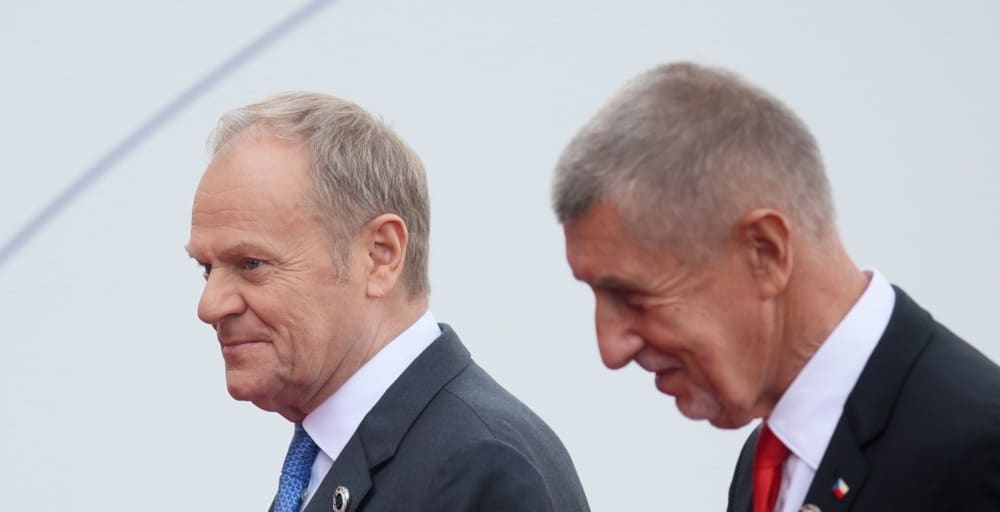
Polish PM Donald Tusk (L) and Czech PM Andrej Babis (R) walk together during the welcome ceremony for the 8th European Political Community Summit, at the Karen Demirchyan Sports and Concert Complex in Yerevan, Armenia, 04 May 2026. EPA/Leszek Szymanski A podcast interview with investigative journalist Lukas Valasek for Seznam Zpravy on Monday laid out a well-organised, large-scale disinformation campaign that pushed the notion Poland was preparing to invade and annex a small border area with its southern neighbour around the twin towns of Ciezyn/Tesin. “It is the first ever operation of this scale,” assessed Valasek. “If we understand this whole thing as a test from a potential Russian actor on how the Czech Republic will respond to a wave of disinformation, then I think that the Czech political scene, and especially the government, did not quite pass.” The campaign relied on paid Facebook ads, AI-generated images, a fake website mimicking Czech Radio’s iRozhlas.cz, as well as fake social media accounts of both ordinary citizens and top officials – including Czechia’s ambassador to Poland. The apparent goal, most have deduced, was to spark fears of a land grab and property seizures while stirring up historical grievances between the two EU and NATO countries linked to a controversial 1958 border treaty between Poland and then-Czechoslovakia. According to Czech security expert Bohumil Kartous, the campaign bears all the hallmarks of a Russian-backed hybrid operation, exploiting “a fragment of truth” – the lingering, albeit relatively minor Czech-Polish border dispute – to place it “in a completely different context of fear over losing property”. “The goal is precisely to trigger a dispute within this pro-Ukrainian coalition,” according to Kartous. It appears to have mostly missed the mark. Poland was fastest to respond, with both Polish Prime Minister Donald Tusk and his Foreign Minister Radoslaw Sikorski quickly dismissing the claims of imminent annexation as absurd and orchestrated. As a symbol of Czech-Polish unity, Prime Minister Tusk posted an image of friendship between the countries’ most famous cartoon characters, the Polish dog Reksio and the Czech mole Krtek, captioning: “Reksio and Krtek have known this for a long time, Poland and Czechia are true friends.” But over the border the response took longer and was more muddled, with finger-pointing now underway to determine who was to blame for these failings. It took several days for the Czech Foreign Ministry to unequivocally reject “the spread of false information about alleged Polish territorial claims to the Czech Republic”. Czech President Petr Pavel also weighed in: “This is a targeted provocation. And I’m very glad that people are not listening to this provocation on either side of the border,” going on to assure that “Poland is one of the Czech Republic’s closest and most important partners.” Czech hesitancy Yet late last week, Czech Prime Minister Andrej Babis lashed out against his intelligence services, saying he had only heard about the ongoing hoax campaign through the media. On Monday, he again pointed the finger at the Office for Foreign Relations and Information (UZSI) and blamed Czechia’s envoy in Poland, Bretislav Dancak, for the failed response. Although evidently failing to drive a wedge between Prague and Warsaw, security experts said such a campaign could be used to test both Polish and Czech responses to hybrid threats and influence ops. Highlighting the decision to entirely scrap the Strategic Communications Department (Stratkom) shortly after taking office, on top of reducing the number of ministerial experts focused on disinformation, many argue the Czech government only has itself to blame. “If, by chance, there had still been any strategic communication of the state, analysts would have caught [the disinformation campaign] long before and the top representatives of the state could have communicated it,” argued former Stratkom chief Oldrich Bruza. “At least we have our Polish brothers.” Opposition politicians, too, have accused the government of bringing this upon itself. “We have repeatedly warned about this,” said former foreign minister Jan Lipavsky. “For ideological reasons, the government is liquidating the state’s capacities for combating disinformation and influence operations at the very time when someone is using them against the Czech Republic.” Hints of Russian involvement abound, but officials have so far refrained from unequivocally accusing Moscow of being behind the operation. Intelligence services in both Poland and Czechia are still investigating the matter. But in Prague the finger-pointing continues. “We don’t need a Strategic Communications Department,” argued Prime Minister Babis. “We have [intelligence] services here that are supposed to work for the state, for the people and for the interests of the state.” While failings at the top were evident, the response from the local population did not disappoint, with social media quickly flooded with montages of Reksio and Krtek as long-time chums, nipping in the bud any fears of cross-border animosity.
‘Polish Annexation’ Hoax Campaign Spotlights Czech Disinformation Vulnerability
Full Article
Original Source
Read the full article at Balkaninsight →KhanList aggregates and links to publicly available news content. We do not host full articles from third-party sources. Always verify important information with original sources.