
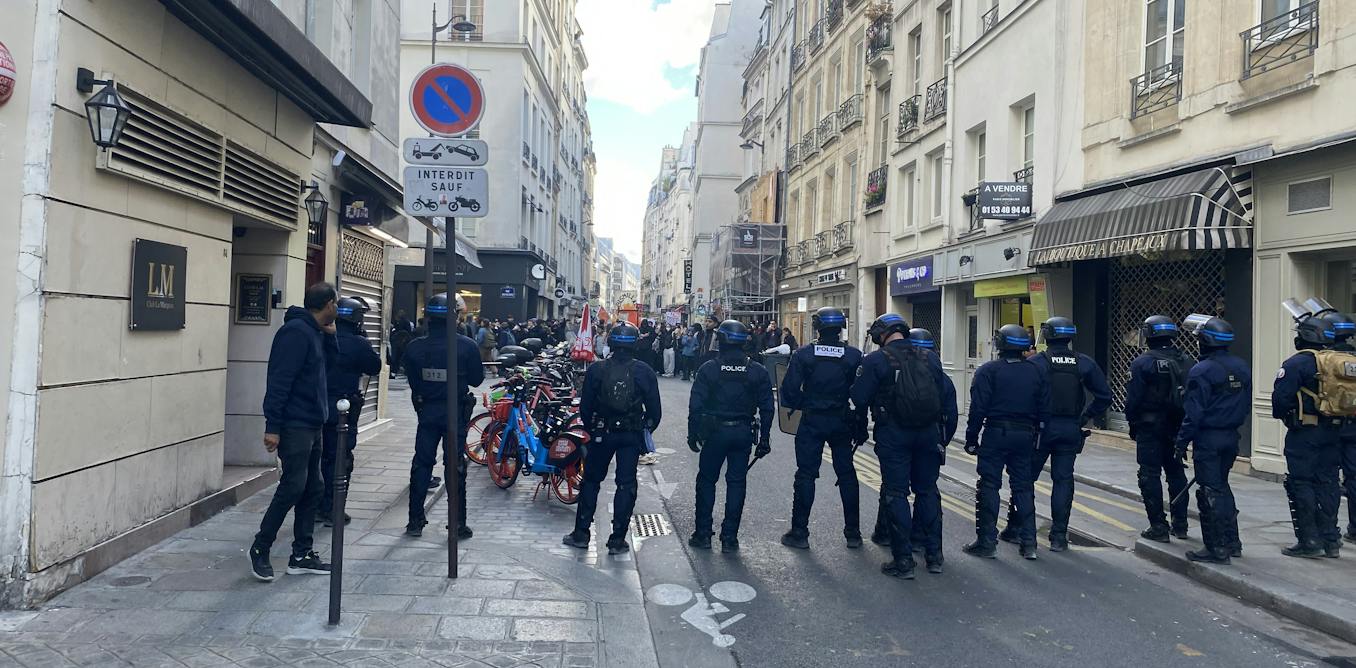
KEY TAKEAWAYS The French authorities have responded to protests with arrests, police violence, curfews and restrictions rather than dialogue in mainland France and in its overseas territories. Young people are protesting against key issues such as poor education, unemployment, discrimination equating to a lack of opportunities. These problems are particularly severe in Kanaky-New Caledonia, where socio-economic inequalities are also linked to ethnic discrimination. Younger generations feel ignored by political leaders, while older voters have greater influence over elections and political decisions. In both France and Kanaky-New Caledonia, protesters feel their voices and demands are not being heard. Protests are ongoing in France, but also on a European scale, as young people, the so-called “Gen Z”, are protesting in Greece, Spain, and other countries. Here, we explore the forces behind protests in France and draw parallels with earlier events in its semi-autonomous Pacific territory Kanaky-New Caledonia (KNC). The mass protests we are witnessing this autumn in France are rooted in the global environmental and economic crisis, bleak future prospects, according to economist Yann Algan, and a lack of university places and funding for education. Protests by high school students, calling for better conditions such as the replacement of absent teachers, consistent heating in schools in winter, and smaller classes have been relatively peaceful. In Mayotte, where the student movement started on August 31 and then in France, where the protests rapidly spread to over 700 schools and to universities, blockades and demonstrations were swiftly suppressed by police using tear gas and breakout grenades, which are prohibited across much of Europe. On October 17, 500,000-800,000 people demonstrated in France; on November 5, up to 1.6 million. There were violent clashes between police and so-called casseurs, who, mostly apolitical, became radicalised in the face of discrimination, inhospitable immigration politics, and school failure, and have destroyed infrastructure and looted supermarkets, also attacking schools and public buildings such as Limoges’ historical neo-Renaissance town hall. France’s approach to policing protest We have identified four parallels in terms of protest and state response with the insurrection in Kanaky-New Caledonia in May 2024, when pro-independence demonstrations against an electoral bill turned violent and resulted in 14 deaths (12 citizens, mostly young Kanak activists, and 2 policemen) and the destruction of businesses, schools, and other infrastructure. The first parallel is how the French centre-right government responded to dissent not with dialogue, but with military-style repression to reclaim “public order”. In one week, more than 5,000 students – many of them minors – were arrested, more than in any other social movement in France’s history. This was perceived as intimidation. Several schoolchildren were severely injured, leading to even stronger dissent in which “yellow vests” soon participated. After the violent outbreaks on October 17, France’s Minister of the Interior deployed the army and anti-terrorist special forces. Youth protesters faced prolonged detention, often in dismal conditions. Several requests for demonstrations were subsequently refused, and curfews imposed. While the violence of the casseurs was highlighted by different media, police violence was often downplayed. France’s national human rights body has detailed disproportionate repression by security forces in France (October 2026) and also in Kanaky-New Caledonia in May 2024. In KNC, curfews lasted more than six months. There was a state of emergency, and TikTok was suspended – both for around two weeks. The ratio of police deployed was 4 times higher in KNC in 2024 than in France in 2026. Although distinguishing casseurs from student protesters is not always easy and police are themselves the target of violent attacks, the criminalisation of (peaceful) protesters and violent repression creates longstanding animosity in both territories, particularly amid reports of underage students being held overnight for questioning. In KNC, pro-independence supporters, Kanaks, the political association CCAT, and (youth) looters were all labelled as insurrectionists. This was perceived as a form of colonial (in) justice, according to New Caledonian lawyer Louise Chauchat. Secondly, there is an uncompromising stance and a failure to listen. Back in 2021, pro-independence parties in KNC asked, during the Covid-19 pandemic, to postpone the third referendum on independence to mourn their losses – the request was refused. In 2024, they wanted negotiations on independence before altering electoral eligibility. Nevertheless, the French government tried to push through the proposed electoral changes. In October 2026 in France, President Macron and the government were slow to open a dialogue with students, and protesters felt disregarded. The third parallel is socio-economic: the lack of decent education and increasing inequalities. This is not unique to France, of course, and European “social contracts” are failing in key domains of employment, housing, schooling, and hope for the future. In France, there are also pro-business policies and a taxation system that favours wealthier citizens. Young people, particularly immigrants, are facing soaring rents in major cities, like Paris, Lyon, and Marseille, which is fuelling resentment. A scene from recent protest action in Paris. Matthias Kowasch and Joseph Bohbot, Author provided (no reuse) In KNC, social disparities run deeper and overlap with ethnic inequalities and discrimination. For example, around 30% of non-Kanak have a university degree, but only 5-6% of Kanaks. They are more affected by unemployment and have less access to healthcare and rented urban accommodation. In France, the unemployment rate for young people (15-24 years) reached 19.8% in 2025. The political right in France and KNC blame unruly youth, the political left and French immigrants for violence, contradicting French values of equality and fraternity. Fourthly, demography. Older generations largely determine presidential and other elections. Since 2025, voters over 50 have formed an absolute majority in France, and they no longer act as a barrier to the far right. Most political parties fail to seriously address youth priorities. The electorate mandate is also key in KNC. Since the end of the 1960s, Kanak people have represented less than 50% of the population, with immigration fuelled by the nickel mining “boom” and with support from Paris. Opening the restricted electorate to more recent immigrants, favouring non-Kanak voters, is a red line for many pro-independence supporters. Again, Kanaks feel their voices are diluted and unrecognised. A protester carries a sign that reads Matthias Kowasch and Joseph Bohbot, Author provided (no reuse) Our research (forthcoming in Human Geography journal) leads us to conclude that heavy-handed intervention by the state comes back to haunt it. We should question whether the government and police forces use an escalation of violence to delegitimise the protest movement in the eyes of the public. With the French Presidential elections in April 2027, France’s far right, which favours law and order and repression of dissent, has sought to gain from the protests. For pro-independence Kanaks, and youth lacking faith in the future, law and order are not the answer to their demands: they aim for equal opportunities, concessions, reform of public services, and possibly in KNC, political independence. We are deeply thankful to Catherine-Fournet-Guérin, Olivier Milhaud, and Joseph Bohbot (all Sorbonne University) for proofreading our article and their fruitful comments. A weekly e-mail in English featuring expertise from scholars and researchers. It provides an introduction to the diversity of research coming out of the continent and considers some of the key issues facing European countries. Get the newsletter!
Policing protests: how France’s student movement echoes the political crisis in Kanaky-New Caledonia
Full Article
Original Source
Read the full article at Theconversation →KhanList aggregates and links to publicly available news content. We do not host full articles from third-party sources. Always verify important information with original sources.