
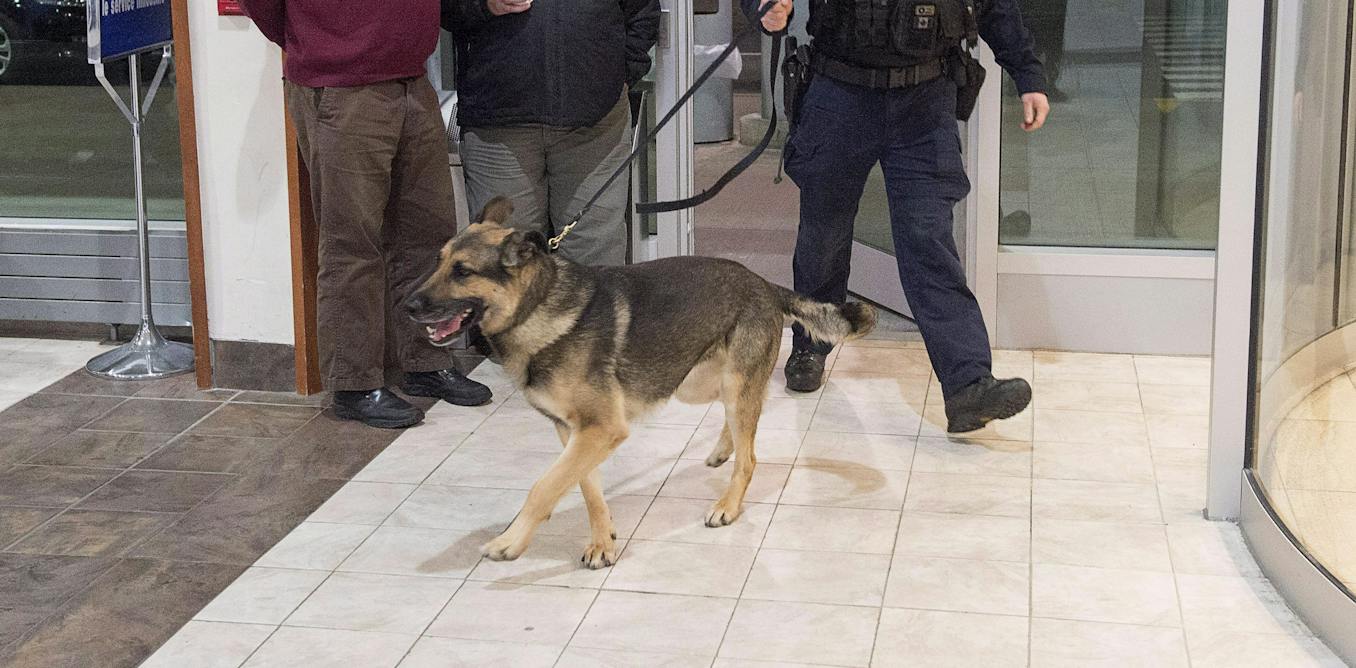
Police departments across the world use “sniffer dogs” to help in searches — for explosives, for people who are lost, for human remains and for narcotics. These dogs are widely understood as important for police investigations. They are often praised by courts for their accuracy and reliability. In Canada, police officers must have “reasonable and probable grounds” to search a home for evidence of a crime or to search a vehicle for drugs or other evidence during a traffic stop. In a series of cases, including R. v. Kang-Brown and R. v. Chehil, however, the Supreme Court of Canada has applied the lower standard of “reasonable suspicion” to sniffer dog searches. That’s because sniff searches are considered highly accurate and minimally intrusive to the individual searched. My recent research challenges both these assumptions. It suggests that the underlying rationale for the use of the reasonable suspicion standard in sniffer dog searches no longer holds. High rate of false alerts Despite our persistent belief in the “infallible” dog, empirical studies from around the world suggest that even trained and certified detection dogs have an alarmingly high rate of false alerts. In 2023, for example, data from New South Wales police in Australia revealed that nearly 75 per cent of searches following an alert from a sniffer dog yielded no illicit drugs. Similarly, a 2011 Chicago Tribune investigation found only 44 per cent of alerts led to the discovery of drugs or drug paraphernalia. Denver, a Canada Border Services Agency narcotics detection dog, is seen during a tour of the CBSA Lansdowne port of entry, with Minister of Public Safety David McGuinty (right) and Canada’s fentanyl czar Kevin Brosseau (centre right), in February 2025. THE CANADIAN PRESS/Spencer Colby This high rate of false alerts has multiple and overlapping causes. Poor and inconsistent training procedures can have a significant impact on field performance. A dog’s abilities also vary from day to day. In other cases, dogs are detecting minuscule residual traces of drugs on currency or alerting to the smell of drugs and not the drugs themselves. For example, the chemical compound piperonal is found in MDMA, but is also used in vanilla flavouring and mosquito repellent. Another source of error is handler cuing, or the conscious and unconscious cues a dog receives from its human handler. In a 2011 study, for example, dog handlers were told that markers placed in certain search areas indicated where target scents were located, even though no target scents were present. The dogs falsely alerted in 85 per cent of the searches and were more likely to alert at the marked locations, suggesting that handlers’ expectations influenced their dogs’ behaviour. Unconscious racial bias If a police officer harbours unconscious racial biases — even those they would consciously reject — they can transmit them to their dogs through unconscious handler cuing. If these cues cause the dog to falsely alert to the presence of narcotics, this will often give officers reasonable grounds to arrest the individual and, once the arrest is made, to conduct a more thorough search of the person and their immediate surroundings. The use of a reasonable suspicion standard makes it easier for police to conduct the initial sniff search, but the phenomenon of handler cuing operates just the same. This further reduces reliability and can lead to false alerts and unnecessary arrests. Moreover, investigations in the United States have found that police use sniffer dogs in stops involving racialized drivers at a disproportionately higher rate than stops involving white drivers. The 2011 Chicago Tribune investigation similarly found that the dogs’ overall success rate of 44 per cent fell to just 27 per cent when the driver stopped by the police was Latino. Virginia state police K-9 officer Tyler Fridley works his dog Aries at State Police headquarters in Richmond, Va., in May 2021. (AP Photo/Steve Helber) Physical and psychological harm Far from being “minimally intrusive,” the use of drug detection dogs can cause both physical and psychological harm. People subjected to a sniffer dog search often report feelings of fear and anxiety stemming from the public humiliation involved. Others describe physical distress, including increased heart rate, sweating and shaking. People who are subjected to a drug dog search also often report feeling uncomfortable in the presence of police and an increased fear of police afterwards. This can damage police-community relations, especially among racialized and marginalized populations where this relationship is often already strained. Reasonable and probable grounds The Canadian Charter of Rights and Freedoms does not prohibit the use of police sniffer dogs. However, my research suggests that the rationale for applying the reasonable suspicion standard — that sniff searches are highly accurate and minimally intrusive — no longer holds. Instead, the reasonable and probable grounds standard, which has generally been applied to search and seizure powers, should also be applied to sniffer dog searches to ensure that power is used in accordance with the Charter. If this standard creates a legislative gap that makes sniffer dogs a less useful investigative tool for police, that’s a matter for Parliament to address.
Police ‘sniffer dogs’ are less accurate, and more harmful, than courts assume
Full Article
Original Source
Read the full article at Theconversation →KhanList aggregates and links to publicly available news content. We do not host full articles from third-party sources. Always verify important information with original sources.