
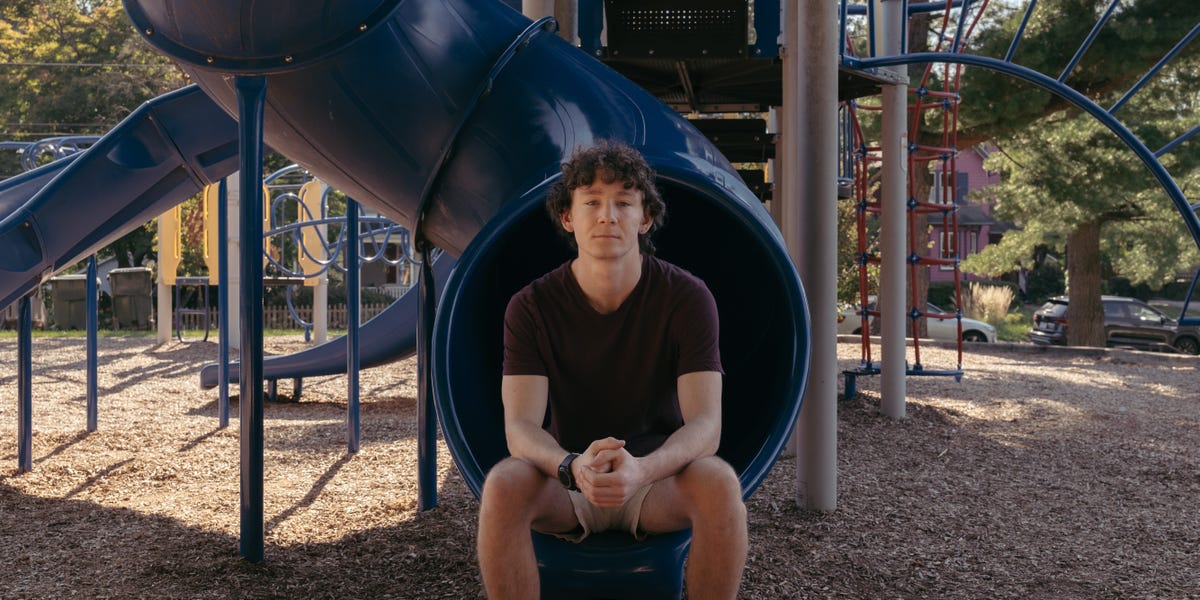
In 2015, Danielle Meitiv (left) let her son Rafi (right) walk home alone with his sister, Dvora. The kids were stopped by the police, and the family was investigated by CPS. Caroline Gutman for BI Police picked him up at 10 for walking home alone. At 21, he says free-range parenting gave him freedom. Bundled in heavy coats, hats, scarves, and mittens, Rafi Meitiv and his little sister Dvora had just spent a sunny Saturday afternoon in December 2014 playing at a local playground in suburban Maryland.After an hour, the 10- and 6-year-olds began their trek home, about three-quarters of a mile. While it was their first time walking from that particular park to their house alone, they'd traced the same route in Silver Spring dozens of times with their parents and had also ventured off alone to other playgrounds in the area before.About halfway through their journey, they were stopped by three police officers, who instructed them to get in their car so they could drive them home and speak to their parents.Rafi and Dvora were confused."At this point, we knew how to obviously use crosswalks, walk the street safely," Rafi, now 21, told Business Insider in his first time speaking out about this incident in over a decade. "We had our parents' phone numbers. We knew how to take care of ourselves."The incident led to a six-month investigation into potential child neglect by Child Protective Services, followed by another, more harrowing run-in with CPS and the police.Rafi and Dvora's parents, Alexander and Danielle Meitiv, fought back, appearing on TV news programs, including "Today" and "Good Morning America." They were eventually cleared of "unsubstantiated child abuse or neglect" — a legal limbo meaning that CPS could neither find enough evidence to prove nor fully rule out neglect — in June 2015.The Maryland Department of Human Services told Business Insider in a comment that it's "committed to transparency and being as open as possible while maintaining the confidentiality of children and their families, as protected by law." Alexander Meitiv, right, prepares dinner with Rafi (left) and Dvora (center) in 2015. Bonnie Jo Mount/The Washington Post via Getty Images The Meitivs' story isn't unique. In August 2026, Karyann Parkinson, a mom of five from Virginia, was convicted of "contributing to the delinquency of a minor" after allowing her 5-year-old son to walk half a mile alone within their gated community. It earned her a six-month prison sentence, which was immediately suspended, and landed her on the state's child abuse and neglect registry for seven years, banning her from volunteering at her children's schools, among other things. The Parkinsons have since left their HOA and filed an appeal, hoping to have their case heard before a jury.Parkinson's case recently reignited the debate around childhood independence in the US. For parents who are mindfully raising free-range kids, the decision to let their kid walk or play alone comes with risks. Besides considering the obvious ones — like their children getting hurt or lost — parents may also worry about being slapped with a child-neglect investigation or criminally prosecuted for endangering the welfare of a child.Rafi said he loved being a free-range kid because it taught him to be more "street-smart" and gave him the freedom to roam around, climbing trees and jumping into streams. "It was definitely better than being inside on an iPad for my entire childhood," he said.The drawbacks were his brushes with the system designed to protect him."I was definitely having nightmares during the whole ordeal and afterward," he said. "It was just not something a kid should have to go through."CPS visits at school and a 'safety plan' Rafi Meitiv, now 21, remembers being "shocked" by a CPS worker asking him if his parents hurt him. Caroline Gutman for BI When the police arrived at the Meitivs' home with Rafi and Dvora in the backseat, the atmosphere quickly became "extremely hostile and intimidating," Rafi later wrote in his college application essay to Towson University, where he's now studying exercise science.Alexander Meitiv, now 55, was the only one home because his wife, Danielle, now 57, was on a work trip. When the father of two opened the door, he was told he needed to show ID before his children could be let in. At one point, Rafi called his mom and said he was afraid "Daddy is going to be arrested." Alexander was given a "safety plan" to sign, which involved two instructions: "The children will not be left unsupervised by an adult anywhere," and that Alexander would "avail himself" to CPS while it investigated the incident. There was no clear end date to the restrictions.After that night, CPS began investigating the Meitivs for potential child neglect. At one point, Rafi and Dvora were pulled out of their classrooms in their nearby school to be interviewed by a CPS worker."They were asking serious questions, 'Do your parents hurt you?'" Rafi said. "I was just shocked."According to Rafi, Danielle only learned about the questioning when she was interviewed by the same CPS employee later that day, who had a school-visitation sticker. Danielle and Alexander Meitiv had to sign a CPS safety plan. They eventually printed laminated "kid licenses" for Rafi and Dvora to carry when out alone. Sammy Dallal/For The Washington Post via Getty Images Two months after their children's run-in with police, the Meitivs received a letter from CPS saying they had been found responsible for "unsubstantiated child abuse or neglect." While not an official ruling, it would remain on file for the next five years."I might laugh about that now — what does that mean, 'unsubstantiated'?" Danielle told Business Insider. "But I remember crying. I can't believe they think they were neglecting our children. I pride myself on really caring, being so deliberate in my parenting."Reflecting on his past, Rafi said he didn't feel unsafe because of his free-range childhood. If he ever got lost, for example, he said he felt confident he could approach a security guard and recite his parents' phone number from memory.His free-range lifestyle came with limitations, too. "We weren't allowed to go across big streets. We weren't always unsupervised in other areas," he said. "It was mainly just that they would let us go for walks."Tighter fences around free-range parenting The playground that Rafi and Dvora Meitiv walked from was 0.75 miles away from their house. Caroline Gutman for BI Many American parents long for their kids to experience more of the "latchkey" childhoods they themselves enjoyed. Still, they hesitate to actually implement that level of independence.A 2023 poll from the University of Michigan's C.S. Mott Children's Hospital, surveying 2,044 parents in the US, found that 84% of parents of 9- to 11-year-olds agreed that kids benefit from time without adult supervision. Yet only 33% said their child had walked or biked alone to a friend's house, 15% said their child had trick-or-treated with friends, and 58% said their child had stayed home alone for 30 to 60 minutes.A common parental fear — the risk of kids being kidnapped while venturing alone — is rare. A 2026 report from the National Center for Missing and Exploited Children found that non-family abductions make up only 1% of all reported missing-child cases in the US.Lenore Skenazy, president of Let Grow, a nonprofit promoting childhood independence, told Business Insider that parents and bystanders have been culturally convinced that responsible parenting means hypervigilance."I call it 'worst-first thinking,' Skenazy said. She cited milk cartons of missing children in the 1980s, the "Taken" franchise, and nearly three decades of "Law and Order: SVU" as contributing to parental anxiety around kidnappings, homicides, and sexual abuse against minors. It's "jumping to the worst-case scenario first and proceeding as if it's likely to happen." Danielle Meitiv walking with Dvora (left) and Rafi (right) in 2015. Sammy Dallal/For The Washington Post via Getty Images She added that both parents and kids benefit from gradually releasing the reins. "When you let go, and you see what your kid can do on their own, that rewires a parent like nothing else," Skenazy said. "You've gone from, 'My kid is a baby, they need me, they'll be hurt, and I'll feel terrible forever,' to 'Look at what my kid can do, how beautifully they're growing up.'"The question is not whether children should gain independence, pediatric safety experts say, but how much freedom is appropriate for a child's age, skills, and surroundings. The American Academy of Pediatrics notes that most children are not ready to cross streets alone until at least age 10, and has called for communities to make routes to school and play safer so children can move about independently."You have to take into consideration not only your personal children, but also geography," Sheri Langston, a licensed professional counselor practicing in Colorado and California who focuses on families, told Business Insider. "Every parent gets to make those decisions, those choices: 'What am I OK exposing my children to?'"As a free-range kid, Rafi said he sympathizes with fearful parents, but added that it shouldn't hold them back from letting their children have more autonomy. "The benefits of letting your kids have some independence and walk around the neighborhood far outweigh the negatives," he continued.More afraid of CPS than stranger-danger Danielle Meitiv said she sympathizes with free-range parents like herself. Caroline Gutman for BI In the months following the February 2015 letter from CPS, Rafi felt things had blown over — the family hadn't heard from CPS again. The Meitivs resumed letting their kids walk home alone. As a precaution, they gave Rafi and Dvora laminated "kid licenses" to hand to strangers in case they were stopped.In April 2015, Rafi and Dvora stopped to pet a stranger's dog on their way home. When they kept walking, they noticed the man following them. Eventually, he called the police. This time, the children weren't driven home. Instead, they waited for hours in the back of a police car. All the while, they wondered if they'd be separated from their parents this time.Rafi said his parents weren't notified for hours and had begun searching the neighborhood for them. Eventually, they realized their children must have been picked up by the police again.When they arrived at CPS headquarters around 8:30 p.m. with food for the kids, Rafi said, it took an additional two hours for the family to be reunited.After their second and more serious interaction with CPS, the Meitivs signed the new safety plan, which would now also require them to escort the kids to and from school.After two appeals, CPS dropped its investigation in June 2015. That same month, Maryland's Department of Human Resources issued guidance saying that CPS should not investigate cases involving children walking or playing outside alone unless the children were harmed or were in substantial risk of harm. Maryland state law also prohibits leaving a child under 8 alone in a home, building enclosure, or car without a reliable person over 13 present. In May 2026, Congress introduced a bill titled "Promoting Childhood Independence and Resilience Act of 2026," which would cover activities like kids walking or biking alone, running errands, taking public transit, and staying home alone for brief periods of time, so long as they don't present "unreasonable disregard of a foreseeable risk of serious harm." Movement on the bill has been slow, and if it dies with this Congress, it would need to be reintroduced in 2027.Rafi sees a direct link between how he was raised and who he's become as an adult."I have a lot of friends at school right now who had a much more helicopter-ed, for lack of a better word, childhood, and they are a lot less independent," he said. "They have to call their parents for every decision that they make."Comparatively, he said he feels more comfortable navigating unfamiliar places and interacting with strangers. He also just remembers having more fun."I look back at my childhood and the freedom I had," Rafi said. "It felt like being a kid the way it's supposed to be." Police Law Most popular Business Insider tells the stories you want to know about the world of business, technology, and finance Business Insider tells the stories you want to know about the world of business, technology, and finance Business Insider tells the stories you want to know about the world of business, technology, and finance Business Insider tells the stories you want to know about the world of business, technology, and finance Business Insider tells the stories you want to know about the world of business, technology, and finance Business Insider tells the stories you want to know about the world of business, technology, and finance Julia is a senior health reporter at Business Insider. Julia covers a wide range of topics, including the rise of colon cancer cases among young people, the unique challenges modern parents face, and the growing trend of Gen Zers abstaining from social media. She also writes about fitness, nutrition, longevity, and the routines of highly successful people for Business Insider’s Power Hours series. She’s published interviews with Arnold Schwarzenegger, Serena Williams, Esther Perel, Bill Nye, Naomi Watts, and James Van Der Beek.Julia's work has appeared on the BBC, CBS, Bloomberg Radio, Morning Brew, Fast Company, and the Daily Flash. She has also moderated panel discussions at Nasdaq and Duke University, and appeared on the podcasts Open to Debate, Airtalk, The Evan Bray Show, and The Last Show with David Cooper. Prior to this role, Julia was an education and personal development editor on the Business Insider Reviews team and a sex and relationships editor at Cosmopolitan and BuzzFeed, respectively. You can say hi to Julia at jpugachevsky@businessinsider.com and check out more of her work on her website. Jane Ridley is a correspondent on Business Insider’s Life team, where she tackles parenting, health, careers, and real estate with a reporter’s edge and a storyteller’s instinct.She’s known for her signature As Told To narratives — raw, first‑person accounts shaped from intimate, revealing interviews.Before Business Insider, Ridley spent a decade at the New York Post and six years at the New York Daily News, where she wrote exclusive, standout features.Born and raised in the UK, she moved to the US in 2005 after seven years at The Daily Mirror in London. Her reporting has taken her everywhere from Tokyo and Beijing to Sydney, Bangkok, Athens, and Madrid.
Police picked him up at 10 for walking home alone. At 21, he says free-range parenting gave him freedom.
Full Article
Original Source
Read the full article at Businessinsider →KhanList aggregates and links to publicly available news content. We do not host full articles from third-party sources. Always verify important information with original sources.