
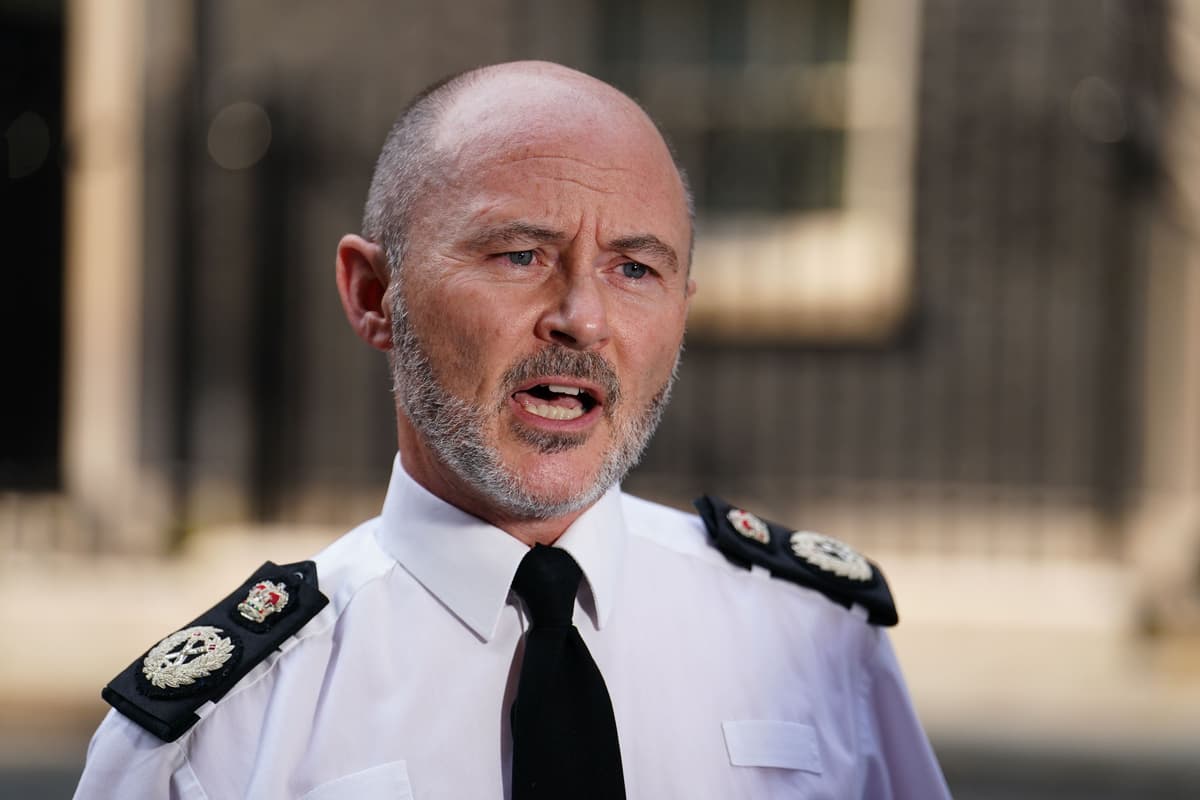
Police chiefs cannot afford “complacent nostalgia” and must reform the service amid billions of pounds of debt and a health crisis in the workforce, one of the UK’s most senior officers has warned.Chairman of the National Police Chiefs’ Council (NPCC), Gavin Stephens, used a major speech to back Government plans for fewer, larger police forces alongside a national police service, saying “our job is not simply to preserve the police service we inherited.”Speaking at the annual NPCC conference, held jointly with the Association of Police and Crime Commissioners, he told delegates: “We cannot afford a complacent nostalgia.“We must reform policing to keep pace with threats to our safety, and we must be clear-sighted on what we are seeking to achieve.”Earlier this year, the Government unveiled plans to bring counter-terrorism, some fraud and serious gang crime under a new National Police Service, while drastically cutting the number of local police forces.The current 43-force system in England and Wales means there is a postcode lottery in levels of access officers have to technology and specialist support, Mr Stephens said.“I think about my Mam in rural North Yorkshire, or my son getting his first flat in London.“They both deserve a local policing team tuned into the local problems,” he told the audience in Westminster.NPCC chairman Gavin Stephens called for a reform to policing, saying it ‘should not be a postcode lottery’ (Jordan Pettitt/PA)PA Archive“And those officers in both places deserve the same access to proper equipment, specialist support and modern technology.“They need to be able to exchange intelligence at ease, obtain digital forensic results quickly, and connect to specialists for support when needed.“That should not be a postcode lottery as it is now.”Currently, officers are sometimes left having to type information into different, incompatible systems, he said.“We have also built a system where 43 forces organise their service delivery in similar, but sufficiently different ways to mean that suppliers and services end up being duplicated, different and incompatible.“And since the financial crash of 2008, every force has made year upon year upon year of savings, sometimes in collaboration, but more often than not within their own boundaries, and the jigsaw of policing no longer fits together. This cannot continue.”Read MoreWhile homicide dropped by 7% in the year to March 2026, and knife-enabled crime by 8%, more than 40% of people in the UK report seeing anti-social behaviour, and more than 5 million women are victims of violence per year, delegates were told.Mr Stephens said that the regional boundaries that he saw when he first became a police constable now “barely exist”, with most crime involving a digital element.“A criminal can target a child in their bedroom, steal a pensioner’s savings, exploit a vulnerable person without ever setting foot in the victim’s hometown.“And increasingly, the internet is not just a tool for committing crime. It is driving crime.”He continued: “Online algorithms, the attention economy and its unrelenting creation of information and content can amplify violence, misogyny, hate and exploitation, with very real consequences in our homes and on our streets.“Ofcom research found that almost three-quarters of children aged 11 to 17 encounter potentially harmful content on an app, a website or online game in just four weeks.“Behind that statistic are children and families who need all of us, the technology companies and society, to do better.”Gavin Stephens called for improvements to how police deal with violence against women and girls (Jordan Pettitt/PA)PA ArchiveThere must also be improvements in how police deal with violent crimes against women and girls, he said.“Violence against women and girls is another national emergency.“Around one in five crimes recorded by police are violence against women, or public protection offences.“We have to get better at identifying repeat perpetrators, protecting victims, bringing offenders to justice across boundaries.”He also cited research by the Police Federation that suggested more than half of officers regularly feel physically exhausted, and 45% said they are burnt out.“We cannot talk seriously about reform without talking seriously about the people that deliver it.“They deserve simpler systems. They deserve manageable workloads, with technology that helps rather than hinders.“They deserve support, development and recognition about the unique demands of the profession they have chosen.”The Chief Constable continued: “I said last year we can no longer afford the current policing system, and I don’t just mean the billions short we are in the medium-term financial plans, or the billions we are stacking up in debt.“The biggest cost of an outdated way of policing is being carried by our teams, who then feel they are letting the public down.“We owe it to them to face up to the scale of this challenge and not to pretend we can continue as we are.”
Police chief warns against ‘complacent nostalgia’ as he backs major reforms
Full Article
Original Source
Read the full article at Standard →KhanList aggregates and links to publicly available news content. We do not host full articles from third-party sources. Always verify important information with original sources.