
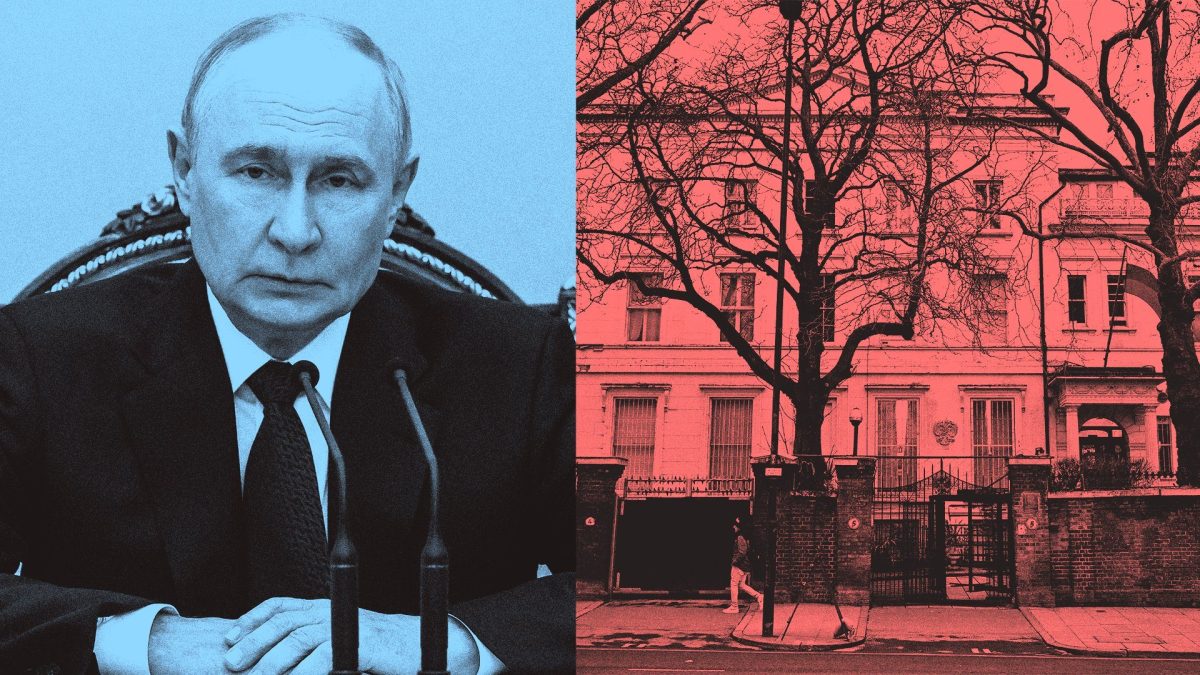
At the height of the Cold War, the Russian embassy in London was the base for Moscow’s shadow war against the UK. From inside the thick-walled Kensington mansion, Kremlin spies orchestrated the betrayal of the “Cambridge Five” and the assassination of a dissident with a poison-tipped umbrella. In more recent years, the murder of Alexander Litvinenko with polonium, and the Salisbury poisonings, have been tied back to Russian intelligence operating from within the London site. Shorts This week it emerged that Russia’s ambassador to the UK, Andrey Kelin, had been called back to Moscow, and had yet to be replaced amid mounting diplomatic tensions. It means the public role of the embassy – as a diplomatic bridge between the Kremlin and No 10 – is not functioning in the normal way. But the secret role of the site – as a forward base for Vladimir Putin’s intelligence agents operating in the UK – is very much still active. The i Paper has spoken to multiple experts and insiders to build a picture of the role of Putin’s London mission in the hidden “grey war” on the UK’s streets. Leigh Turner, a former UK ambassador to Ukraine and author of the book Lessons in Diplomacy, said the embassy “is a spy hub anyway”, and the withdrawal of Kelin will not change that. “The ambassador himself won’t be deciding what the spies do inside the Russian embassy,” he said. “The resident, or head of station, will be doing that.” The head of station is a term to describe the senior intelligence officer operating in a foreign country, usually based in an embassy or trade mission. MI6 and the CIA also run similar teams within the UK and US embassies around the world. It is why a common response in tit-for-tat security rows is to expel several of a rival country’s diplomats. Leigh Turner, former UK ambassador to Ukraine, also served at the UN and in Moscow (Photo: Leigh Turner) Many so-called “diplomats” will in fact be helping to gather intelligence, and may even be intelligence officers themselves. Reduced number of spies The UK Government has repeatedly identified and expelled undeclared Russian intelligence officers operating under diplomatic cover out of the Russian Embassy in London. In the most recent case, in 2024, Russia’s defence attaché was identified as an undeclared military intelligence officer and expelled. Following the Salisbury nerve agent attack in 2018, Britain expelled 23 Russian diplomats for being suspected spies. British security services assess that this move was a significant factor behind Russia’s current use of criminal groups to act as its “proxies” in Britain, both for acts of espionage and sabotage. These groups are typically directly organised from outside the UK, court cases show. But providing “on the ground” intelligence, diplomatic and logistical support is the role of security services operating in foreign countries. Former CIA officer Sean Wiswesser said the London embassy operated like a “giant ear”. “It is a major signals and listening post for the collection of electronic intelligence, signals intelligence, and generally as much data and cyber collection they can possibly do from the embassy,” the author of Tradecraft, Tactics and Dirty Tricks said. Like Russia’s other consular headquarters around the world, it would be a base for officials in Russia’s SVR foreign intelligence service and GRU military intelligence, he said. But Russian intelligence officers remain in Britain – albeit thought to be in smaller numbers – and UK intelligence agencies believe the London embassy is linked to wider espionage work such as illicit communications interception and data collection. Having no ambassador would not “decrease the ability of the Russian overseas intelligence service to do its business day to day,” said Turner, who led the UK’s mission in Ukraine from 2008 to 2012 and has also served in Moscow. A new Russian ambassador would likely only be involved with the spies when they are “going to do something really risky that might come out” – in preparation to “deny anything and say it’s nothing to do with Russia”, he said. Former KGB spy Alexander Litvinenko reported “repeated visits” from a Russian embassy official in the years leading up to his death (Photo: Natasja Weitsz/Getty) Embassy staff ‘working for Russian intelligence services’ A spokesperson for the Russian embassy said Kelin, who served in his post for seven years, made “considerable efforts to preserve contacts and channels of communication” with the UK during his time as ambassador and accused the UK government of choosing a “path of confrontation” with Moscow. Keir Giles, associate fellow at Chatham House’s Russia and Eurasia Programme, said that despite this reduction in communication, “the UK is an important intelligence target for Russia”,noting the “expulsions of large numbers of Russian military intelligence across Europe”. “We can assume that a substantial number of embassy staff are still working for the Russian intelligence services,” Giles said. The UK has a long history of assassination plots linked to Russia’s secret services – from a poison-tipped umbrella killing Bulgarian dissident Georgi Markov in 1978 on Waterloo Bridge, whose perpetrator remains untried in court; to the 2006 murder of former FSB agent Litvinenko via polonium-laced green tea; to the Salisbury poisonings that inadvertently killed a British woman. Markov was targeted by the Bulgarian Secret Service, with the technical and logistical assistance of the Soviet KGB. A former Soviet ambassador to the UK, Viktor Popov, claimed during the 1980s out of 70 diplomatic staff at the embassy, only 15 were “genuine” diplomats, with the rest being intelligence officers. The Russian intelligence officers behind the Salisbury poisonings and Litvinenko’s murder had been flown into the UK directly from Russia and removed shortly afterwards, but official inquiries have uncovered links to the Russian embassy in London. Before his death, Litvinenko alleged that an embassy official had commissioned a “reconnaissance exercise for a possible attempt to assassinate” Russian exile Boris Berezovsky, who died in unclear circumstances at his Berkshire home in 2013. Litvinenko also reported “repeated visits” from a different embassy official to his home in the years leading up to his death, and said he believed that the man was the Russian agent in charge of monitoring him. The GRU operatives dispatched to poison former Russian spy Sergei Skripal with novichok in 2018 were housed in hotels and removed rapidly from Britain, but UK intelligence services noted “unusual and increased activity” at the Russian embassy in the days around the attack. Wiswesser said there “would certainly have been support” from intelligence officials operating within the London embassy for the “collection of background and intelligence” that fed into both the Skripal and Litvinenko killings. Beyond Russia’s covert operations in the UK, Turner said it was difficult to read too much into Kelin’s quiet removal from his London post. “We’re all looking for straws in the wind in this latter-day Kremlinology that we face of trying to work out what the Russians really mean by anything they do or say,” Turner said. Russia has “a state policy of never saying what they really think – or indeed telling the truth”, he added. Bigger concerns in UK-Russia relations There are concerns that Moscow may choose not to replace Kelin – a move that could further dismantle the very limited communication between the two countries over Russia’s war in Ukraine. The former ambassador suspected that Kelin’s departure was not a formal withdrawal and is not intended as “a grand gesture” to the UK. “If the Russians were to expel the British ambassador, that would be a very serious sign of displeasure, that they really weren’t interested in working with us,” Turner said. Only if Kelin is not replaced after some three months, he said, should this be seen as Russia “seeking to downgrade their relationship” with the UK. A gap between ambassadors is not unprecedented. Kelin was only put in post three months after his predecessor Yakovenko departed in 2019. Following confirmation of the departure the Russian embassy said it had no intention “to downgrade the level of diplomatic relations between our two countries”. For now, matters in London are in the hands of the chargé d’affaires, Vasily Tsyganov – the only publicly listed senior embassy staff member. A chargé d’affaires is a lower-ranking representative than an ambassador and is accredited to the foreign ministry rather than the head of state. Natia Seskuria, senior research fellow for Russian and Eurasian Security at the Royal United Services Institute, said the vacant post was not a “significant concern” for the UK government at this stage. “UK-Russia relations are already at their lowest point in decades, but the current gap does not necessarily mean that the Kremlin will not appoint a new ambassador to London,” she said. “Of the possible escalation options available to Moscow, diplomatic escalation would be among the least harmful and predictable.”
Poisonings, betrayal and proxy attacks – inside Putin’s London ‘spy hub’
Full Article
Original Source
Read the full article at Inews →KhanList aggregates and links to publicly available news content. We do not host full articles from third-party sources. Always verify important information with original sources.