
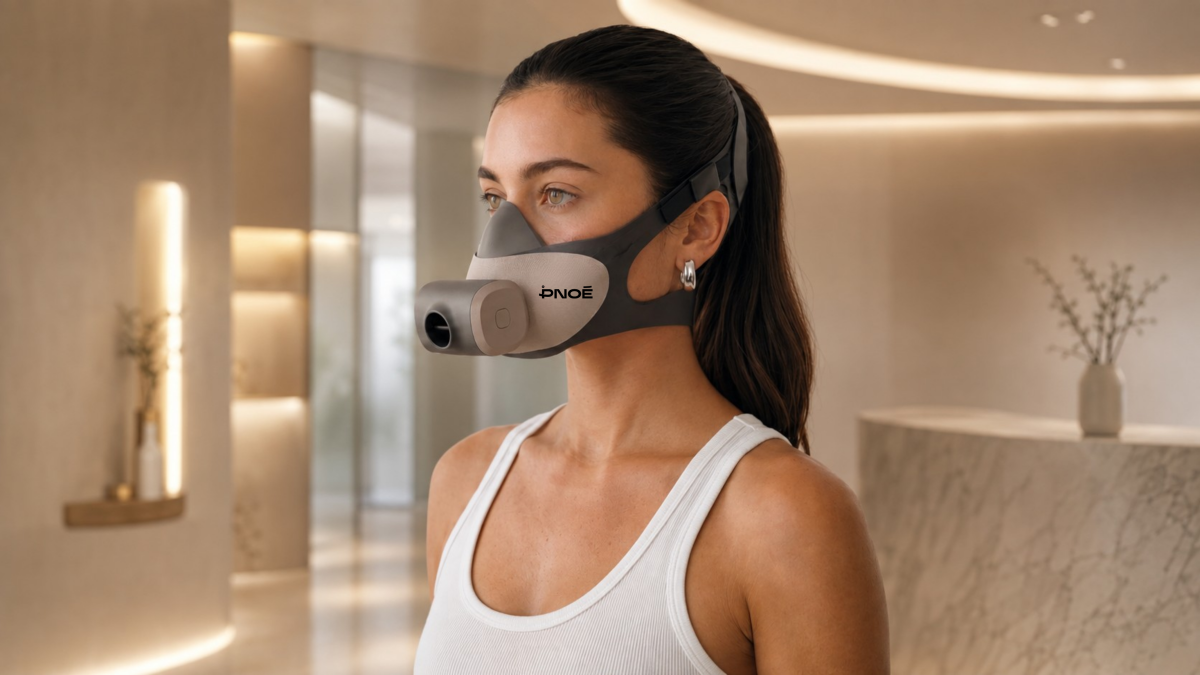
At first glance, the newest device from PNOĒ looks like something a comic-book villain might wear. The mask, which covers the nose and mouth and straps around the back of the head, bears more than a passing resemblance to the one worn by Bane, Batman’s hulking nemesis. But its purpose is far more benign; it measures how much oxygen you consume and how much carbon dioxide you exhale, then turns that data into advice about how to eat, train, and, the company hopes, live longer. PNOĒ, which is based in Malden, Massachusetts, and has operations in Athens, Greece, is preparing to launch the PNOĒ 2.0 on October 1. The big change from its current device is that users can administer the test themselves. According to co-founder and CEO Apostolos Atsalakis, someone can walk into a gym, “just wear the mask, push the button, sit down,” and breathe for eight minutes. “That’s it. It’s that easy,” he said recently, talking with this editor over a Zoom call from the company’s Athens location. That matters because PNOĒ’s current device requires a trained operator, which limits where it can be used. A self-serve version could open the door to fitness centers without dedicated staff and potentially even pharmacies, Atsalakis said. The science behind PNOĒ isn’t new. Metabolic testing, which analyzes the gases in a person’s breath to gauge how their body produces energy, has been around for more than a century. For decades, it has been the gold standard for measuring VO₂ max, the maximum amount of oxygen the body can use during exercise and a widely used measure of cardiorespiratory fitness. But the tests have traditionally required bulky, expensive equipment found mainly in sports labs and hospitals, which is why they’ve largely been the province of elite athletes and executive wellness programs. What 10-year-old PNOĒ promises is the same accuracy in a portable package, paired with software that translates the results into recommendations. “We made it accessible to everyone,” Atsalakis said. The company says its test captures 23 biomarkers, including (beyond measuring VO₂ max) one’s resting metabolic rate (how many calories the body burns at rest), and metabolic flexibility (how well the body switches between burning fat and carbohydrates). Atsalakis argues that these metrics answer questions that blood tests can’t, such as how many calories a person needs or how they should train. The timing is good for PNOĒ. VO₂ max has become a buzzword among longevity enthusiasts, thanks in part to research linking higher cardiorespiratory fitness to lower mortality. Atsalakis calls VO₂ max the strongest predictor of human longevity, and he sees his company’s data as a kind of scorecard for the booming wellness industry. The new device is smaller and more compact than its predecessor, with fewer parts, which Atsalakis said makes it more reliable. It was designed with Milan-based Design Group Italia over what Atsalakis described as “a lot, a lot, a lot of iterations,” since a self-administered metabolic testing device hadn’t been done before. It also addresses a question that post-pandemic users are likely to ask: who wore it last? The answer: it doesn’t matter, as the electronics detach from the silicone mask and straps, so multiple people can share the costly hardware while each user keeps their own mask. For all its clinical ambitions, PNOĒ is careful about what it claims. The device isn’t cleared by the U.S. Food and Drug Administration, and Atsalakis said that “we do not provide medical recommendations.” Instead, PNOĒ considers itself a wellness device. “It’s like a body composition device, like a scale,” he said. “A doctor cannot prescribe medication based on our results.” That could change down the road. Researchers have long explored whether compounds in human breath can signal diseases such as cancer, and Atsalakis believes the company’s growing trove of data could eventually help it flag health issues. But he acknowledged that full diagnoses are “definitely a couple of years away,” with regulatory hurdles likely stretching that timeline further. “We’re not there yet,” he said. PNOĒ traces its roots to Atsalakis’s PhD work in sensing technologies at the University of Cambridge, when wearables were taking off and he became fascinated by what the breath could reveal about the body. He co-founded the company with Panos Papadiamantis, a childhood friend who is now the company’s chief product officer. The startup went through Y Combinator’s Winter 2019 batch, back when “longevity” was not yet the industry it is today. It has since raised about $22 million, including a recently closed $11 million round, from investors including 50 Years and Google Maps co-founder Lars Rasmussen, who is himself now based in Athens. PNOĒ sells only to businesses, which then offer the test to their customers. Its clients include Equinox, where it’s available at almost all clubs, said Atsalakis, as well as Four Seasons hotels, Red Bull, the NBA, the Mount Sinai Health System, and the med spa chain Restore Hyper Wellness. About 85% of its business comes from the U.S., which Atsalakis described as “by far the most advanced market globally” for longevity. The company is now expanding in Europe and, through partners, in Latin America and Asia. Businesses pay a subscription ranging from $400 a month to more than $1,000, which covers the hardware, software, training, and marketing materials, a package Atsalakis calls a “business in a box.” PNOĒ also links its results to the services a business sells, so a gym or spa can recommend specific offerings based on a customer’s test. Many clients use the test during onboarding, Atsalakis said, positioning it somewhere between a full clinical workup and the estimates people get from their smartwatches. That middle ground is increasingly crowded. Apple, Garmin, and Whoop all estimate VO₂ max from heart-rate data, while consumer devices like Lumen analyze breath to gauge fat and carb burning. At the high end, traditional metabolic carts remain the standard in labs and hospitals. PNOĒ, which employs 110 people, says it recently turned profitable, while growing more than 100% a year. Atsalakis said the company plans to raise a Series B within the next six to 12 months as it tries to put its mask — Bane comparisons and all — in front of more faces. When you purchase through links in our articles, we may earn a small commission. This doesn’t affect our editorial independence.
PNOE’s new face mask wants to make lab-grade breath testing a self-serve affair
Full Article
Original Source
Read the full article at Techcrunch →KhanList aggregates and links to publicly available news content. We do not host full articles from third-party sources. Always verify important information with original sources.