
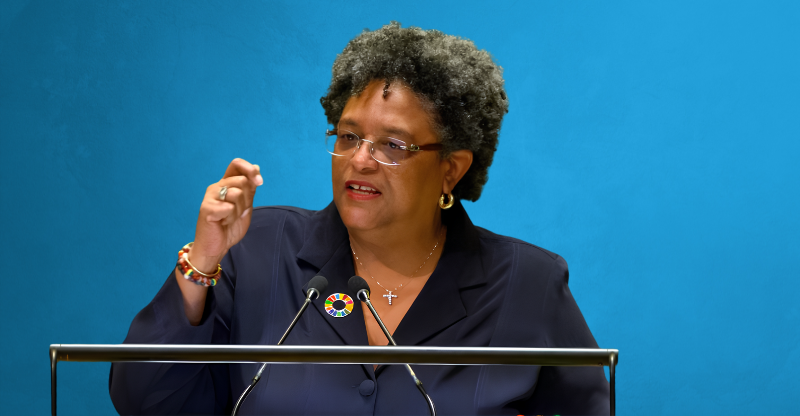
Prime Minister Mia Mottley (Photo Credit: FP) A technical committee of historians and economists is to quantify Barbados’ compensation claim for more than two centuries of slavery, Prime Minister Mia Mottley announced on Friday, urging Caribbean governments to strengthen the global campaign for reparatory justice. Delegates at the CARICOM Conference on Reparations. (Photo Credit: Emmanuel Joseph) Appearing on a high-level panel during the opening dialogue of the CARICOM Regional Conference on Reparations, entitled The Global Reparatory Justice Movement: Charting the Way Forward at the Wyndham Resort Sam Lord’s Castle, Mottley said Barbados would need strong evidence in order to present a strong reparations case. “I will be appointing a technical committee of historians and economists to do the research so that Barbados’ specific case can be quantified in accordance with what we have seen and experienced,” she said. The Prime Minister also suggested that most other countries should follow suit. She insisted that governments should demonstrate the moral leadership required to make the reparatory movement effective, contending that where there is a will, there is a way. “To that extent, therefore, we need to stop being just advocates of a movement, and become advocates of a case,” Mottley added. You Might Be Interested In She was adamant that all concerned must work to amplify the work already done by the various reparatory groups and the CARICOM Reparatory Commission, which met earlier this week. The Prime Minister urged countries to have the moral fortitude to agree on the way forward, and not to frustrate efforts to reach a common accord by trying to agree on every single element. “We cannot let this moment pass,” Mottley stated. While acknowledging that the reparatory movement started at grassroots level, the Prime Minister expressed concern about what she described as indifference in the Caribbean and Africa as seen by the number of grassroots people involved in the movement. Mottley sought to underscore the power of the people in making the reparatory justice movement and its outcome successful. “We need to start a global petition over the course of a six-month or 12-month period to get as many signatures from around the world as possible. We need to show the power of the people.” She argued that the evidence for reparatory justice is there for all to see, but what was missing was the will to move the case forward. Mottley also insisted on the need to ramp up the CARICOM case for reparations, arguing that too many distractions are emerging across the globe in conversations that could negatively affect all the work already done and about to be done. Pointing to the attitude of some countries towards the need for reparatory justice, Mottley said there is too much hypocrisy among them. Rather than do the right thing, these countries adopt the convenient approach, she said. The Prime Minister contended that, in the same way some would tell their children to do the right thing, leaders themselves take the route of “do as I say but not as I do”. “I believe we now have to move to a stage with clarity of the evidence and a common strategy.” She noted that in the same way the British government could repay its slave owners almost £20m in 1834 — $200bn in today’s money — CARICOM should not have any difficulty sharing the bounty across generations of Caribbean people. “The problem that I have is the power structures in Britain and Europe, even those outside the government, have made it clear they do not want to participate because the mentality is clearly one that wants to continue the exploitation and the degradation.” Declaring that the Black Lives Matter movement in the US gave impetus to the reparations campaign, Mottley insisted that no more lives should be lost as ordinary people go about their regular business. She declared that the world needs a moral centre to be able to face many of the crises currently being experienced, lamenting that the Caribbean was suffering and still paying for the economic and climatic perils it did not create. (EJ)
PM urges govts: Turn reparations advocacy into action
Full Article
Original Source
Read the full article at Barbadostoday →KhanList aggregates and links to publicly available news content. We do not host full articles from third-party sources. Always verify important information with original sources.