
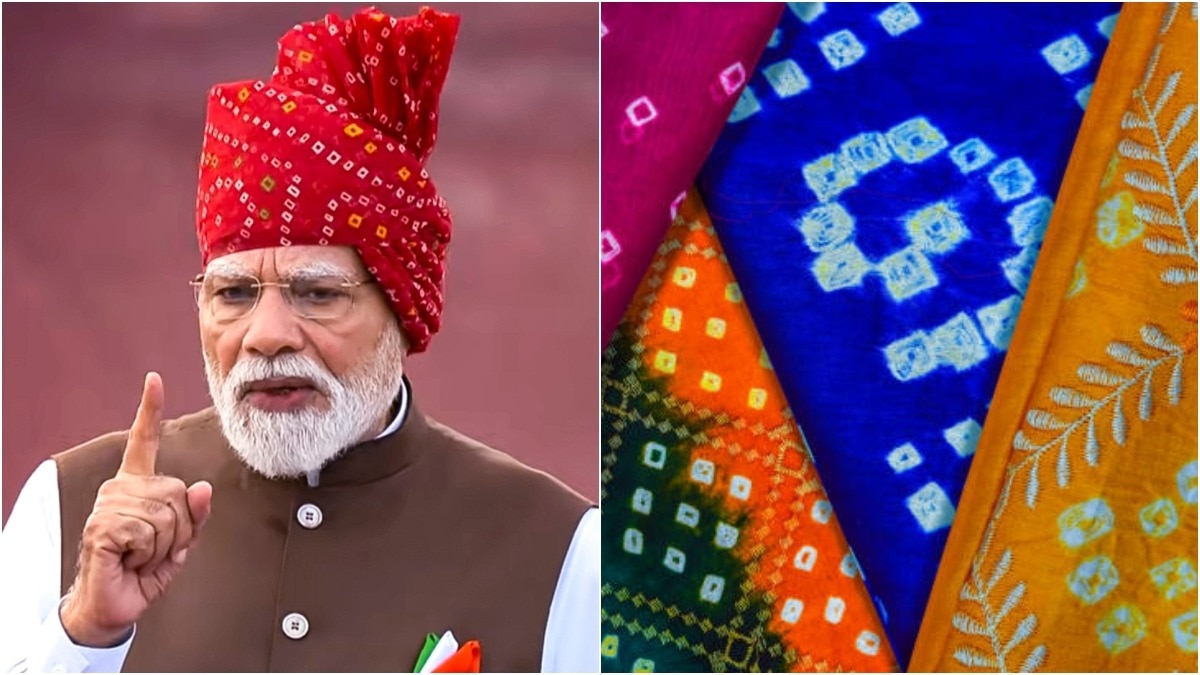
PM Modi's Bandhani safa at the Red Fort may be a familiar Independence Day style statement, but the dotted textile has a rich history. From Gujarat's artisans and royal wardrobes to weddings and regional identity. Bandhani is a textile steeped in history, identity and symbolism. (Photo: PTI/Getty Images)To address the nation on India’s 80th Independence Day, Prime Minister Narendra Modi appeared at the Red Fort in a maroon Bandhani safa, its yellow-and-white dotted pattern standing out against a white kurta-pyjama and brown Nehru jacket. It was another addition to his now-familiar Independence Day tradition of using his headgear to bring a distinctly Indian textile or regional style to the national stage.But Bandhani is far older than its latest appearance at the Red Fort. PM Narendra Modi addressing the country from Red Fort on Independence Day. (Photo: PTI) Look closely at the fabric and those tiny dots are not printed on it. They are made by tying the cloth before it is dyed. An artisan picks up tiny portions of fabric, ties them tightly with thread and then dips the cloth into dye. The tied sections resist the colour, leaving behind the little dots and patterns that have come to define Bandhani.It is an incredibly simple idea. And if you remember carefully, many of you might have learnt the technique at school during art and craft sessions. And behind those dots is a history that stretches across centuries, from the textile traditions of western India to weddings, community identity and royal wardrobes.The meaning and rootsBandhani, also called Bandhej or Bandhni in different regions — belongs to India's long tradition of resist dyeing. The name is linked to the Sanskrit root bandh, meaning to tie or bind. In Gujarat, the craft is commonly known as Bandhej, while Bandhani or Bandhini is widely used in Rajasthan and Madhya Pradesh. The basic process sounds almost childishly simple: tie the fabric, dye it, untie it. The skill lies in everything between those three steps.The artisan has to pick up tiny portions of the fabric and tie them tightly enough to prevent the dye from reaching them. Thousands of these tiny interventions can go into one piece. The patterns and designs vary based on the way the fabric is tied and dyed, allowing endless creative possibilities. (Photo: Getty Images) Government craft sources trace Bandhani back to the Indus Valley civilisation, with one official handicrafts source dating it to around 4000 BC. It also points to speckled textiles depicted in Ajanta paintings and a reference in Harshacharita, the 7th-century work by Banabhatta.But saying “Bandhani is 5,000 years old” as an established, uninterrupted fact would be too neat. What we can say with greater confidence is that India has a very old tradition of tie-dyeing and patterned textiles. Paintings at Ajanta, dating from roughly the 2nd to 5th centuries AD, show figures wearing speckled textiles that have been cited as evidence of early tie-and-dye traditions.The Bandhani we know today developed through later regional craft traditions. And two places became particularly important to its story: Gujarat and Rajasthan.Gujarat's Khatris and the rise of BandhaniIn Gujarat, Bandhani became closely associated with the Khatri community, whose artisans played a major role in developing and passing down the craft. The Ministry of Textiles says Khatris introduced Bandhani to Kutch in the 12th century, where it subsequently became an important craft and eventually an export product.Today, Jamnagar and Kutch remain major Bandhani centres.Jamnagari Bandhani even has a Geographical Indication (GI) registration, with Jamnagar identified as the main production centre in Saurashtra and Bandhani also produced across Kutch. The fabric itself can vary too. Traditional Bandhani has been made on cotton, silk and other fabrics, with natural dyes historically used before chemical dyes became widespread.Some versions are made up of tiny dots. Others create flowers, geometric shapes or more elaborate motifs. Rajasthan also has related tie-dye traditions such as Leheriya, where the fabric is manipulated to create flowing, wave-like stripes.From the sarees to the turbanAnd Bandhani was never restricted to sarees. It has traditionally been used for odhnis, ghagras, head coverings and turbans. That makes PM Modi's Bandhani safa an interesting continuation of a much older relationship between the textile and headgear in western India.And interestingly, it was a major part of the royal wardrobe as well (and continues to be) and there are documented proofs of it. One photo shows Maharani Gayatri Devi, the third Maharani consort of Jaipur, in a pink bandhani saree. If you know even a little about her, you will know that besides being a royal icon and a pioneering politician, she was a global fashion figure.Rajasthan developed a rich vocabulary of turbans and safas, with different communities and occasions having their own ways of tying and wearing them. Bandhani became one of the fabrics used to make these head coverings particularly striking.Which brings us back to Red Fort.PM Modi's safa is not just a brightly coloured turban with dots on it. It draws on a textile tradition in which colour, pattern, fabric and the way something is worn, have long carried cultural meaning.- EndsPublished By: Jigyasa SahayPublished On: Aug 15, 2026 08:56 IST
PM Modi's Bandhani safa and the centuries-old craft behind it
Full Article
Original Source
Read the full article at Indiatoday →KhanList aggregates and links to publicly available news content. We do not host full articles from third-party sources. Always verify important information with original sources.