
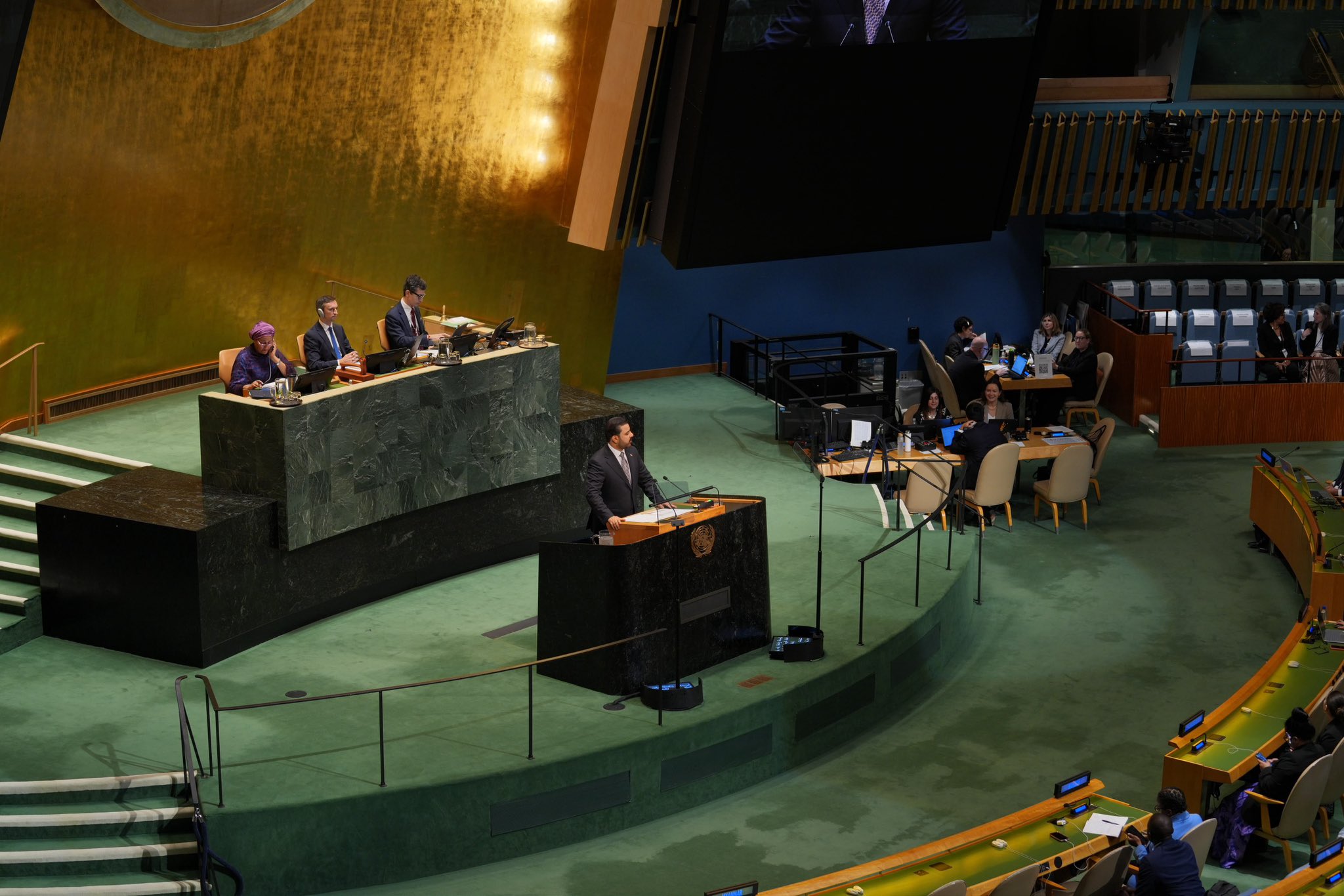
Baghdad (IraqiNews.com) – Iraqi Prime Minister Ali Falih Al-Zaidi delivered a wide-ranging policy address before the 81st Session of the United Nations General Assembly in New York, presenting Baghdad’s strategic vision for national sovereignty, economic restructuring, and regional stability. Reaffirming Iraq’s adherence to the principles of the United Nations Charter, Al-Zaidi framed the nation as an ascending economic force and an essential bridge for multilateral dialogue and cooperative diplomacy. He declared that the country’s immediate priorities stem from a decisive national will to restore the prestige of the rule of law, consolidate constitutional governance, and rebuild public confidence in sovereign state institutions. Addressing the nation’s security architecture, the Prime Minister emphasized that the federal government holds the exclusive authority to determine matters of peace and war, asserting that all arms and instruments of legitimate force must remain strictly confined to the command of constitutional institutions. Al-Zaidi underscored that current executive and regulatory enforcement measures are rooted in statutory mandates and supreme national interest, aimed at defending territorial integrity, consolidating security gains, and establishing the stable environment required to support sustainable socio-economic development and incoming international investments. Highlighting a pivotal sovereign transition, Al-Zaidi noted that the conclusion of the U.S.-led International Coalition’s mission in Iraq marks a strategic evolution in Baghdad’s foreign partnerships, pivoting defense-centric alignments toward multifaceted economic and developmental cooperation. He stressed that Iraqi forces have built the requisite autonomous military and intelligence capabilities to defend the nation’s borders, land, and people in the post-defeat era of terrorism. To sustain this regional equilibrium, the Prime Minister called on international partners and neighboring states to enforce rigorous border management, eliminate security gaps, and maintain constant counter-extremism coordination. Turning to economic governance, Al-Zaidi outlined Iraq’s ongoing campaign against administrative and financial corruption, identifying the recovery and safeguarding of public funds as an indispensable pillar of institutional reform. He articulated an ambitious modernization agenda designed to transition Iraq away from the vulnerabilities of a rentier economy toward a dynamic, open-market framework integrated with global digital and technological systems. To realize this transition, the federal government has established legal, tax, and customs incentives aimed at empowering private enterprises, attracting foreign direct investment, and leveraging Iraq’s strategic geographical crossroads to expand commercial flows. In the energy sector, the Prime Minister reaffirmed comprehensive plans to boost crude oil production, capture and process natural gas reserves, and scale up refining capacities alongside downstream petrochemical industries, aiming to cement Iraq’s standing as a dependable global energy supplier. Al-Zaidi voiced grave concern regarding disruptions to freedom of navigation and commercial shipping routes that have triggered sharp increases in global energy prices. To insulate national revenues and reinforce global market stability, he confirmed that Baghdad is actively advancing strategic pipeline corridors linking Iraq with Turkey, Jordan, and Syria to diversify crude export outlets away from maritime chokepoints. Concluding his address, the Prime Minister presented Iraq’s multibillion-dollar Development Road project as an overarching blueprint for regional integration, characterizing the multimodal transit corridor as a vital artery connecting East and West through trade, logistics, industry, and energy networks. Finally, Al-Zaidi invited neighboring states and global investment partners to participate directly in the transit corridor, reiterating Iraq’s conviction that shared economic interests, reciprocal trade ties, and cross-border infrastructure constitute the most durable foundation for lasting regional peace and prosperity.
PM Al-Zaidi asserts state monopoly on arms and outlines economic vision at UNGA81
Full Article
Original Source
Read the full article at Iraqinews →KhanList aggregates and links to publicly available news content. We do not host full articles from third-party sources. Always verify important information with original sources.