
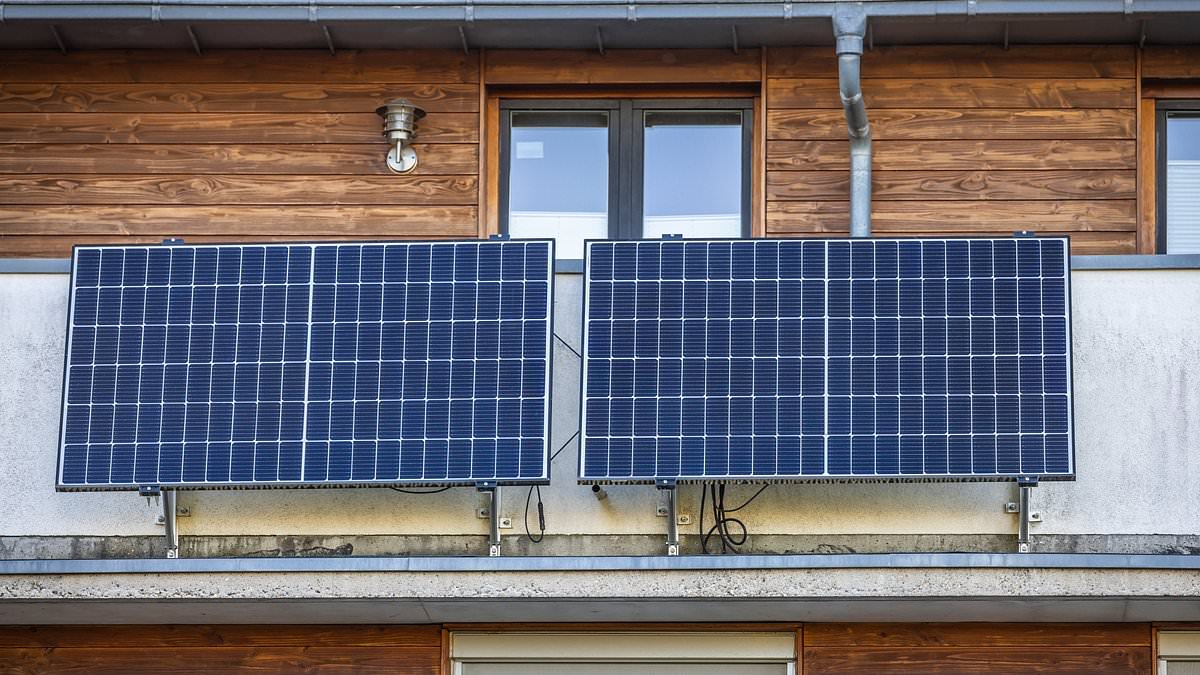
Plug-in solar panels could soon hit British shops, as the energy-saving devices can be legally sold from next week.The panels, a smaller, cheaper and more portable version of traditional solar panels, have not been allowed in Britain to date because of safety regulations. New rules allowing their sale come into force on August 27, and retailers including B&Q and Lidl are understood to be preparing to stock plug-in solar panels over the coming months. Plug-in solar panels are expected to cost between £400 to £600 per panel, and according to government estimates could save households between £70 and £110 per year on energy bills. A spokesman for the Department for Energy Security & Net Zero told This is Money the panels 'Will be available to buy this summer'.But before rushing out to buy them, Britons should be aware that solar panels might not be suitable for all homes. If installed in the wrong property, they could even cause homeowners to lose money. This is Money outlines the mistakes to avoid when buying and installing plug-in solar panels. Ready for solar? Plug-in solar panels are expected to hit shops across Britain soon1. Not having enough sunshineThe government says a well-positioned, south-facing 800W plug-in solar panel system could save households around £110 a year on energy bills. For west-facing or east-facing setups, the savings are expected to be lower at about £70 a year. George Penny, solar panel expert and director of solar panel firm The Solar Co, said: 'For an estimated 6.2million Britons that have a north-facing garden, generating enough electricity to pay back the cost of the system may prove difficult.'He suggests using a smartphone's compass app to check which direction the panels would be facing. Before buying, households can also use free online tools such as SunCalc to check how much sunlight their garden or balcony gets throughout the year. Penny added: 'A compass reading close to 180° means the space is south-facing, while around 90° is east and 270° is west. Homeowners should also check for shade from trees, neighbouring buildings or balcony structures, as this can significantly reduce generation.'The size of the solar panels will also make a difference. The bigger the kit, the more energy it will produce. 2. Drilling through your neighbour's fencePlug-in solar panels can be mounted onto a variety of structures such as walls, fences and balconies. They are anticipated to be popular in flats, where residents can't install panels on the roof. If looking to install on a garden fence, it's important to check who owns it before drilling into it or attaching mounting equipment. Penny said: 'If the fence belongs to your neighbour, you should get their permission before making alterations. Solar panels can also add extra weight and wind pressure, potentially damaging an unsuitable fence.'Replacing individual fence panels can cost around £20 to £240 before labour, while longer fence replacements can run into four figures. 'If your installation damages a neighbour's property, you could be asked to remove the panels and pay for the repairs.'Renters who want to drill into a fence or wall to install plug-in solar panels should check the terms of their lease and inform their landlord if required, while leaseholders may need permission from the freeholder. 3. Voiding your home insurance According to the government's advice on plug-in solar panels, they must not be installed on timber balconies or timber cladding due to the risk of fire. Installing plug-in solar panels somewhere which is prohibited on fire-safety grounds could render your home insurance void if something goes wrong. Penny said: 'Depending on the policy an insurer could challenge a claim linked to an undeclared or non-compliant installation. 'Check your balcony material and speak to your insurer, landlord or freeholder before attaching panels if you are unsure.'4. Getting in trouble with your landlordThe legislation for domestic plug-in solar panels does not automatically override a tenancy agreement. Renting tenants should obtain written permission before attaching plug-in solar panels to a balcony, wall, fence or other part of the property.Penny said: 'Without permission, tenants could be charged for removing the system or repairing damage at the end of their tenancy.'In England, tenancy deposits can commonly be worth up to five weeks' rent. A landlord cannot automatically keep the whole amount, but evidenced repair costs resulting from an unauthorised installation could be deducted.'The government has said it is working to ensure there is clear guidance on what tenants can and cannot do. 5. Not getting your wiring checkedIf you install plug-in solar panels, you are introducing a new source of electricity into your home meaning there are additional electrical and fire risks to consider. It is important to check that it is safe to use plug-in solar panels at your home before doing so. There are many older homes in Britain, which may have old wiring, worn parts or DIY alterations that could make using solar panels unsafe. The Institution of Engineering and Technology has recommended getting wiring professionally checked before installing plug-in solar panels. Options: Lidl is one of the shops expected to sell plug-in solar panels You can get an Electrical Installation Condition Report from a qualified electrician to check the health and safety of your electrics. Make it clear to the expert that you are considering installing plug-in solar panels, as this may affect any recommended updates. These reports typically cost between £100 to £250 according to Checkatrade, which will add to the length of time before the panels pay for themselves. 6. Adding a useless battery Battery storage can help households with traditional, roof-mounted solar panels save more money by storing the electricity they generate for use later. However, the new plug-in solar rules only cover solar systems without batteries.Penny said: 'Consumers should not assume they can simply connect a plug-in battery alongside their new panels. 'Doing so could take the system outside the approved safety framework and may also create insurance issues if a non-compliant setup causes damage.'For now, plug-in solar owners should aim to use as much of the electricity as possible while their panels are generating.'7. Choosing solar ahead of a cheaper energy tariff Solar power isn't the only way to save money on your bills. Given that the power plug-in panels generate will be less than a traditional solar set-up, some households might save more if they switched to a tariff which rewards using energy at off-peak hours. Such tariffs include Economy 7, which offers cheaper energy between the hours of 12am and 7am. Penny gives the following example of how much it could cost to run a typical washing machine cycle. 'If on a sunny day a plug-in solar panel covered half of a typical 0.7kWh wash, the remaining grid electricity would cost around 9p at the current Ofgem standard variable rate of 26.11p/kWh. 'The same wash on a 7p/kWh overnight tariff, such as Economy 7 or Economy 10 tariffs, would cost nearly half that at 5p.'Given the unpredictability of British weather, many plug-in solar arrays may struggle to consistently create enough energy to make energy-guzzling appliances cheaper to run, means it is likely that the cheapest options for households would be to switch to an overnight energy tariff and run appliances between 12am and 7am.'8. Being out a lot during the dayAs plug-in solar panels won't be able to utilise battery storage, those who use more power during the daytime when the panel is generating will make maximum savings.Any surplus that the household cannot use will flow back into the grid. Those with traditional solar panels are often paid for this surplus power, but we don't know if this will be possible for portable panels or how it would work. Penny said: 'Homeworkers, retirees and families regularly using electricity during daylight hours may therefore benefit most.'Commuters whose homes are empty throughout the day could take longer to recover the system's cost, particularly if most of their electricity use takes place after sunset.'9. Not informing your network operatorIf you know you can safely install plug-in solar panels in an unshaded area outside your home, the next step is to install them properly. You will probably need to attach the solar panels to a mounting bracket and connect the microinverter. If mounting on a wall or balcony railing, extra steps may include securing the bracket or drilling holes. If installing the plug-in solar panels yourself, follow the manufacturer's safety guidance carefully.Once installed, you will need to let your electricity Distribution Network Operator (DNO) know within 28 days of connecting the panels. This is the company that owns local energy infrastructure such as cables, transformers and substations. You can find out who your DNO is for free via the Energy Networks Association website. It is understood that the Government plans to launch a central registration website when plug-in solar becomes available from August 27. No details of the website have been published yet. Best mortgage rates and how to find them Mortgage rates have shot up again due to inflation triggered by the conflict with Iran reversing hopes that the Bank of England would cut rates. This means those remortgaging or buying a home face higher costs.That makes it even more important to search out the best possible rate for you and get good mortgage advice, whether you are a first-time buyer, home owner or buy-to-let landlord.This is Money's partner L&C can help you with its fee-free mortgage service.> Compare mortgage rates> Find the right mortgage for you To help our readers find the best mortgage, This is Money has partnered with the UK's leading fee-free broker L&C.This is Money and L&C's mortgage calculator can let you compare deals to see which ones suit your home's value and level of deposit.You can compare fixed rate lengths, from two-year fixes, to five-year fixes and ten-year fixes.If you’re ready to find your next mortgage, why not use This is Money and L&C’s online Mortgage Finder. It will search 1,000’s of deals from more than 90 different lenders to discover the best deal for you.> Find your best mortgage deal with This is Money and L&C Mortgage service provided by London & Country Mortgages (L&C), which is authorised and regulated by the Financial Conduct Authority (registered number: 143002). The FCA does not regulate most Buy to Let mortgages. Your home or property may be repossessed if you do not keep up repayments on your mortgage.
Plug-in solar panels can be sold from next week: Nine mistakes to avoid if you want to install them
Full Article
Original Source
Read the full article at Dailymail →KhanList aggregates and links to publicly available news content. We do not host full articles from third-party sources. Always verify important information with original sources.