
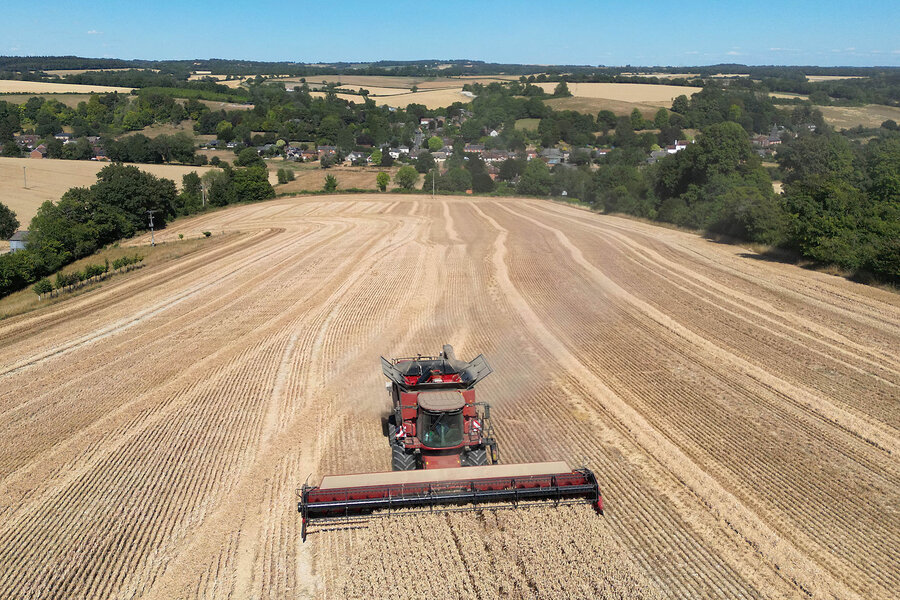
In this southeast corner of England, farmer Andrew Barr surveys his fields, wondering what on earth to plant next. There’s one factor that he and thousands of others are finding it increasingly difficult to work with: a lack of summer rain.The county of Kent, about 50 miles southeast of London, is known as the Garden of England. For most of the summer, though, it looked more like a dust bowl after one of the driest seasons ever recorded in the United Kingdom.Field after exhausted field on his 750-acre East Lenham farm languished under a furnace sky for weeks on end, grilled yellow like French toast. With no significant rain for more than 40 days, the harvest was deeply disappointing. Why We Wrote This Farmers across Europe are trying to adapt to hotter summer temperatures and less rainfall. Changing the crops they sow and storing more water over the winter could be part of the solution. “It drives you a bit mad sometimes because it is something you can’t do anything about,” says Mr. Barr. “At one time, just growing good crops or raising livestock – you made money. But that’s no longer the case.”Repeated hot, dry summers are forcing farmers and governments to think differently about how to respond to what appears to be a new normal. Much of mainland Europe has endured its hottest, driest summer in living memory.“It is all about water management”“This was the year that climate change shifted from being an abstract statistical problem to a disruptive presence in everyday life,” says Samantha Burgess, senior climate scientist at the European Centre for Medium-Range Weather Forecasts.She ticks off the impacts on society: schools closed, rails buckled, widespread wildfires, water usage restricted, nuclear reactors switched off – and people told not to go outside.“The physics are very clear,” she adds. “Heat waves will continue to get more intense and more persistent.” A person runs near the Elizabeth Tower – more commonly known as Big Ben – and the Houses of Parliament, during near-drought conditions in many parts of the United Kingdom, July 29, 2026. Mr. Barr’s family has run this place since his great-grandfather migrated south from Scotland in 1903. You get the sense that it’s never been harder.His wheat yields this year were 15% lower than normal. Spring crops were even worse. The harvest was done and dusted (literally) by July 27 – a month earlier than usual.Now, he and many farmers like him are trying to innovate to adapt to the dry summer conditions. He’s already breeding hybrid wheat types that may perform better in such weather, but says that crop innovation and gene editing is no quick fix. “If you find something in a wild race of wheat that you want in a commercial operation, it’ll take 30 years to get the genes right,” he says.A much quicker fix could be creating more capacity to store water at wetter times of the year.“It is all about water management,” says Jim Monaghan, a professor of crop science at Harper Adams, a British university. Noting that climate change is also bringing wetter winters, he adds: “We need to capture the water that lands, store it effectively, and use it efficiently.”That is certainly the case on Mr. Barr’s farm. A reservoir of rainwater would make a difference, particularly to spring crops like barley and beans, which had a wretched time of it this year.“The situation is crying out for reservoirs on farms,” says Mr. Barr. “We are getting more winter rainfall, we’re just not getting it in the summer.”Unfortunately, he says, the red tape involved – for planning, licensing, and monitoring – would cost a hefty five-figure sum.“That makes it too much of a risk for us,” he concludes.Attitudes will need to shiftDuring the worst of the drought, the U.K. government signaled that help may be on the way. Prime Minister Andy Burnham chaired an emergency meeting and announced a £65 million ($88 million) package with promises that building reservoirs on farms will be made easier. At his East Lenham farm in southeast England, farmer Andrew Barr reports a harvest down by 15% to 20% compared with normal years, because of a prolonged heat wave and drought. But farmers are unsure how much difference it will make.“They are talking about reservoirs, so a farm can irrigate over summer months, and for the livestock sector ... harvesting rainwater for the animals,” says Stephen Dennis, a sheep farmer and regional manager in the Farming Community Network, an agrarian charity.“There is the potential here for this to be beneficial,” he says. “But it won’t make grass grow in very dry periods.”For public water supplies, the government wants to build nine major new reservoirs, the first in more than three decades, though these will take years to come on stream.If heat and drought are to become the new normal in Britain, then attitudes will need to shift. This is a country used to grumbling about too much rain. Now it is coming to understand what happens when there is too little.In a key document published last year, the Environment Agency, a U.K. government body, said: “Never have so many people and so many sectors critical to the functioning of society placed such a demand on our water resources, at a time when nature and the environment are reliant on that water to cope with a changing climate.”It added that water companies needed to reduce water leakages, estimated at around 2.8 billion liters every day, and drive more efficient use by households and businesses. “In tandem, they must develop new supply options such as water recycling, desalination and new reservoirs,” the document added.Without urgent action, public water systems will face critical shortages in the future, it has warned.“Very few farms won’t have diversified”Farmers say society is just catching up with what they have known for years.“It all comes back to water,” says Nigel Skinner, a farmer who has spent almost his entire life on a 300-acre family farm in the southwest of England. “If you have another year exactly the same as this one, there will be serious problems.” Cattle farmer Sam Squier herds his Aberdeen Angus cows on a green pasture at Humphreys Farm in Great Waltham, Chelmsford, Britain, Aug. 11, 2026. The farmer has made his 200-acre beef farm more resilient to drought through regenerative farming practices, such as planting herbal leas and using mob grazing to improve water retention and soil health. He argues that it’s not just farmers who need to innovate for the dryer conditions. “There isn’t the water storage capacity for the population that we have,” he says. “The population has grown hugely in the last 30 years, and there is such demand on water.”Professor Monaghan, from Harper Adams, agrees, saying that as far as solutions are concerned, the short-term fix is water management; the medium-term is adopting plant varieties that are known to perform better in drier weather; and the long-term answers are big water infrastructure projects and precision breeding of crops.In the meantime, many farmers like Mr. Barr are doing something that makes sense from a business point of view – but not for food security: diversifying away from producing food.He already has a solar farm on 40 acres of land, and gets paid through government grants for turning other land back to nature. He is considering growing drought-hardy crops for an anaerobic digester – essentially, an energy producer.Mr. Barr has also rented out several farm buildings to furniture restorers and other companies needing warehouse space, providing around a quarter of his annual income.Other farms rent cottages to tourists and fields to dog trainers or even music festivals. “Very few farms won’t have diversified in some ways, converting barns into holiday lets, things like that,” says Mr. Dennis.For his part, Mr. Barr says he wants to keep his farm, but it strikes him that life might be a lot easier if he retraced his great-grandfather’s footsteps from 125 years ago.“There are reasons I should move back to Scotland now,” he muses.“Scotland still gets subsidies. And rain.”
Plowing a new furrow: Europe’s farmers try to adapt to drier summers
Full Article
Original Source
Read the full article at Csmonitor →KhanList aggregates and links to publicly available news content. We do not host full articles from third-party sources. Always verify important information with original sources.