
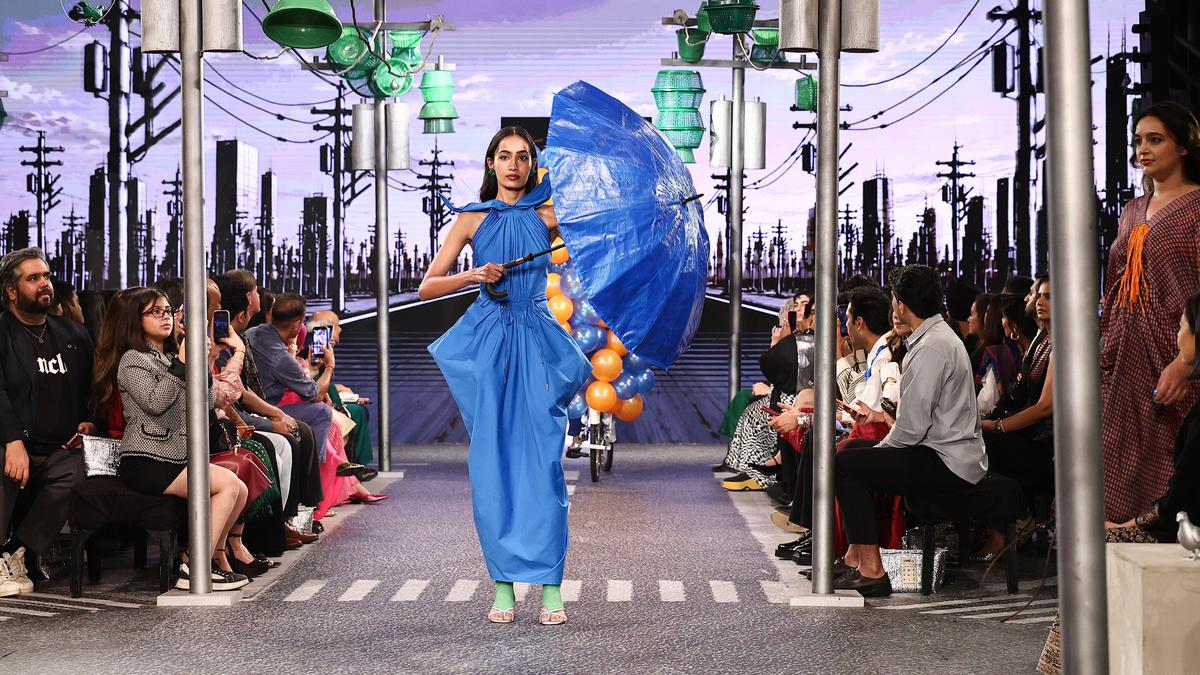
There were 35-odd designers this season, but the clothes I kept thinking about after Lakmé Fashion Week x FDCI ended on Sunday in New Delhi began with things most people would overlook. A 150-year-old swatch of silk from a friend’s grandmother. A polymer mat from a studio floor. Threads swept up after cutting. Denim marbled to look worn. And the kiss-lock clasp of an old coin purse. Here is what five designers made of them.Amit Aggarwal: The polymer matAggarwal first came across polymer in a scrap factory. This time, however, he found it on the floor of his Noida studio, in the polypropylene chattais the women there sit on while they work. The mat’s patterns turned up on totes, skirts, bibs, cummerbunds and dresses when he closed Fashion Week on Sunday (October 18).His runway was a crossroads, lane markings and all, with green plastic colanders hung from lamp posts and signs that said ‘Keep Going’, ‘Hug!’ and ‘No Stress’. One said ‘Lakmé 5-9’, which rather summed up the collection. On a Day Like Today, for his ready-to-wear label AM:IT, is about what people wear after work. So, models crossed in every direction — one pushing a pram, another wheeling an ice-cream cart. An autorickshaw nosed its way through. A man looking at his phone walked into another model, as happens in cities every day. Models wear designs from Amit Aggarwal’s On a Day Like Today | Photo Credit: Courtesy FDCI x Lakme Fashion Week Aggarwal calls himself an RTW designer first, though the couturier in him had other ideas. For the collection, he pulled the mats apart and rewove them into patterns reminiscent of ikat. He then 3D-printed the same patterns in polymer onto the mesh before weaving them by hand. On the totes, the stripes kept going past the edge, as fringe. That’s the kind of trouble only a couturier would take with a floor mat. Amit Aggarwal with actor Aneet Padda at the LFW x FDCI finale | Photo Credit: Courtesy FDCI x Lakme Fashion Week From there, he said, the mats’ geometry turned into stripes and gingham. At the show, the stripes on the clothes showed up in the stripes on the street: the zebra crossing, the ice-cream cart, the pram, the bucket hats. The best piece was a trench cut from blue tarpaulin, the kind that covers half-built houses. Its pockets were finished in his signature black and white concentric lines, like ripples. He used the same lines on a handbag shaped like the yoke of a shirt. Add a tarpaulin backpack and a bag twisted shut like a toffee, and some of the most desirable things from the Week were an old polymer mat and a tarp.TIL by Ankur Verma: The floor scrapsMy attention first went to the shoes. Verma makes them out of whatever is left on the workroom floor: threads, katrans (leftover fabric scraps), lace and buttons. The threads form mossy textures on wedges first made for TIL’s 2024 show, repainted each season. “Nothing is really finished,” Verma said. His new collection, Still Becoming, treated ageing as a record of growth. Freckles, wrinkles, scars and pigmentation found expression here through thread. Remnants are layered, quilted, appliquéd and embroidered into what the label calls “textile terrariums”. Models sporting designs from Still Becoming | Photo Credit: Courtesy FDCI x Lakme Fashion Week The Belgian interior designer and stylist Isla Maria “Loulou” Van Damme opened the show in a sheer embroidered slip and a fringed wrap as thick as a rug. Her face, lined and freckled, made the case for the collection better than the show notes did. Interior designer and stylist Isla Maria “Loulou” Van Damme | Photo Credit: Courtesy FDCI x Lakme Fashion Week Ankur Verma | Photo Credit: Special arrangement There was a cropped jacket and long skirt, beaded to look like a forest floor after the monsoon, all lichen and pebbles. A trouser suit came printed the colour of a bonfire, worn with sandals crusted in balls of rolled-up scraps. A tunic was covered in wrapped beads, like spools in a tailor’s drawer. As separates, the pieces stood alone. The hoodies, gender-fluid and easy, carried all that texture into something you could wear on a regular day. One model held a glass terrarium planted with thread moss, in case anyone missed the point.Countrymade by Sushant Abrol: The marbled denimAbrol called his collection Material Memory. He opened with a shirt-jacket and wide trousers in pale marbled denim. Up close, at his stall, the denim had the soft, broken-in weight of something washed a hundred times. Under the jacket, a blue shirt with a slim line of beading down the placket and along the collar. It was the kind of detail you noticed only when you drew near.Material Memory from Countrymade by Sushant Abrol | Photo Credit: Courtesy FDCI x Lakme Fashion Week Sushant Abrol | Photo Credit: Courtesy FDCI x Lakme Fashion Week The film for the collection was also about the material. There were no models. In an empty white studio, two puppeteers worked the garments on strings, like marionettes. The clothes acted like people. An indigo jacket slumped over a chair. The marbled jacket laid a sleeve on the shoulder of a rust overshirt. It was whimsical and, on screen, it was almost moving.Namza by Padma Yangchan: The grandmother’s swatch‘The Fifth Season: A Fashion Story from Ladakh’, the Union Territory’s showcase with FDCI, arrived as a government brief: promote Pashmina, at two weeks’ notice. But Yangchan didn’t scramble. Namza Couture works on its own calendar: one collection a year, unconcerned with forecasts. Its latest, Gyal Yul, which means kingdom, was already done. The label’s Pashmina is made entirely in-house, from raw fibre to dyed cloth, the colours coaxed from walnut husk, marigold, rhubarb and onion skin. “We don’t use any chemical dyes,” said Yangchan. Padma Yangchan | Photo Credit: Special arrangement One look was a traditional mogos (long robe), the Ladakhi goncha, in purple silk, small motifs scattered across its surface, copied from a 150-year-old swatch belonging to a friend’s grandmother, and rewoven in Banaras. It wrapped across the body and tied at the side, over rust trousers. The collar and sash were in rust, a counterpoint to the purple. Draped over the shoulder was a bok, the cape Ladakhi women wear over their robes, here in yellow-gold gyasar brocade woven with pure zari and peacock feather. A crane, a bird Ladakh holds dear, perched at the top, wings open. At the centre, a protective mask with red tassels. Near the hem, above a thick gold fringe, ran the takri churi bands: mountains, clouds, water, a pattern once reserved for royals. The traditional mogos | Photo Credit: Courtesy FDCI x Lakme Fashion Week Brocades like this came into Ladakh along the Silk Road from Xinjiang and Tibet; when the road closed, Banaras took over the weaving. The music came from traditional instruments, the kopong, a six-string lute, among them. For a few minutes, the forgotten kingdom seemed to walk the runway, present, then gone.Siddhartha Bansal: The patterns from aboveBansal has always flirted with excess, one pattern stacked over another, sometimes exuberant, sometimes incoherent. Sonam Kapoor Ahuja wore his rust chintz and geometric bandhgala at actor Arjun Kapoor’s sister Anshula’s wedding in 2025, a case study in maximalist risk. Sonam Kapoor Ahuja in a Siddhartha Bansal rust chintz and geometric bandhgala | Photo Credit: Aviraj Singh Saluja But his World from Above collection felt edited, purposeful. Bansal cited centuries-old Vesara temples and aerial landscapes as starting points, a nod to unity beyond borders. Lofty, maybe, but you could see it in a fitted, mandarin-collared jacket, its purple geometry running down into a bubble-hemmed skirt. His signature kiss-lock clasps, lifted from the old coin purse, framed the pockets, a small piece of punctuation in all that print. A model walks the ramp during Siddhartha Bansal’s show, and (right) a close-up of the designer’s signature kiss-lock clasp | Photo Credit: Courtesy FDCI x Lakme Fashion Week Siddhartha Bansal | Photo Credit: Courtesy FDCI x Lakme Fashion Week Patterns still piled up but stayed within a single colour family. Purple threaded through the show, and for once, the restraint was his own. Shorts and abbreviated hemlines brought a youthfulness his earlier work rarely had.The writer is a columnist and critic, with a keen focus on fashion, textiles, and culture.
Plastic mats to a grandma’s silk swatch: the curious origins of five collections at Fashion Week
Full Article
Original Source
Read the full article at Thehindu →KhanList aggregates and links to publicly available news content. We do not host full articles from third-party sources. Always verify important information with original sources.