
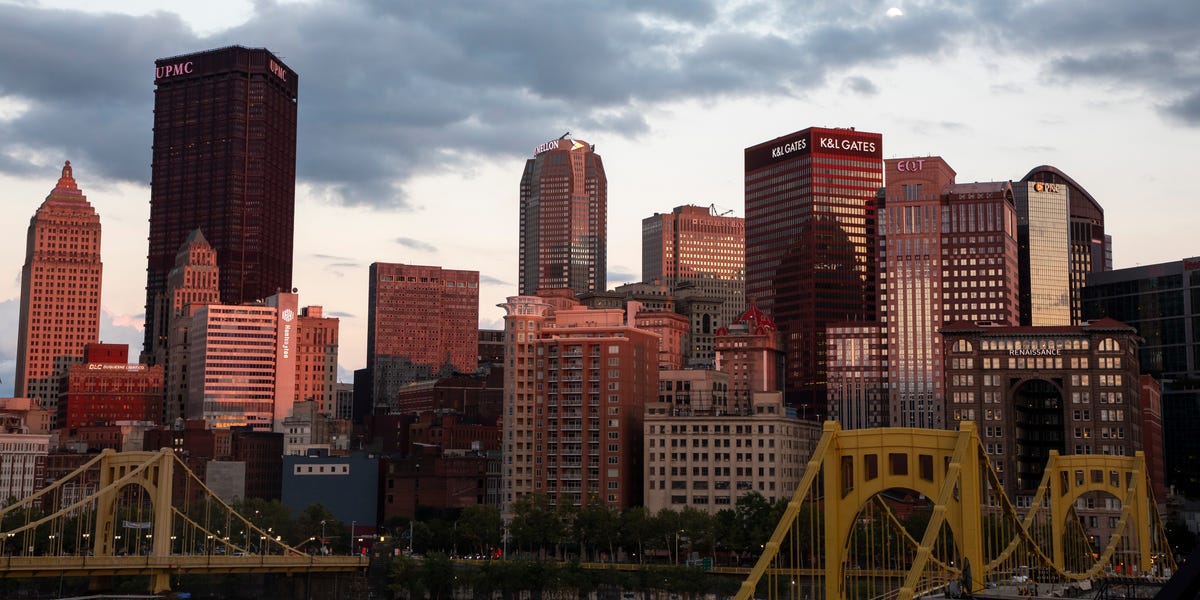
Derek Slagle//Getty Images15 min readIt was a beautiful sunny day this past July when I found myself on an expansive, vibrant green lawn in the last place I ever expected one. I was in Downtown Pittsburgh, sandwiched between the city’s skyscrapers and the neighboring Strip District, an old warehouse neighborhood that has been rebuilt with restaurants, shops, galleries, and food stalls. Where I stood had very recently been a parking lot.Still, it was a perfect place for a park: I wasn’t far from the banks of the Allegheny River, just upstream from where it meets the Monongahela River and the two become the Ohio. If I closed my eyes and threw a ball, odds were it would hit a bridge named for a famous Pittsburgher: the Roberto Clemente Bridge, Andy Warhol Bridge, and Rachel Carson Bridge (known locally as the Three Sisters bridges) all fell within a radius of two city blocks.This vast, friendly green space is called Arts Landing, and I was visiting with Derek Scalzott, a senior director of the Pittsburgh Cultural Trust, one of the top performing arts organizations in the country and the developer of the site. “The new Arts Landing is designed to bring people together more frequently for all kinds of artistic experiences,” he explained as we walked by 23 works of art, downtown’s first playground, and the site of this year’s Dollar Bank Three Rivers Arts Festival, which drew 110,000 visitors. I was incredibly impressed—and surprised. This park? And this arts district? Here?I was born and raised in the Steel City, though I left after graduating from Pitt to pursue a publishing career in New York. When I was a kid, the steel mills were in full force along the rivers, and the Steelers Dynasty was in full swing with four Super Bowl wins. The city was predominantly a blue-collar town, where Iron City beer was the drink of choice, chipped-ham sandwiches from Isaly’s were the staple food, and the local dialect was known as “yinzer.” Pittsburghers still celebrate the unique words and accents, which include dahntahn for downtown and haas for house.It was also a time when, if I would go to the South Side to visit my grandparents, we would pass the huge Jones & Laughlin steel mill, a loud, noisy, black hulk that was once the fourth-largest steel-production facility in the world. In 1868, a writer for The Atlantic Monthly described Pittsburgh as “Hell with the lid taken off.” It wasn’t exactly an insult—the city’s factories exhausted fire and brimstone because they were churning out the raw materials that would build America—but over the years, especially in the 1970s and 1980s, when the city was hit hard by the collapse of the steel industry, the idea of Pittsburgh as a city of industrial might would be gone.That’s the Pittsburgh I remembered, and it’s also the Pittsburgh the Cultural Trust came out of. It was founded in 1984 by, among others, H.J. Heinz II, a scion of one of the most famous local families. It oversees 14 square blocks of downtown, which it has transformed from a burnt-out red-light district to a thriving arts center that includes seven theaters and concert venues; multiple galleries; the Agnes R. Katz Plaza, withits delightfully weird benches; and even a speakeasy for magic shows.But there is a bigger story at work. Arts Landing was part of Governor Josh Shapiro’s $600 million grant to rejuvenate downtown. It also helped to revitalize Market Square, which dates back to the late 1700s, and Point State Park, where the three rivers meet and which has the oldest surviving building in Western Pennsylvania.Even more than that: Pittsburgh is having a moment. The HBO Max medical drama The Pitt, set in one of the city’s hospitals, Allegheny General, is a huge hit. Twenty-five Emmy nominations! The 2026 NFL Draft in Acrisure Stadium drew the largest attendance ever, with more than 750,000 fans over three days (including the largest-ever crowd on day one). The new Mayor, Corey O’Connor, won with 85.5 percent of the vote and is getting rave reviews for some of his innovative ideas. Even the city’s 240-year-old newspaper has a new lease on life—it managed to get itself snatched from the jaws of death to continue to bring quality journalism to its readers.I’ve written travel guides for Esquire before, about Santa Fe and Mendoza, Argentina. This article is kind of a travel guide to Pittsburgh, because when you’re done reading it you’re going to want to go, and you’re going to know at least a dozen things you want to do when you get there. But it’s also something different. I can tell you, as a native son, that many of us never thought that Pittsburgh would become what it has become. There was a time when we all thought Pittsburgh was going to be just another rust-belt city that might not survive. Not only did it survive; it’s thriving. And I wanted to know how it pulled that off.So when I went home in July of this year, I decided to talk to people from every corner of the city to try to find out. I started with another native son, who’d just recently moved back from Los Angeles, a city that’s much more interesting than Pittsburgh. Supposedly.Justin Berl//Getty ImagesNative Pittsburgher Joe Manganiello waves one of the Pittsburgh Steelers’ iconic Terrible Towels.Joe Manganiello, ActorWhen we met for a coffee in Joe Manganiello’s neighborhood, he explained that to be in his business, living in L.A. is no longer necessary. “There isn’t as much film and TV production in L.A. anymore. I was traveling eight months out of the year, and I just didn’t need to be there,” he said. He had just come back from six months in South Africa, where he was shooting the third season of the Netflix series One Piece, and was getting ready for the launch of Bloodlines, his new book, which chronicles his seven-year battle with autoimmune illnesses.“I always loved Pittsburgh and missed it. The people look out for you. They are friendly and aren’t focused on wanting a picture for their Instagram, like in Los Angeles,” he explained, adding that “they treat me like a neighbor.”There’s a long history of Pittsburghers looking out for one another. The city gave rise to the huge fortunes of Andrew Mellon, Henry Clay Frick, Andrew Carnegie, George Westinghouse, and Henry John Heinz. At one point, there were more industrial billionaires per capita here than in almost any city in the world. They invested a lot of money in their home city; the establishment of major nonprofits, from the Hillman Family Foundations to the Heinz Endowments, have made Pittsburgh one of the strongest philanthropic hubs in the country. That money has gone toward, among other things, establishing cultural centers like the Carnegie library and Carnegie Museums group, which includes the Andy Warhol Museum, and funding education, including helping to establish Carnegie Mellon University and the University of Pittsburgh.Now a yinzer once more, having bought a home in Pittsburgh, Manganiello is continuing the tradition to give back. He’s a board member at the University of Pittsburgh Medical Center Children’s Hospital, which is a big deal. Hospitals are huge here; The Pitt isn’t fantasy. Medicine and health care, and the schools that support the industry, have been central to the city’s success—and its largest employer.Ken Gormley, Chancellor, Duquesne UniversityToday there are eight universities in the Greater Pittsburgh area, six of them in the city itself of just over 300,000 people, assembling minds from around the country and the world in medical science, computer science and artificial intelligence, engineering, and the fine arts.Ken Gormley, the former president of Duquesne University who now serves as its chancellor, has been one of the city’s academic leaders. A native, he returned after Harvard Law School because he loved the city and loved its people, who he says are “real, with no pretense” and have a sense of community that he traces back to waves of immigrants who came here for work.“The academic community shares those values. We came together during Covid to learn and care for each other,” he explained. Initiatives that support the well-being of the entire community, like Duquesne’s launch of the Nasuti College of Osteopathic Medicine in 2024, get the support of the city’s other institutions of higher education.Gormley would know: Aside from his leadership at Duquesne, he was once the Chairman of the Pittsburgh Council of Higher Education, a collaborative group of university presidents and their leadership teams who share resources and insights and engage in joint projects. “It’s a testament to the sensibility of Pittsburgh,” he said. “It’s a place where people work together to find the right solutions.”Kevin Dietsch//Getty ImagesDuolingo cofounder Luis von Ahn says Pittsburgh attracts tech-industry talent from more renowned coastal hubs.Luis von Ahn, Cofounder and CEO, Duolingo&John Dick, Founder and CEO, CivicScience“I came to Pittsburgh in 2000 to be a Ph.D. student at Carnegie Mellon and watched the city change dramatically,” said Luis von Ahn, cofounder of Duolingo, who stayed to launch what has now become a global learning company with more than 140 million users across every country in the world. Duolingo is headquartered in what was once a rundown neighborhood, East Liberty. Today the neighborhood also houses offices for a couple other companies you might know, Meta and Google.Tech start-ups like the opinion-research firm CivicScience and robotics companies Gecko and Aurora Robotics also launched here, part of a cohort of companies that have been major players in transforming the city as a magnet for talent.“Our engineers, product designers, and managers come here from California, Boston, New York. The city has a highly educated, interested community of people from all types of backgrounds,” von Ahn explained.CivicScience grew out of an incubator sponsored by Carnegie Mellon, explained its founder and CEO, John Dick. “There are great local resources like Innovation Works and the Pittsburgh Technology Council to support start-ups with everything from seed capital to operational services,” he said. It’s that tight-knit tech community, complete with accelerators, advisors, and mentors across the region, that allows the industry to be such a powerful engine for the city. There is always someone willing to help developing entrepreneurs and young talent.And East Liberty is only one example of a neighborhood transformed. All of the city’s riverfront steel mills are gone, replaced by places like Robotics Row along the Allegheny and Hazelwood Green, a 178-acre technology-innovation hub along the Monongahela. The Jones & Laughlin steel mill of my youth has been leveled and now houses SouthSide Works, an open-air district with parks, new housing, and abundant commercial real estate—as well as the practice facility for the Steelers and Pitt Panthers. Lawrenceville, Bloomfield, the Strip District, South Side, and the North Shore are all old working-class and industrial communities that have been revitalized with new businesses, galleries, housing, and, of course, the thing that’ll keep employees around: restaurants and cafés.Kate Lasky, Cofounder and Chef, Apteka&Tomasz Skowronski, Cofounder and Chef, AptekaThe longtime staples of the Pittsburgh dining scene are places like the Original Oyster House, which has been operating since 1870, and Primanti Bros., famous for serving sandwiches with French fries and coleslaw inside.In fact, while there were a number of other defining local establishments, those two pretty much give you an idea of the city’s food scene when I was a kid. Back then, Pittsburgh was a real meat-and-potatoes kind of town, with no real diversity of choice.Today, chefs from around the country have moved to the city in part because it is an affordable place to open a restaurant. You can find Ethiopian, Nepalese, Persian, and Cajun Creole food. You can go to Fet Fish for Scandinavian, Morcilla for Spanish, Pusadee’s Garden for Thai, and Duo’s Taqueria, in the Duolingo building, for Mexican. (It’s actually amazing.)But perhaps the restaurant that captures the true essence of Pittsburgh’s past and present is Apteka, in Bloomfield.The flavors of those dishes, to me, honor the immigrants whose energy and industriousness have shaped a city.Founded by locals Kate Lasky and Tomasz Skowronski, who both come from Slavic and Polish backgrounds, the restaurant grew out of their “Pierogi Night” pop-up and has now been operating for ten years in a former industrial space that they turned into a counter-style vegan restaurant. It’s got an unbelievable Polish beer selection and a dynamic menu written out in a mix of Polish and English. Lasky and Skowronski have been nominated for five James Beard awards, and Apteka was named to the New York Times Top 50 Restaurants list in 2022.“We pull from the ethos of Eastern and Central Europe, including fermentation, foraging, and smoking,” said Lasky. She and Skowronski travel regularly across that region to find inspiration. They serve staples like pierogi z ziemniakami that are filled with boiled potato and cabbage with onion and other ingredients, as well as kotlet selerowy, a celeriac schnitzel with beets, leek, apple salad, slaw, dilly potatoes, and more. But each week the menu changes to accommodate what is fresh. The goal, according to Skowronski, who grew up visiting his family in Poland, is to recapture flavors and tastes from the past but also to bring in new ideas.Since my own mother’s ethnic background was Lithuanian and Polish and I grew up eating pierogis and golabki prepared by my grandparents, I have a deep connection with Apteka’s menu of classics. But I also love the inventive dishes they dreamed up to use local produce. The flavors of those dishes, to me, honor the immigrants whose energy and industriousness have shaped a city—one that has been capable of adaptation and innovation for hundreds of years.Fred Vuich//Getty ImagesThe Pittsburgh Post-Gazette has been a touchstone of the city’s daily life for 240 years.Stan Wischnowski, Executive Editor, Pittsburgh Post-GazetteFor more than two centuries, the Pittsburgh Post-Gazette has been covering the invention, reinvention, and evolution of the city. Established in 1786, it was the first newspaper west of the Allegheny Mountains. The fact that scores of newspapers—let alone newspapers of its stature and age—have long since ceased publication is at this point a story well told. What’s less well told is how papers like the Post-Gazette can survive and continue providing the accountability and sense of community essential to any great city.“We call ourselves a 240-year-old start-up,” explained Stan Wischnowksi, the newspaper’s executive editor, when we met at De Fer, one of the popular coffeehouses in the Strip District. The young professionals all around us were busy working away on their laptops as he told me about the paper’s new digital-first, community-embedded reporting, which helps it get deeper into what its audience wants to read. By having local reporters in the city’s neighborhoods, they can post a story on what ishappening on the hyperlocal level in real time.The newspaper changed its approach to reporting around the same time it changed ownership. Earlier this year, the Venetoulis Institute for Local Journalism bought the paper just as it was on the verge of closure. The new ownership has led to some changes, and that’s been a challenge—change rarely comes without pain, and the newspaper had to make some painful restructuring moves—but it’s also brought new opportunities. Now the newspaper can reinvest its revenue to build on its journalistic chops, like the content partnership with Frontline on PBS. The start-up mindset has also let the paper focus less on survival and more on its purpose.“With our new owners, we now have the resources and opportunity to tell a deeper Pittsburgh story,” Wischnowski said.Corey O’Connor, MayorLike any city, so much of Pittsburgh’s vitality, safety, and economic health comes from its local government and the policies that it implements. I’d seen so much of the city, so much of how it was different from the version of it I grew up in. I had mostly talked to people making their way in the city; I also wanted to talk to the man in charge.Corey O’Connor, the new 41-year-old mayor, exudes a sense of optimism about the city and its future. He is always out and about, quite literally: He has walked the streets of 75 of the 90 neighborhoods in Pittsburgh, listening to his citizens. I doubt it’ll take him long to complete the last 15. And I know this is the kind of everyman approach that Pittsburghers respond to—that’s something that hasn’t changed about the city. I doubt it ever will.When we met in his downtown office, O’Connor discussed some of the major new initiatives from his seven months in the role. He touched on “pitching Pittsburgh”—embracing the city as an emerging tech center. “We now have the talent, the land, and the incentives for start-ups to thrive and grow,” he said.He also talked about efforts to bring the city’s major stakeholders together. “They are all partnership agreements, getting everyone together for the greater good of the residents of the city,” he explained. Major players from UPMC, Highmark, Carnegie Mellon, Pitt, and the Richard King Mellon Foundation have all helped, aligning their gifts to their missions. Already, O’Connor has secured pledges for more than $70 million that will augment the city’s effort to make life better for its residents: a learn-and-earn program, a paid youth-employment program for after school, a new fleet of ambulances, upgrades to parks. “Even the Pittsburgh Pirates have helped by supporting the upgrade of neighborhood ballparks around the city,” he added.Affordable housing is the thing that will truly unlock the city’s future potential.After the time I’d spent with entrepreneurs, restaurateurs, artists, and educators, none of this surprised me. After all, what O’Connor had figured out was how to help the city’s civic infrastructure embody the values that were bubbling up from its people, the very people I’d been spending so much time with. But there was another piece he told me about that I could tell was something different. It was about safeguarding the future, the city’s next evolution.“There are 11,000 parcels all over the city that can be redeveloped and become shovel-ready to build new houses,” he told me. As in many American cities, figuring out how to build new houses is especially challenging—but O’Connor has made it his mission to ensure Pittsburgh is one of the most livable cities in the country. New, affordable housing is the thing that truly unlocks the city’s future potential. If done right—and, in a city that has transformed this much, gentrification is always a risk—it’s what makes it so that people and families can stay in their city, and their neighborhoods, throughout their lives.“If we do [the redevelopment] with some help from the state, a developer can build a house for $175,000. It will let us create homeownership for everyday people,” O’Connor said. For context, the current median sale price is roughly $237,000. That’s what lets new waves of people—immigrants, students, regular people looking for better lives, or even prodigal sons—flood into the city and make it great.Courtesy of Michael ClintonAugust Wilson’s childhood home has been renovated and now houses the Daisy Wilson Artist Community, supporting Black artists.August Wilson, Playwright&Denise Turner, Acting Chief Executive, August Wilson HouseWho could get the last word on this town but August Wilson, the Pulitzer prize-winning playwright, the city’s preeminent man of letters? He died in 2005 but left behind a mountain of words about this place, including his “Pittsburgh Cycle” of ten plays, each set in the city in a different decade of the 20th century. Wilson’s work is renowned for its portrayal of the city’s Black community. He was clear-eyed about the fact that the city that shaped him was one where life was difficult for Black residents. “Like most people, I have this sort of love-hate relationship with Pittsburgh,” he said. “This is my home, and at times I miss it and find it tremendously exciting, and other times I want to catch the first thing out that has wheels.”But like many Pittsburghers, Wilson had the idea that things ought to be done to make the place better.In the city’s Hill District, a long-established cultural heart of the city’s African American community, is the August Wilson House, where the great playwright lived as a child in two rooms with his mother and siblings. Paul Ellis, Wilson’s nephew, has been the key driver in securing Wilson’s local legacy as founder of the Daisy Wilson Artist Community, named after Wilson’s mother. He worked directly with Denzel Washington to open the house to the neighborhood; ultimately, he received donations from other high-profile supporters, along with local funding from Pittsburgh’s major nonprofits. The house opened in 2022.In a tour, Denise Turner, the acting chief executive, explained how the mission is to serve as a nonprofit arts and cultural center celebrating Black arts, history, and educational programs, including writing workshops. “Mr. Wilson didn’t want a museum but rather a useful space for other Black artists to engage and learn and to show their work in the galleries in the house,” she explained. She walked me through the galleries to show me the current exhibition, featuring artists from around the country.Wilson once said that “the people need to know the story. See how they fit into it. See what part they play.” Pittsburgh really seems to offer that now. I got a feeling at August Wilson House that I realized I had felt no matter where I turned in city: one of optimism and possibility, a sense that this is a place where you want to be. A place that has shed its industrial skin and found its new future.Among the many reflections you can find at August Wilson House is the playwright’s thoughts on his neighborhood. But, like many people—including me—Wilson didn’t always understand the influence of the place where he grew up. It can be hard to see the truth of where you’re from. When Wilson was honored with the National Humanities Medal, he remarked that it took leaving Pittsburgh for Minnesota to understand his hometown’s hold on him. “In moving to St. Paul and suddenly being removed from that environment and that language,” he said, “I began to hear it for the first time and recognize its value.”I have had a similar experience. Being back in my hometown, I was so impressed by the city’s emerging role in the AI and robotics industries, its growing foodie scene, new urban revitalization projects, and ever-expanding cultural offerings. They’re all adding to the buzz of a start-up mentality that is making the city as vibrant as ever. Other cities would do well to heed its example.Maybe it’s been easier in Pittsburgh because the core of that vibrancy has always been there. Pittsburgh fueled the second industrial revolution. It’s where the first licensed radio station, KDKA, was started; where Jonas Salk developed the polio vaccine; and where the first successful liver transplant took place, at the hands of Dr. Thomas Starzl.The reason Pittsburgh is having a moment is the same reason it’s had so many moments in the past. As Mayor O’Connor told me, more than anything else, Pittsburgh will surprise you.For this native son, it continues to do so.
Pittsburgh Might Just Be the Most Dynamic City in America
Full Article
Original Source
Read the full article at Esquire →KhanList aggregates and links to publicly available news content. We do not host full articles from third-party sources. Always verify important information with original sources.