
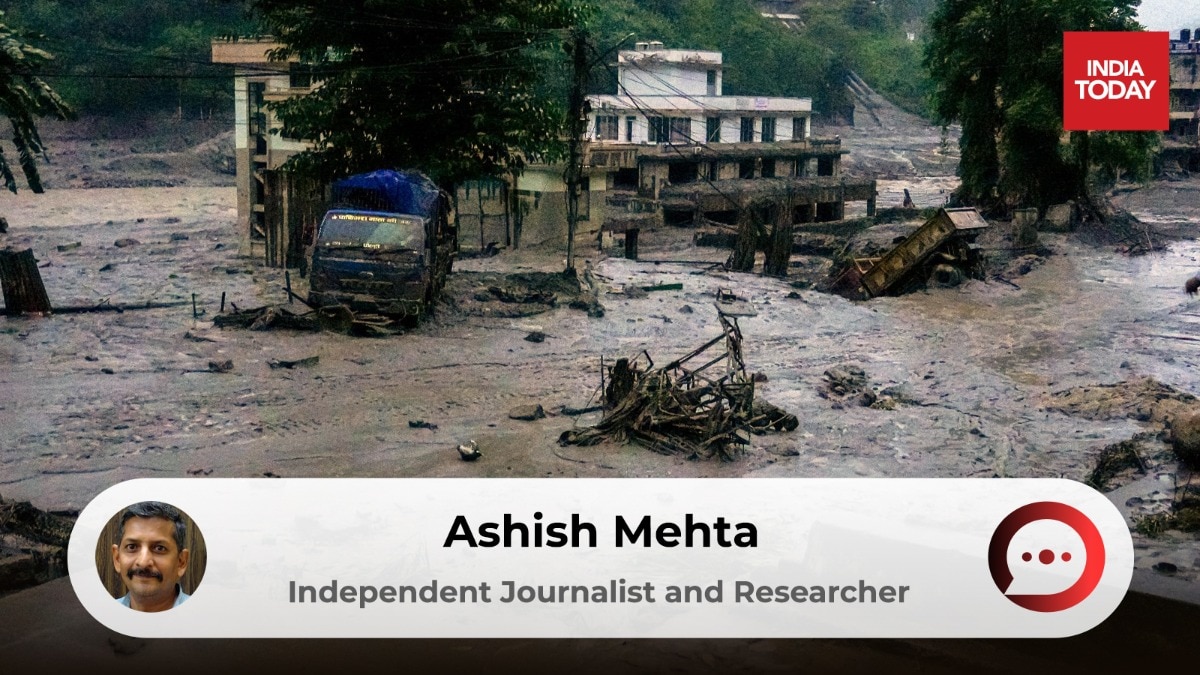
The fate of the Kailash-Mansarovar yatris missing after the Nepal flash floods reminds us of the destructive aspect of the creator, stunning us into silence.Nepal is reeling from the devastation caused by flash floods (Photo: Getty Images)In the early 2000s, the pilgrims returning after completing the Kailash-Mansarovar yatra used to have a halt on a day of long trek in Pithoragarh. A quick lunch used to be served on uneven ground of loose moraine. The pilgrims would be resting afterwards when a piththoo (luggage carrier) or someone from the support staff would tell them quietly: You are sitting on a ground that was once a village called Malpa.The trekking routes for the pilgrims on the Indian side keeps changing depending on the changing conditions on the ground, but there was a time when Malpa, in Pithoragarh district of Uttarakhand, served as a night camp for the pilgrims. On August 18, 1998, there was a massive landslide at 3 am which wiped off the camp as well as the hamlet. Sixty pilgrims – the maximum strength for a batch – were killed along with about 200 residents of Malpa. Protima Bedi, the eminent dancer and celebrity, was among the pilgrims and became the face of the tragedy.The Kailash-Mansarovar yatra, involving two passes exceeding 18,000 feet in height, is known to be notoriously arduous and carries significant risk. These days, the trek up to the formidable Lipulekh pass – an unguarded, actually unguardable border post between India and China – is quite shortened thanks to new roads on the Indian side, but it remains a matter of awe and a daunting challenge. The last halt before entering China is Garbhyang, which pilgrims depart around midnight, and proceed amid silence and darkness. The ITBP personnel facilitating the yatra accompany them – carrying stretchers. At the pass, fearsome icy winds reign supreme during the day and the night, leaving only a small window in the morning for crossing. That is why the pilgrims leave the previous halt in the middle of the night. By the time they reach the small, historic market town of Taklakot on the other side, it is not unusual to have noticed helicopters above, ferrying those suffering from serious medical conditions. Piththoos recount much worse tales too. And that is after two medical screenings of pilgrims to assess their fitness.This account refers to one of the two routes of the pilgrimage organised by the Ministry of External Affairs under an agreement with China (the other, newer route from Sikkim seems less demanding). Private operators, including non-government religious organisations, guide the pilgrims to the holy mountain and the holy lake in Tibet via Nepal. That is the route affected by the flash floods this week. What is it that pits faith against life-threatening risks? Some of the most revered pilgrimage sites for Hindus are located in remote corners of the Himalayas. They are difficult to access at the best of times and now face the added risk of climate change. For some, this represents an exciting combination of nature and faith, adventure and religion, thrill and redemption. But the landscape is changing fast.The trek from Gangotri to Gaumukh, the source of the Ganga, used to be considered ‘moderate’ on the ‘easy’ to ‘difficult’ scale, and attracted a considerable number of pilgrims for its sheer beauty apart from religious significance. Recently, a treacherous section of the route has become more prone to small-scale, almost routine landslides – with a sheer drop on the other side of the narrow pathway. The ‘difficult’ category treks like Kalindi Khal, connecting Gangotri with Badrinath via the ‘upper’ route, have become more challenging – riskier, in fact. Legend has it that until the nineteenth century monks undertaking pilgrimage used to take this short cut while doing a circuit of the Char Dham. Today, only a handful of hardcore enthusiasts would seriously contemplate this “pinnacle” of treks in India.On such terrain, most pilgrims and trekkers are well aware that a personal tragedy is never more than a step away. Of late, however, we have witnessed a number of collective tragedies. For anyone embarking on a pilgrimage anywhere in the Himalayas, the Kedarnath flood of 2013 has become a constant reminder of what sacrifices faith can demand.Why must it be thus? We have no answer. No amount of reasoning can solve the conundrum of an omnipotent God not protecting those who have come to pay homage. Nature (“red in tooth and claw”) has a way of silencing us – whether with its beauty or with its darker side.When an earthquake struck Bihar in 1934, Gandhi interpreted it as divine retribution for the sin of untouchability. Today, many are quick to blame any Himalayan tragedy on the sin of climate change. Gandhi later saw natural disasters in a different light. One of his associates, Swami Anand, an ordained monk of the Ramakrishna order, social reformer, writer and more, spoke of ‘Ananta Kala’, infinite play, of the Creator, of which destruction is an aspect as much as creation is.- Ends(Views expressed in the piece are those of the author)Published By: Yashna TalwarPublished On: Aug 29, 2026 18:34 IST
Pilgrim's Tragedy: Can we make sense of inscrutable nature?
Full Article
Original Source
Read the full article at Indiatoday →KhanList aggregates and links to publicly available news content. We do not host full articles from third-party sources. Always verify important information with original sources.