
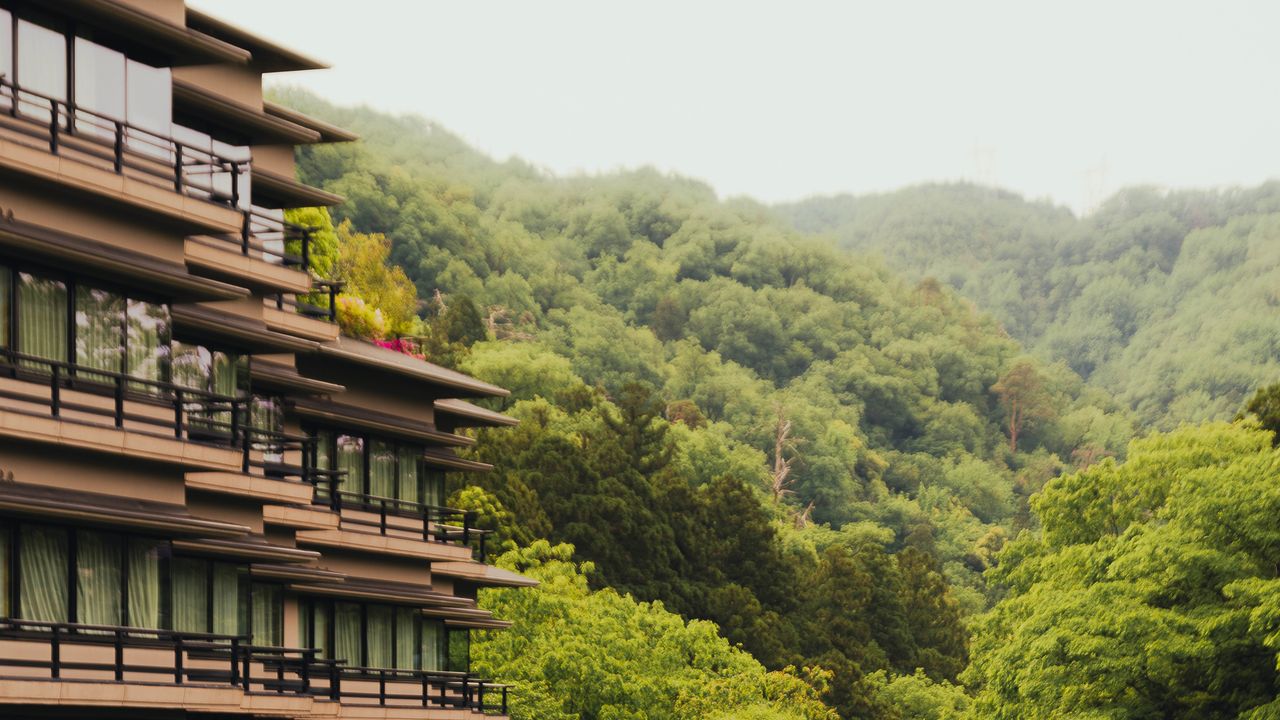
With their forested peace and classic temples, Ishikawa and Fukui exude Japanese tradition.Andrew UrwinI was sitting with my wife, Hiroko, in a deep cypress-wood bath as a full moon rose above the forested hills in front of us. There was no sign of human habitation to be seen from our long terrace; the Daishoji River surged below. We’d completed a nine-course meal that stretched from “sweet potato with Earl Grey taste” to rice from a local farm that protects its crops not with pesticides but ducklings. Now stars were pinpricking the heavens. Hard to believe that, just 48 hours earlier, we’d been caught amid swarming crowds, rush-hour traffic—even a loud demonstration on behalf of Palestine—in ever more jam-packed Kyoto.In the Kayotei ryokan in one corner of Yamanaka Onsen—a hot-springs resort in Ishikawa prefecture that has been a pilgrimage site for the Japanese for more than 1,300 years—we felt as if we were living inside a museum. The inn’s narrow corridors are lined with huge treasure chests, large scrolls, rows of pots; the furniture is constructed without nails. Every now and then, the creator of this vision, Masanori Kamiguchi, showed up in the incense-scented reception to charm guests. Nearly 50 years ago, Kamiguchi, now 93, closed his father’s multistory hotel to build an intimate, 10-suite hostelry showcasing the region’s traditional arts. Now the inn has affiliations with about 30 artisans in Yamanaka and Fukui prefecture, some of whom guests can visit. There’s a kombu, or seaweed, sommelier, a sake brewery and a master maki-e artist, Takeshi Matsuyama, who we watched rubbing gold powder into the intricate designs he had made with a mouse-hair brush to produce glittering lacquerware.Communal onsen at Kayotei RyokanAndrew UrwinAs the inn’s elegant, English-fluent general manager, Jiro Takeuchi, served us tea on arrival, he explained, “This tea is grown on the mountain. Actually,” he added modestly, “we own the mountain.” For a break from classic kaiseki (multicourse) fare, the Alla Contadina restaurant is a few minutes’ drive away; here, a Japanese chef, trained in Venice, serves up delectable pasta. A five-minute walk across Shirasagi (White Heron) bridge is Enuma Station, a French restaurant associated with Kayotei, where I was greeted with a photo of two recent visitors: Mr and Mrs Roger Federer.I’d come here on a pilgrimage of my own. I’ve lived around Kyoto for 37 years, and in the past decade I’ve seen its quiet, narrow lanes overwhelmed with foreign tourists. By 2023, more than 75 million visitors were crowding into its temples and tiny restaurants every year, and friends were writing to me every day asking how they could escape the hordes and find something traditional. So on a warm, blue week in late spring, I’d decided to explore two of the lesser-known corners of Japan—Ishikawa-ken and Fukui-ken in the Hokuriku region of northwestern Honshu—in the hope of uncovering overlooked treasures.Yamanaka has long been beloved of the Japanese, but in 2023, it had barely 36 foreign visitors a day; a Japanese magazine recently placed Fukui 46th among the 47 prefectures of Japan in terms of international arrivals, noting that in 2023, it received fewer than one foreign visitor for every 600 pouring into Tokyo. Yet Yamanaka—the name means “in the mountain”—is just an hour south of the cool and very sophisticated town of Kanazawa; only two hours from Kyoto by train, and three from Tokyo. I’d been drawn to Yamanaka in part by one of the warmest and most evocative books on Japan I’d read of late, Water, Wood & Wild Things. It describes how a young American woman, Hannah Kirshner, came to work for two months at a sake bar in the little village of 7,500 people. She so lost her heart to the area that she returned and bought a house here. She joined her new neighbors in making sake, in learning wood turning, in watching how to catch ducks in Y-shaped nets (while acknowledging how a Buddhist monk leads a prayer service, next to a large tombstone, every autumn for the poor creatures).Entrance to Heisenji Hakusan ShrineAndrew UrwinAn hour after arriving in Yamanaka, I was walking with Kirshner along Kakusenkei Gorge, which runs lyrically along the back of the village. “Hannah-san!” cried a woman who manages an elegant, red-parasol cafe set on rocks right next to the river. “I haven’t seen you for so long.” Everywhere, locals greeted her as one of their own. “People say that Japan is impenetrable,” observed Kirshner as she served me tea in the century-old, high-ceilinged farmhouse she’s turning into a writing studio and a place for hosting retreats in collaboration with local ryokans. “But once the door opens a crack, you’re in.”It wasn’t hard to see the appeal of a place where one shop stocks goods that cost zero yen and old women offer foreigners coffee for free at the weekend market. “Sometimes our guests request keys,” Takeuchi-san had told me at Kayotei, “but usually we don’t need them.” He had come here after working at the majestic Ritz-Carlton in San Francisco, perhaps drawn, in part, by this human-scale world of rich and leisurely conversations. When Kirshner led me back at afternoon’s end, we saw a young woman in a kimono walking alone through the deserted streets. “She’s one of the local geisha,” explained Kirshner. “She’s probably going to be appearing at the eel restaurant we just passed.”Next morning, I headed to nearby Hanamurasaki, another high-end ryokan that is redefining comfort. It’s run by Kohei and Manami Yamada, a Japanese couple in their 30s who lived in San Francisco and Singapore, respectively, and are now turning the sixth-generation inn into a sleek, contemporary take on tradition. I stepped through the automatic doors and half-imagined I was in a black-clad aman. The restaurant looked as if it had been airlifted here from c, and the black lacquer furnishings spotlit the rich greens through the windows.Priestess at Heisenji Hakusan ShrineAndrew UrwinIf Kayotei is all hush, Hanamurasaki feels all buzz; I could imagine cultured parents staying in the treasure house across the street, while their au courant children enjoyed the contemporary vibes. Our welcome tea at Kayotei had been served in a wafer-thin goblet made by a craftsman; at Hanamurasaki, it came in a wine glass as part of a three-tier afternoon tea featuring vegetable sushi, sweets and meringues conjured from roasted twig tea. Yamanaka is made for leisurely walks, a visit to the house celebrating the haiku poet Bashō—who stayed here for nine days in 1689—and quiet days in a world of green hills and rushing water. But when I drove to Fukui prefecture, less than an hour away, I entered an even more pastoral landscape of rice paddies and wooden houses. I saw no concrete towers, and nothing but single-lane roads. Domestic tourists flock in during the winter to enjoy the picturesque landscape and snow crabs, but foreigners still feel like a novelty.Maybe that’s one reason why the locals here seem so proud of their traditional ways. When we stopped at etoe, where high-quality knife handles are sold, a tremendously spirited, infectiously smiling young woman led us around the large compound and then carved my name in Japanese characters on the blade of a gleaming vegetable knife. As we marvelled at her energy, she shyly admitted that she actually doubles as an idoru, or singing-and-dancing pop star. Two days later, a kindly couple at the Ryozo paper mill nearby patiently guided me, as they do many foreign visitors, in making sheets of delicate, translucent washi paper. Next to the cash register was a photo of a familiar face: our new friend, Wakana Iroha, the pop star who, we were told, sometimes served as an instructor here when she wasn’t working on lacquerware. It was an engaging reminder of how many from the area return home to boost Fukui and its culture, even as others move here from big cities in search of a simpler, more human-paced life and the blessings of community. “In Fukui, people are committed to traditions,” one such woman, Haruka Kudo, told me, having left her hometown to live here. “But they want to find ways to make tradition new and fresh.” It reminded me of the sentence at the end of Kirshner’s book: “It takes progressive thinking to keep old ways relevant.”For me, the lure of Fukui lay partly in the great Buddhist complex known as Eiheiji, the largest Zen training centre in Japan. For 40 years, I’d wanted to visit the remote site where Dogen Zenji had founded, in 1244, the first Soto Zen monastery, which now has people across the globe sitting, eyes closed, in front of a wall in meditation. My savvy friends from the Japanese tour company, Wondertrunk & Co., decided to lead me gradually towards this climax. Driving past huge buddhas along the hills, with snowcaps in the distance, we made a stop at Heisenji Hakusan Shrine, a sacred site that housed 6,000 buildings before it was burned to the ground in 1574. We joined old women labouring up the tall, steep slope on canes—many make the pilgrimage every day, I learned—until we came to the main, small shrine, where a woman in elaborate robes was explaining some of its history to a group of visitors. She turned to us and said in clear, bell-like English that her husband, who had been chief priest here, had passed away. Her son was still completing his religious studies at university. So it was left to her to become one of the 15% of Shinto priests who are female. With that, she turned around, waved a fluttery white whisk above two small boys in the centre of the building and sat down by their side to tell them how to get on at school.One dish of the kaiseki dinner served at Kayotei RyokanAndrew UrwinAs part of the build-up to Eiheiji, we then drove to a deserted car park where a beaming monk greeted us in English and led us on a breathless, 20-minute hike up a hillside. At the top was the transfixing stillness of Kippoji, a temple with historical ties to Eiheiji, eight miles away along the mountains. The young monks in training served up a delectable shojin ryori, a monastic vegetarian meal including spiced tofu, mushroom rice and pancakes, all made, by custom, without milk or eggs.Nothing could be heard in the hilltop monastery but birdsong. Then, in the meditation hall, our cheery host suddenly turned serious and began pounding on a 350-year-old drum from a samurai castle used for marking the beginning of chores. Returning to smiles, he confessed he’d been working for Tokyo TV—hence his relaxed English—until a relative died and his family temple needed a new priest. His brother was disinclined to take on robes, so he gave himself to a life of unbending training.Though I’d been hearing about Eiheiji for half a lifetime, nothing prepared me for the monumental collection of large wooden buildings set against the hills, tall pines all around and another rushing river alongside. Its seven principal structures are said to resemble the head, heart, waist, arms and knees of the seated Buddha; in three of them, none of the training monks are allowed to speak. Reverend Donin Adachi, my monastic guide, opened a door to a large, dark space not usually seen by outsiders, and I peered in at the sodo, where the 80 or so training monks meditate, take their meals and sleep, each on a tatami mat.Monk at Kippoji TempleAndrew UrwinWhen I complimented the reverend on his English, he told me he’d toured the world as an opera singer for years. But then his family temple needed a priest, and his life onstage came to an end. For visitors, there’s a stylish guesthouse, Hakujukan, across the street from the temples, and at 4:05 a.m. the next morning, I joined a dozen or so other foreigners in its lobby to follow a faint trail of lanterns under an indigo sky, past Eiheiji’s dragon entrance and up into its dark buildings. Reverend Adachi appeared to give us an introduction, in Japanese and English, to a day in the life of a training monk. Then he led us up to the dharma hall, which stands high above the other buildings. As we took seats at the back, dozens of black-clad monks began streaming in, and while a drum started pounding, they sat down in lines and took to chanting their sutras at high speed. Suddenly, they stood and walked in elaborate crisscrossing patterns. Older monks, many in gold robes, silently corrected the trainees who were bustling along the rows, bearing ceremonial objects. We joined in the recitation of syllables until the hall began to sound like a chorus of buzzing insects.In 37 years around the temples of Kyoto, I’d never witnessed a ceremony so thronged or magnetic. Kyoto’s five great temples are set apart from the city, but they preside over a metropolis of 1.4 million people. Here in this secluded mountain setting, it was hard to think of anything but contemplation and essentials. Almost four decades ago, I’d thrown over my exciting life in midtown Manhattan to live in a Buddhist temple along Kyoto’s eastern hills. For three recent summers, I’d co-led workshops at Tassajara Zen Mountain Centre, the oldest Zen monastery in the west, set up near Carmel, California, by Shunryu Suzuki, who’d done some of his training at Eiheiji. But coming to the birthplace of the tradition allowed me to understand the practice as never before. In the early morning, once the hour-long service was over, I ambled beside the mossy boulders and the rush of water as a gong rang out across the conifers. “To study the way,” Dogen famously wrote, “is to study the self. To study the self is to forget the self. To forget the self is to be enlightened by everything.” Not least the sound of the wind in the trees.Hokuriku hotelsKayotei, Yamanaka Onsen A traditional ryokan with an impressive local craft collection, spacious tatami rooms and private onsen baths. About $452 per person per night, including breakfast and kaiseki dinner.Hanamurasaki, Yamanaka Onsen There are works by up-and-coming artists and views of the Kakusenkei Gorge at this contemporary ryokan. About $587 per night for two people, including breakfast and kaiseki dinner; hana-mura.comHakujukan, Eiheiji This serene inn adjacent to Eiheiji temple offers modern comforts and Buddhist cuisine. About $400 per night for two people, including breakfast and dinner; hakujukan-eiheiji.jpKanshukuen Eshikoto, Eiheiji A modern riverside stay connected to a sake distillery and fine dining restaurant. About $668 per night for two people, including breakfast and tasting menu dinner; kanshukuen.comVisits to artisan studios in Yamanaka Onsen can be arranged through the concierges at Hanamurasaki and Kayotei. Craft Invitation organises guided mindful explorations of Buddhist practice and access to washi-paper makers and knife studios in Fukui; craftinvitation.jpThis story was first published in the March/April issue of Condé Nast Traveller Middle East
Pico Iyer on Seeking Quiet in Japan's Less-Visited Hokuriku Region
Full Article
Original Source
Read the full article at Cntraveler →KhanList aggregates and links to publicly available news content. We do not host full articles from third-party sources. Always verify important information with original sources.