
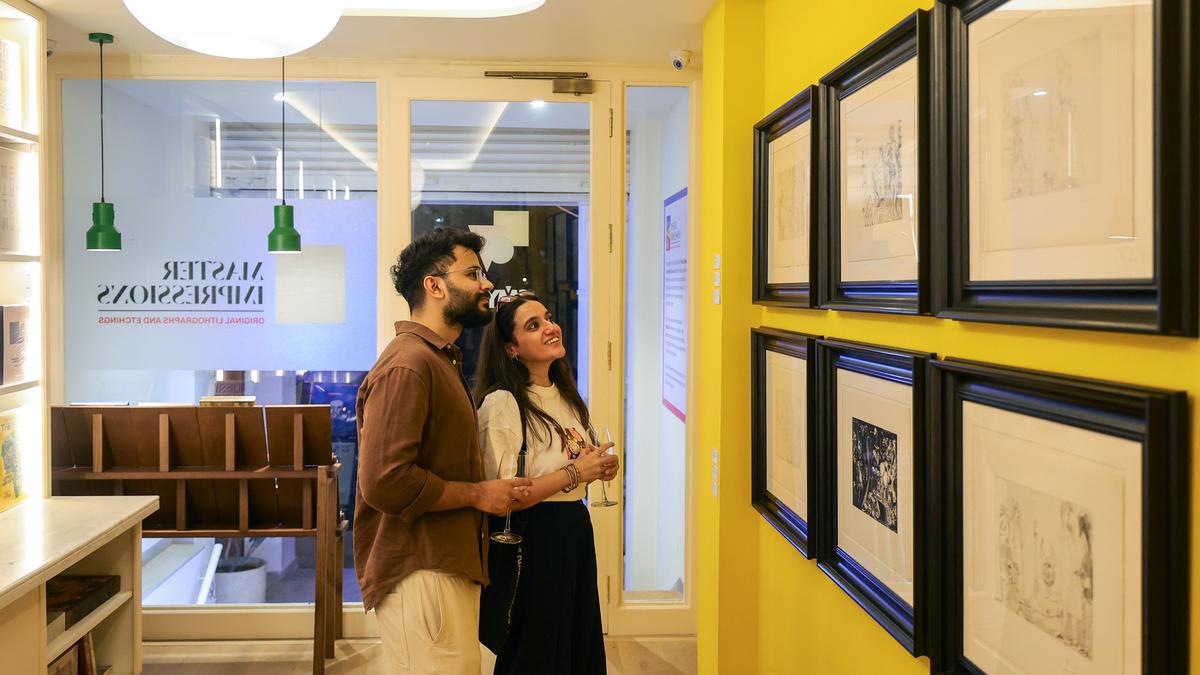
Take Picasso, Miró and Dalí off the museum wall and put them on paper, and the familiar starts to shift. Picasso becomes more spare and searching; Miró more elusive; Dalí more exacting. That is the proposition behind Picasso Miró Dalí – Master Impressions, Original Lithographs and Etchings. The exhibition brings together over 60 original graphic works by the three maestros, offering a concentrated look at practices that have long been overshadowed by their paintings. The works were conceived for lithography and etching, produced in limited editions and individually numbered and signed by the artists.According to curators of the show Kapil and Priya Kapoor, also directors of Roli Books and CMYK, there is a special reason behind this show. “Our interests increasingly extend into the wider world of collecting that surrounds them — from rare books and limited editions to original graphic works by artists.” Artworks at the show | Photo Credit: Special Arrangement The exhibition is part of this continuing exploration, they add, introducing audiences and collectors in India to an important side of the practices of artists whose work is universally familiar, while offering a closer look at their achievements in lithography and etching.Three masters, three languagesThe exhibition is most compelling as a three-way comparison. Picasso pares the figure down with extraordinary economy; Miró builds a vocabulary from signs, creatures and biomorphic forms; Dalí applies meticulous draftsmanship to the fantastic logic of Surrealism. Seen together, their differences are immediate—and illuminating.Picasso’s Portrait de Femme II (1955), a portrait of Jacqueline Roque, the artist’s second wife and muse of whom he produced around 400 portraits, is a particular highlight. Produced in an edition of just 50, it captures the economy that makes Picasso’s graphic work so compelling. A few lines establish the sitter, but the portrait is never merely descriptive. Picasso continually tests how much information a face needs before it becomes an image — and how much can be left unresolved. Artworks at the show | Photo Credit: Special Arrangement An edition of the work is held in the collection of the Museum of Modern Art in New York, but its significance here is less about pedigree than about what it demonstrates. Picasso could make the line do almost everything.With Miró, the line behaves differently. His works seem to emerge from a vocabulary of floating signs: eyes, birds, stars, bodies, gestures and strange, half-recognizable forms. What initially appears spontaneous is carefully calibrated. A mark need not describe an object literally to suggest one. His compositions hover between drawing and writing, as though an unknown alphabet were continually being invented.Maestros’ methodsPlaced alongside Picasso, the distinction is striking. Picasso’s line dissects and reconstructs the visible world; Miró’s seems to invent another one. Dalí occupies a third territory. His works return us to the precision of drawing, but place it in the service of Surrealism. Bodies, objects and landscapes become vehicles for impossible combinations, while his meticulous technique gives even the strangest images an unnerving credibility. Artworks at the show | Photo Credit: Special Arrangement Conservation architect and curator Radhika Dhumal calls the exhibition a “rare treat” for art lovers offering them a unique opportunity to encounter works of exceptional quality by three masters of modern art.“Printmaking is not as acknowledged as its glamorous counterparts like painting and other visual arts. Even so, it remains an important part of an artist’s journey while learning the craft,” she says. Indian maestros such as Shakti Burman and Krishna Reddy are known proponents.However, behind its exquisite results lies an arduous, painstaking process involving chemical treatments and acid baths that can expose artists to toxic fumes. The power of the editionDespite the pitfalls involved in printmaking, the show helps highlight the uniqueness of the craft as it offers a compact study in three graphic languages: Picasso’s economy, Miró’s signs and Dalí’s precision. All three artists pursued the medium extensively, working with specialist printers and ateliers and exploiting its particular technical possibilities. The resulting editions belong to their oeuvres in their own right. CMYK Bookstore | Photo Credit: Special Arrangement That distinction becomes especially useful for viewers who know the three artists primarily through their paintings. Their names are familiar; not so much their graphic work. Here, the prints provide a different route into their practices without requiring a survey of their careers.For artists whose images have been reproduced almost endlessly, Master Impressions offers something more valuable than familiarity. It gives us another way to look at them.On view until November 22.
Picasso, Miró and Dalí’s original prints go on show at CMYK Bookstore in Delhi
Full Article
Original Source
Read the full article at Thehindu →KhanList aggregates and links to publicly available news content. We do not host full articles from third-party sources. Always verify important information with original sources.