
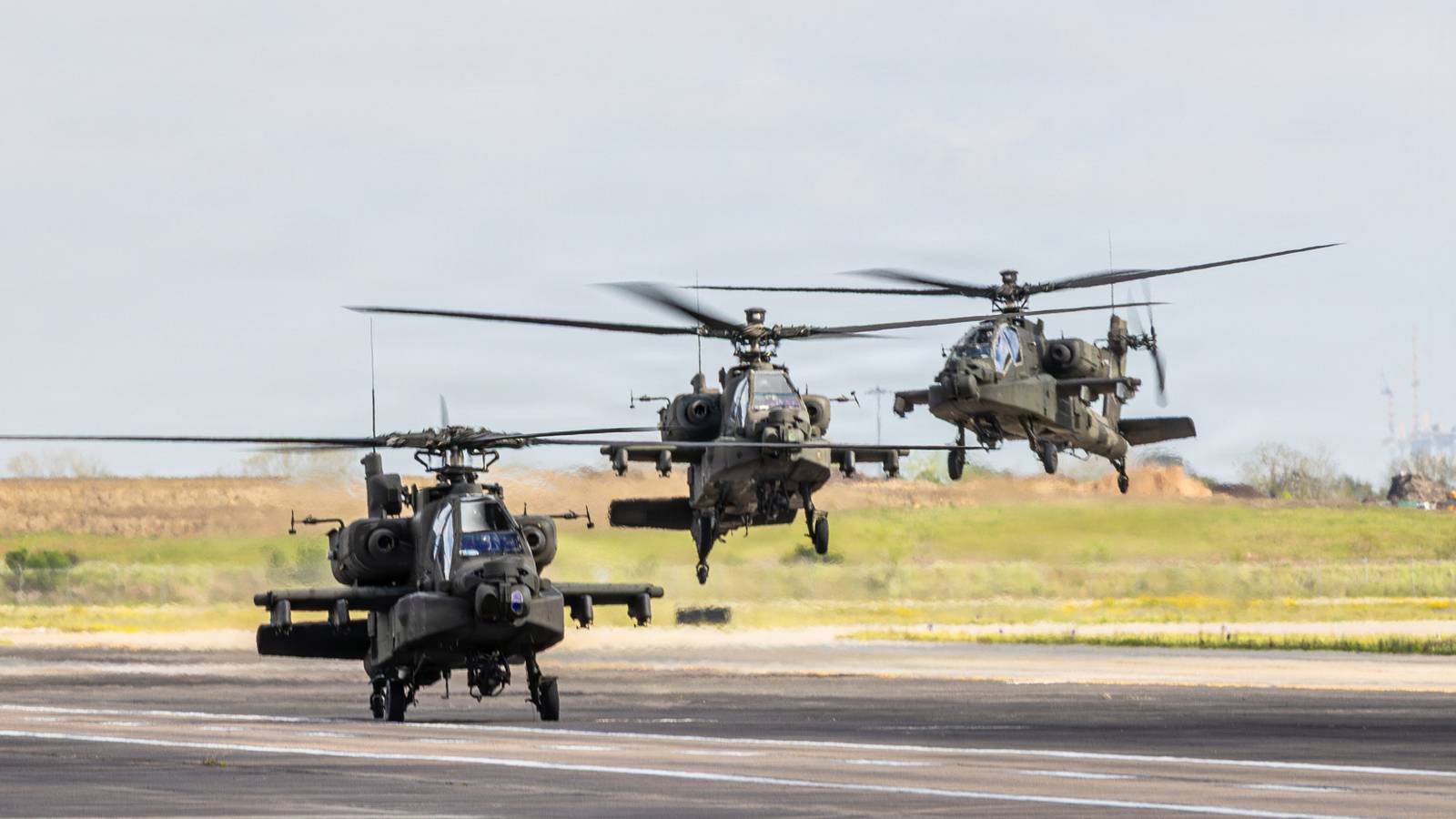
Published Aug 24, 2026, 4:00 PM EDT Aaron is an aviation enthusiast and world traveler with a deep interest in aerospace history and technology. He has traveled around the world numerous times, often incorporating visits to aviation museums and historic aircraft collections into his journeys. A native of New Zealand, he is an expert in aviation and maintains a broad interest in a variety of other subjects. Currently, there is an ongoing debate about the future of the attack helicopter. Perhaps surprisingly, most talk about the attack helicopter's alleged obsolescence does not stem so much from the threat posed by enemy fighter jets, but rather from the proliferation of MANPADS and the emergence of uncrewed systems able to fill much of the role. It may be somewhat surprising to know that it can be difficult for fighter jets to successfully intercept low-flying helicopters, and yet, they are still becoming increasingly vulnerable and are being pushed away from the front. The US Army is reducing its active-duty AH-64E Apache fleet from 408 to 240 aircraft, with some helicopters being transferred to the National Guard. It is also no longer planning to buy new-build Apaches, instead focusing on sustaining and modernizing its existing fleet. At the same time, the traditional roles performed by attack and utility helicopters, including armed reconnaissance, close air support, resupply, ISR and MEDEVAC, are increasingly being challenged by other systems. Let's examine why it can be difficult for fighter jets to kill low-flying helicopters, and why helicopters are nevertheless being forced to adapt. Why It's Difficult For Fighter Jets To Kill Helicopters Credit: US Army It is surprisingly difficult for fast jets to shoot down low-flying helicopters, although it is possible. The issues are that helicopters can benefit from terrain masking, flying at 100 feet (30 meters) to 300 feet (100 meters) above the ground. This allows the helicopter to quickly disappear behind hills, ridges, buildings, and trees. A fighter jet flying over a mile or two away from it may simply lack a line of sight to the helicopter. From above, the helicopter can be difficult to distinguish from the ground clutter, although modern fighter jets are now equipped with AESA radars and are much better at solving this problem. Another issue is the high speed mismatch. This has proven an issue for fighter jets downing Shahed-type slow-flying one-way attack drones. It's possible, and through 2025 and 2026 it's happening all the time in Ukraine, Russia, and the Middle East, but it is dangerous. At least one Ukrainian F-16 is believed to have been lost after ingesting debris from the drone. With helicopters, the fighter can overshoot the target quickly, although this is a bigger issue for the conventional gun rather than missiles. Helicopters are able to exploit terrain extremely effectively as they don't need to fly in a straight line at low altitude. The fact that they can pop up briefly to observe and fire and then duck again means there might only be a fleeting opportunity to attack the copter. Fighter Jets Can Absolutely Down Helicopters Credit: Department of Defense The point that helicopters are hard to hit when flying low does not mean they are hard to hit in general. If a helicopter is flying low over flat terrain, then it may be in some serious trouble. If it is flying at a higher altitude, then it is an easy target, with modern short-range infrared missiles having little problem targeting the copter's hot engines and exhaust. Part of the issue is a lingering memory that fighter jets were optimized to engage other fighter jets. A fighter with suitable sensors, datalinked targeting, or airborne early warning support is a different proposition. Stephen Olguin, a former US Army Apache pilot, argues in a War On The Rocks article published in 2025 that the biggest threat to attack helicopters is not SAM coverage: it's the threat of not being permitted to fly. He argues that attack helicopters should “hunt the hunters” rather than simply avoid enemy air defenses. Some Army aviation units should be trained and equipped to actively find and destroy them. He adds that Suppression of Enemy Air Defenses (SEAD) should become a core competency for American attack helicopter pilots, and potentially the primary mission of some specialized units. It needs to be stressed that his argument is not that Apaches should be operating alone. Instead, they should be a node and platform in a larger system of assets mapping an air defense network, exploiting weaknesses, and dismantling it. The Apache Tank Buster Myth Credit: US Army One important myth to dispense with is the Cold War notion that attack helicopters, like the Apache, are tank killers. While not completely a myth, it is mostly detached from today's battlefield reality. This is similar to the lingering myth that A-10 Warthogs are also tank busters, but those days are gone. While it is certainly possible for Apaches (and Warthogs) to take out enemy armor, this is no longer their primary mission, and it's not expected to return. In reality, a foe that is able to field significant amounts of armor is also an adversary that is likely to have a proliferation of MANPADS and other short-range air defense systems. This has meant that Russian attack helicopters could not safely operate in the kind of exposed, close-range anti-armor role envisaged during the Cold War. Instead, the Ka-52 increasingly relied on standoff weapons and carefully controlled engagement profiles. By the time of Ukraine's 2023 counteroffensive, Russia was still able to use its Ka-52 attack helicopters with great effect against Ukrainian armored columns. However, these used missiles like Vikhr-1 (9K121) and LMUR (Izdeliye 305), which had a range of five+ miles (eight+ km). As Ukraine received US ATACMS missiles, the forward bases they relied on became vulnerable, and many helicopters were destroyed on the ground. The proliferation of drones has also made these forward bases untenable. As of 2026, the Russian Ka-52 fleet remains flying but has suffered enormous attrition and is used in different roles. The Shift In US Army Attack Helicopter Doctrine Credit: Shutterstock Maj. Gen. James P. Isenhower III (former 1st Armored Division and Fort Bliss commander) has stated that the Army no longer plans to use the Apaches "in direct support of an infantry platoon or tank platoon, but we're using those as maneuver elements." Isenhower then explains that in Red Flag exercises, Apaches (working with the Air Force's fifth-generation aircraft) could penetrate around 350 miles in a trip. He states that "no kidding, we operated beneath, literally, beneath the Red Flag exercise." The doctrinal shifts are being driven by several reasons. One is that air defense is incredibly dense at the front, but no nation can provide that level of air defense all through the rear. Once the Apaches break through the lines (while there will still be some air defense), it's essentially open season for targeting logistics nodes, command centers, ammo depots, repair bases, and storage facilities. Select US Army helicopters (per US Army) Current fleet Planned future AH-64 Apaches 240 active (600+ total) 240 (active, exc. National Guard) UH-60 Black Hawk family 2,000+ Large continuing fleet CH-47 Chinook Approx. 500 Large continuing fleet MV-75 Cheyenne II (tiltrotor) Up to 334 by 2040 FARA (Future Attack Recon Aircraft) 0 (canceled) Put another way, the US Army is increasingly seeing the Apache as a deep strike asset. The statements by Isenhower focused on the Apache attacking supply depots and the like, while Olguin in the War On The Rocks piece spoke of attacking air defense units. These are related concepts. In a February 2026 piece by the US Army entitled Arctic Apaches Clear the Way: 11th Airborne Division Conducts Deep Attack Ahead of Air Assault, it was pointed out that the longer range of the modern E models makes this much more feasible compared with the earlier D models. The Apache Is Losing Its Close Air Support Mission Credit: Shutterstock Largely missing from the debate over the Apache's future is its use as a close-air support platform. The US Army's emphasis has shifted towards armed reconnaissance, mobile strike and supporting maneuver, rather than defining it simply as an anti-tank platform or CAS missions. On CAS missions, Nicholas Theodore Moran says that "if you really need to send a slow-flying aircraft with anti-tank missiles into that environment, save a life or two and send [a drone]." None of this is to say the Apache will not be used in CAS and anti-armor roles, but that the emphasis of its role is shifting. It may be difficult for fighter aircraft to engage helicopters operating at very low altitude, but that is changing as modern fighters are becoming increasingly networked, allowing them to exploit offboard sensors and engage targets without necessarily needing to detect them independently. Even worse is the proliferation of MANPADS and other air defense systems. However, arguably the biggest issue is not the vulnerability itself: it's that drones of various descriptions are becoming increasingly capable and are able to take over an increasing share of a helicopter's traditional role. Generally speaking, it's not vulnerability and cost that render a system obsolete: it's those factors paired with an alternative. Helicopters' Roles Are Shrinking Credit: US Army What is emerging is a nuanced picture for the future of the helicopter. Like fighter jets, attack helicopters are set to be paired with CCAs or loyal wingman drones under development. Helicopters, especially attack helicopters, are too expensive and difficult to replace to be used as attritable and expendable assets. Meanwhile, an increasing share of helicopters' roles is being taken over by autonomous systems. Autonomous and remotely piloted aircraft have already taken over a large share of the reconnaissance and ISR missions that helicopters once performed. Their CAS role is being squeezed due to vulnerability and alternative assets able to perform the role. An emerging picture is that utility and cargo helicopters are being pushed further behind the lines and will not be able to reach the front. For MEDEVAC missions, militaries (such as Ukraine) are increasingly turning to drones to get personnel an acceptable distance from the front. Meanwhile, the Marines and other services are increasingly looking to autonomous VTOL runway-independent aircraft (uncrewed helicopter, tiltrotor) to provide the 'last mile' of supply missions.
Physics Of The Ambush: Why Fighter Jets Struggle To Kill Low-Flying Helicopters
Full Article
Original Source
Read the full article at Simpleflying →KhanList aggregates and links to publicly available news content. We do not host full articles from third-party sources. Always verify important information with original sources.