
If the Big Bang created equal amounts of matter and antimatter, everything in existence should have canceled itself out billions of years ago. Yet, our world remains standing. Now, physicists at Northwestern University may have figured out why. A team led by Professor Gerald Gabrielse and Ph.D. student Thomas Myers, captured, cooled, and trapped a single positron (the antimatter twin of an electron) into an “exquisitely controlled quantum state.” Interestingly, it is the first-ever creation of a “one-positron quantum cyclotron.” Quantum control of positron While regular matter consists of electrons, protons, and neutrons, an antimatter universe would be composed of positrons, antiprotons, and antineutrons. However, antimatter is extremely tricky to study. The moment a particle of antimatter touches standard matter, both annihilate in a flash of energy. Positrons cannot be stored in containers because contact with ordinary matter instantly destroys them. So studying these particles requires careful handling, though the tiny quantities used pose no real explosion risk. “If we want to study antimatter, we must handle it carefully,” Gabrielse said. “To be clear, it’s not dangerous. We don’t have enough antimatter to make an explosion.” In this work, physicists captured a single positron from radioactive decay, cooled it to near absolute zero, and trapped it inside a vacuum using magnetic and electric fields. This state creates a one-positron quantum cyclotron. It allows the particle to act like an “artificial atom” whose energy levels can be precisely manipulated without contacting ordinary matter and annihilating. In this work, the researchers captured a high-energy positron emitted during the radioactive decay of sodium-22, slowed it, and funneled it into a custom-designed electromagnetic trap. Once inside, the interior was chilled to a freezing 300 millikelvins (just 0.3 degrees above absolute zero). Suspended in a near-perfect vacuum by invisible forces, the positron never touched a single wall. Freed from external noise, it settled into its lowest energy state, essentially behaving like an artificial atom that the scientists could manipulate for months at a time. “We cool it down so much that it’s in its quantum ground state,” Gabrielse said. “We actually coaxed this very fast positron to sit there and behave for months at a time.” Looking for cracks in the model The Standard Model describes fundamental particles and three of the universe’s four forces, but physicists know it’s incomplete because it cannot explain why matter dominates over antimatter. Northwestern researchers demonstrated they can trigger and observe individual quantum transitions in a trapped positron using precisely tuned microwave pulses. This level of control helps measure the positron’s magnetic moment with extreme precision, replicating a previous experiment that measured an electron’s magnetic moment to one part in 10 trillion. Comparing these two measurements head-to-head will help physicists look for microscopic differences between matter and antimatter. “Current theories suggest that there will be no difference in the two measurements,” Gabrielse said. “If it turns out they are not equal, that would be the biggest discovery in physics in the last century.” If a discrepancy appears between the two measurements, it could break open the Standard Model. And finally offer a clue as to why matter won the cosmic tug-of-war and allowed our universe to exist.The study findings were published on Oct. 21 in Physical Review Letters.Get the latest in engineering, tech, space & science - delivered daily to your inbox.Mrigakshi is a science journalist who enjoys writing about space exploration, biology, and technological innovations. Her work has been featured in well-known publications including Nature India, Supercluster, The Weather Channel and Astronomy magazine. If you have pitches in mind, please do not hesitate to email her.
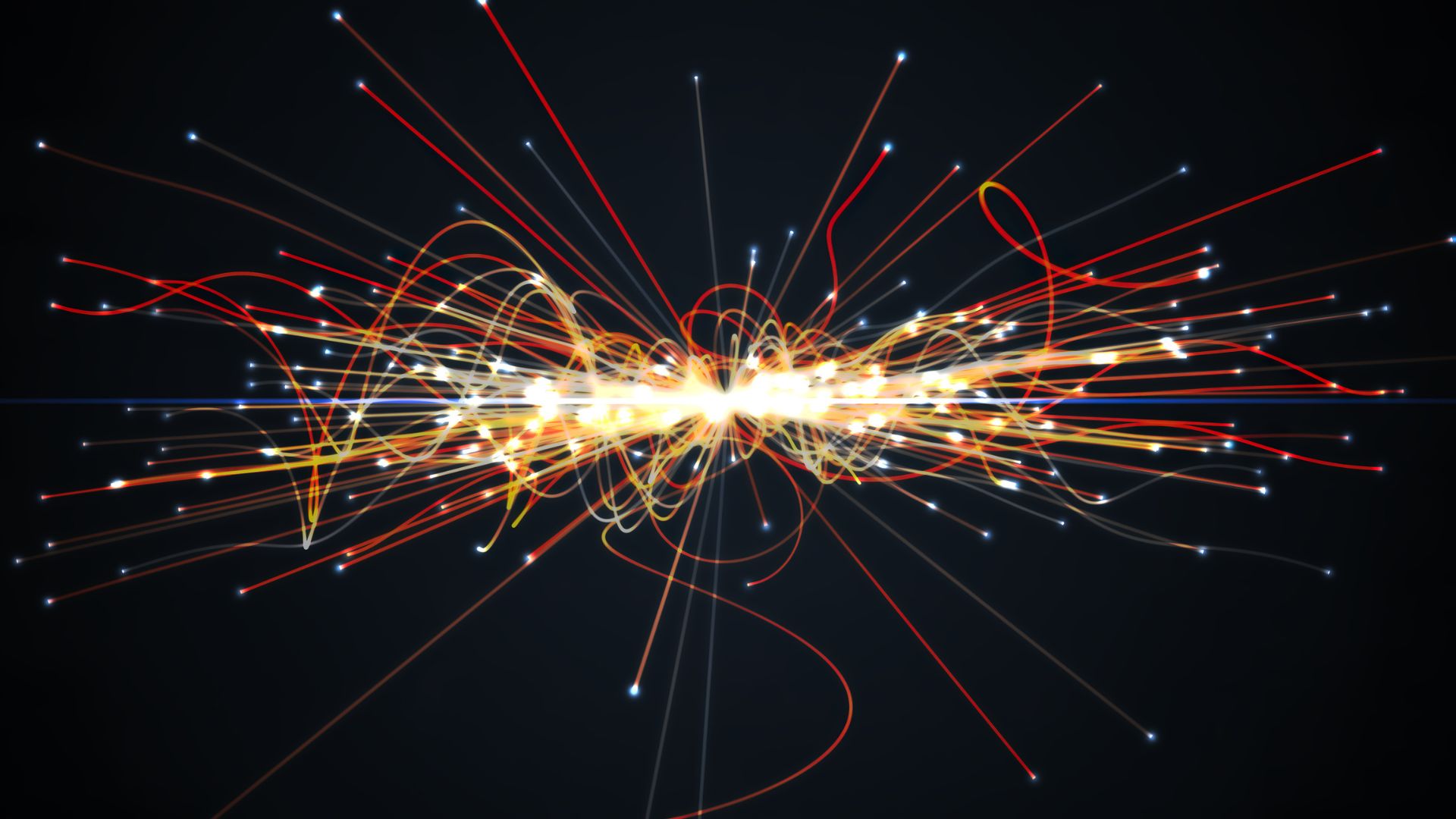
Physicists tame antimatter in a ‘quantum trap’ to solve universe’s greatest mystery
Full Article
Original Source
Read the full article at Interestingengineering →KhanList aggregates and links to publicly available news content. We do not host full articles from third-party sources. Always verify important information with original sources.