
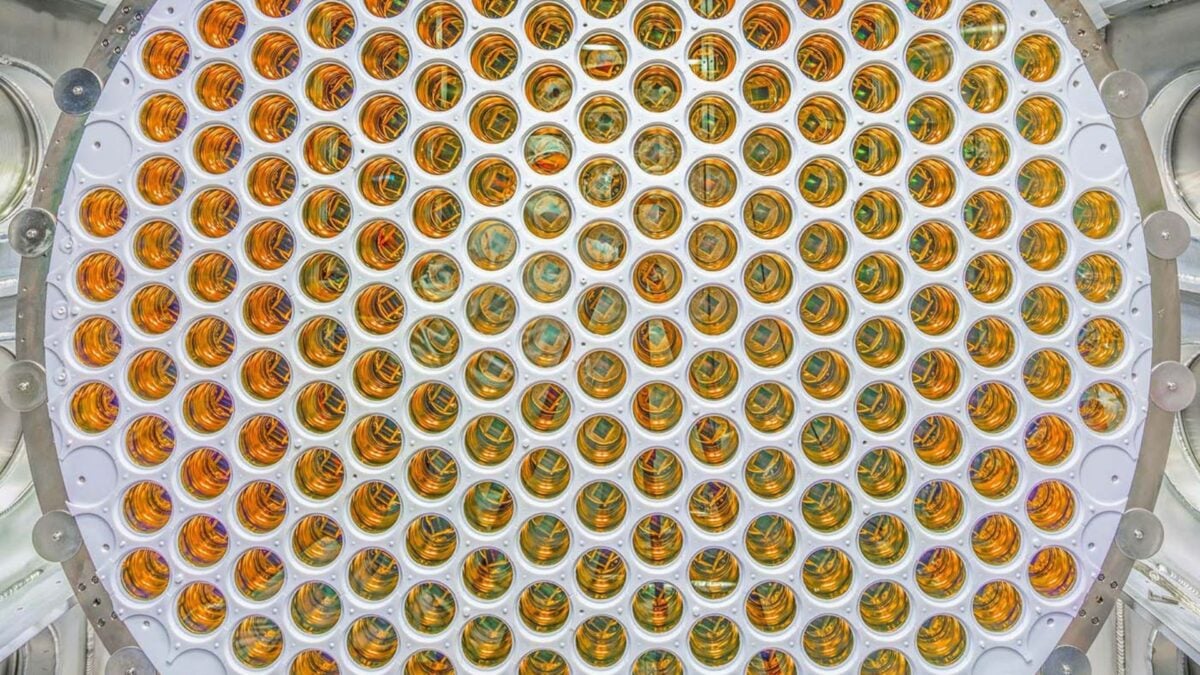
Deep beneath the Black Hills of South Dakota, physicists have spent years searching for dark matter. This substance has long eluded detection, and yet it is supposedly everywhere, making up about 85% of the universe’s mass and serving as the invisible scaffolding that holds galaxies together. Researchers running the LUX-ZEPLIN (LZ) dark matter experiment, an ultra-sensitive particle detector buried inside an abandoned gold mine, have recorded a single particle interaction that can’t be explained by any known background signals from normal matter. This event, described in a preprint set to be published in the journal Physical Review Letters, is arguably the most compelling candidate for a direct dark matter detection to date. But the authors say it’s still too soon to close this case. “We’re very intrigued to see this event in the data, in the region where we expect dark matter to show up, and the competing backgrounds are very low,” Rick Gaitskell, a professor of physics at Brown University and the spokesperson for LZ, said in a statement. “With only one event, we don’t want to get ahead of ourselves. We are not claiming to have seen dark matter. But we have seen something interesting that we want to share with the scientific community for their input.” Suspicious signal Scientists believe dark matter exists because no observable matter in the known universe can explain certain gravitational effects, such as the unexpectedly rapid rotation of galaxies or the fact that they’re held together more tightly than they should be. Thus, dark matter is a core component of the standard model of cosmology, the simplest theoretical framework for our universe. If dark matter exists (and the indirect evidence strongly suggests that it does), its particles clearly do not absorb, reflect, or emit light. If they did, researchers would have seen this abundant substance by now. To figure out what dark matter is actually made of, we need a direct detection, and looking for one has been likened to looking for a needle in a haystack. To narrow the search, physicists have come up with a few ideas of what dark matter particles might be, and one of the strongest candidates is Weakly Interacting Massive Particles (WIMPs). They believe these theoretical particles interact with gravity but not light and only very rarely interact with other particles. The LZ detector is specifically designed to sniff out WIMPs. It’s essentially a 10-ton tank of ultra-pure liquid xenon equipped with sensors to record a possible collision between a WIMP and a xenon atom. It operates nearly a mile (1.6 kilometers) underground at the Sanford Underground Research Facility (SURF) in Lead, South Dakota, where it is shielded from cosmic radiation and other sources of background noise that might mimic a dark matter detection. For this new study, LZ researchers analyzed 220 days of data collected between March 2023 and April 2024. They had searched this dataset for faint signals from the simplest WIMP interactions before, but now they were searching for a broader range of possible WIMP interactions that could deposit more energy into the detector. “This was a detailed study in a region we hadn’t explored within this dataset, and we spent months of additional effort to understand all the possible causes of background events,” lead author Sam Eriksen, a senior research associate at the University of Bristol in the U.K., said in the statement. The signal that Eriksen and his colleagues describe in their paper was detected on June 16, 2023. If it stemmed from a dark matter-xenon interaction, the WIMP that generated it would have to be about 200 times heavier than a proton. The collision also appears to have been unusually energetic. Thus, the findings have created a mystery within a mystery. The search continues If LZ really did detect a high-energy WIMP event, standard theories suggest it should have already seen numerous lower-energy ones—but it hasn’t. This could mean that WIMPs interact with ordinary matter in a way scientists don’t yet expect or that this particular particle somehow received a boost in speed. Or perhaps the event was not caused by a WIMP at all but instead resulted from some other unidentified particle or physical process. Fortunately, the LZ team has a wealth of data they can use to investigate further. This project has already accumulated the world’s largest dark matter dataset, and it will only continue to grow. If future analyses uncover more interactions like the June 2023 signal, two competing experiments—PandaX in China and XENONnT in Italy—will help confirm whether LZ is seeing WIMPs, Scientific American reports. So while the dark matter mystery remains unsolved, these findings offer a tantalizing new trail of clues for researchers to follow. Perhaps one day, we’ll look back at June 16, 2023, as the day physicists caught their first glimpse of this elusive substance—or something even stranger.
Physicists Detected a Signal That Defies Explanation. It Could Be Dark Matter—or Something Stranger
Full Article
Original Source
Read the full article at Gizmodo →KhanList aggregates and links to publicly available news content. We do not host full articles from third-party sources. Always verify important information with original sources.