
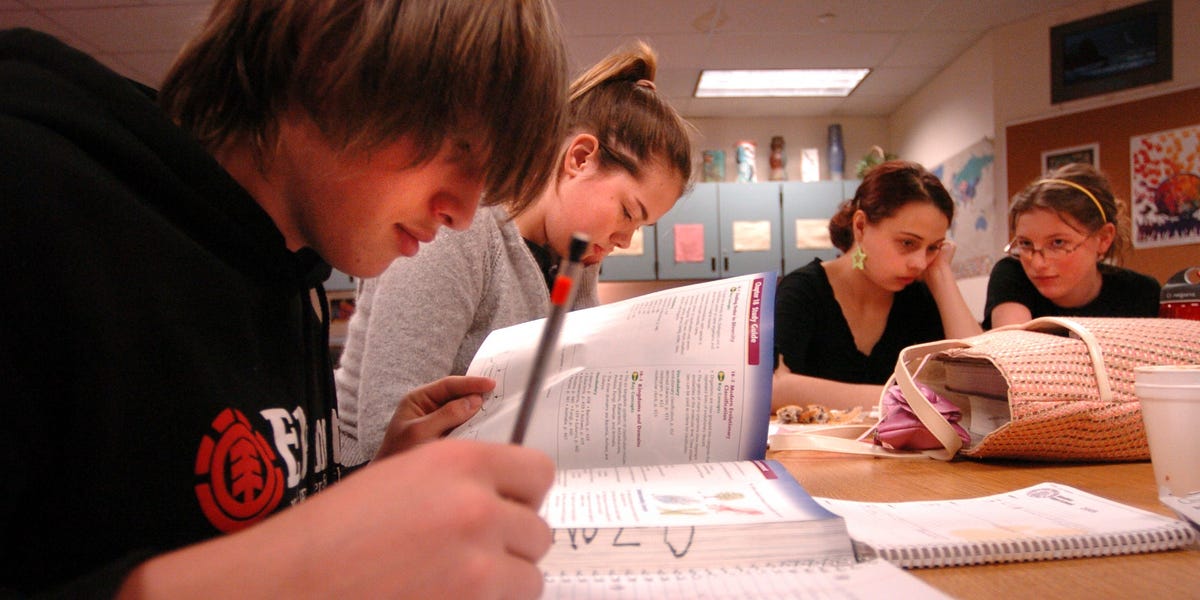
Two students use Smart Board technology on December 10, 2010. John Carl D'Annibale /Albany Times Union via Getty Images Much like the rest of the world, US classrooms have changed quite a bit since the beginning of the 21st century.The onslaught of technological advancement, from the internet and computers to AI, has brought the biggest changes to US education, but societal changes have, too.The rise of social media in the early 2010s changed how students interact with each other, and an uptick in school shootings in the mid-to-late 2010s called for heightened security systems across various school districts.Add in a pandemic at the beginning of the 2020s, and classrooms were nearly unrecognizable from what they looked like in the early 2000s.Three different generations — millennials, Gen Z, and Gen Alpha — have been at the forefront of these changes.Those born between 1981 and 1996 are defined as millennials, according to research from the University of Southern California, while people born between 1997 and 2012 are considered Gen Z, and those born between 2013 and 2025 are defined as Gen Alpha.Here's how US classrooms have evolved alongside each of those generations. Chalkboards were still used in classrooms in 2000, but they all largely disappeared by 2010. A Minneapolis teacher instructs a third-grade classroom on May 22, 2000. JOEY MCLEISTER/Star Tribune via Getty Images Chalkboards, invented in 1801 by Scottish geography teacher James Pillans, had been a classroom staple since the early 20th century.The boards themselves went green in the 1960s to help reduce the glare from classroom lights bouncing off black surfaces and into students' eyes.Whiteboards began replacing chalkboards in classrooms in the 1980s, in part because chalk dust can irritate the lungs of students and teachers with asthma.By 2010, chalkboards had become less common, though many classrooms still used them. In the early 2000s, completing classwork by hand was still the norm. A Chicago teacher takes notes for the Chicago Public Schools' "Reading Initiative" program on August 29, 2002. Tim Boyle/Getty Images Technology had not yet become central to day-to-day instruction in the US, and, for the most part, classrooms looked much as they had decades earlier.Research might have happened in a computer lab — in fall 2002, 99% of public schools had internet access — but most essays, worksheets, and class notes were completed the old-fashioned way: by hand. By 2006, 63% of US teenagers owned a cell phone. Students in Portland, Maine, text and listen to music during lunch on February 2, 2006. Gordon Chibroski/Portland Press Herald via Getty Images Teenagers' adoption of personal cell devices — cellphones —fundamentally changed how students interacted with each other.Communication became instant: students could call friends and send text messages, but it was still a long shot from the capabilities of a smartphone.Social media and around-the-clock internet access had not yet taken over the school day. In the late 2000s, overhead projectors hadn't yet been replaced by digital ones. A Texas student works through an algebra problem on an overhead projector on June 17, 2008. Steve Campbell/Houston Chronicle via Getty Images For many teachers, the overhead projector was still a classroom essential.Transparencies could be written on, marked up, and projected onto a wall or screen, creating a familiar bridge between a chalkboard lesson and the more digital classroom just around the corner.Compared to today's learning tools, the overhead projector wasn't as personalized as an AI tool or digital learning program might be.Instead, the whole class interacted with the lessons together. By 2009, 93% of all US public schools had computers with internet access. Students in San Francisco work at computers during a social media networking class on August 3, 2010. Lea Suzuki/The San Francisco Chronicle via Getty Images As the 2000s came to a close, so did the dependency on pen and paper in US education. Schools adopted computers in classrooms rather than in computer labs, but the number of computers each school had varied across districts. In 2009, 97% of public school teachers had at least one computer in their classroom daily, and internet access was available on 93% of those computers.While some schools still had large desktop computers, others had tablets or laptops — just one year after Apple's iPad launch in 2010, over 600 school districts across the US had implemented programs in which at least one classroom provided iPads to each student.Google's Chromebook, a lightweight laptop running Chrome OS, was introduced in 2011 and accounted for 58% of mobile computing devices shipped to K-12 schools in 2016, according to EBSCO, a research database provider. Teachers adopted SMART Boards in their classrooms by the early 2010s, enabling more interactive lessons. A Maryland teacher instructs her class with an electronic whiteboard on September 13, 2012. John McDonnell/The Washington Post via Getty Images SMART Boards became widely adopted alongside digital projectors in the mid-2010s, bringing a more hands-on element to the front of the classroom.With them, teachers could pull up websites, videos, and digital worksheets, while students could come up to the board to move images, solve problems, or write answers directly on the screen. The Common Core State Standards pushed for computer-based testing in the 2010s. A kindergarten student from Fountain Valley, California, works on a math program at the school's computer lab on September 9, 2013. Paul Bersebach/Digital First Media/Orange County Register via Getty Images The Common Core State Standards, launched in 2009 by the National Governors Association and the Council of Chief State School Officers, outlined learning expectations for schools across the US.By 2011, most states had adopted the standards. Only four states — Alaska, Nebraska, Texas, and Virginia — never adopted them.Students were expected to meet specific reading and math standards that were heavily focused on complex problems and critical thinking skills.The learning program quickly faced backlash, however, due to concerns that it wasn't personalized but rather a generalized curriculum.Still, by 2015, 44 states had adopted the Common Core State Standards for math and English-language arts. COVID-19 disrupted how students and teachers interacted in classrooms in the early 2020s. Illinois students wear masks while at their desks on Sept. 1, 2020. Bloomberg/Getty Images When schools closed in 2020, classes suddenly moved onto laptops and video calls.Teachers had to find new ways to teach lessons and keep students engaged remotely, while students navigated a school experience marked by muted microphones, virtual assignments, and far less face-to-face time.Mask requirements made it difficult for students and teachers to listen to each other and understand social cues. Physical-distancing rules, which often called for students to stay 6 feet apart early in the pandemic, also made socializing harder.The change in learning led to a mass loss of attention in students, socialization issues, and a chronic absenteeism rate that spiked following the pandemic. School entrances saw heightened security measures as safety became a greater concern. Florida students walk through a weapons detection system on June 24, 2024. Joe Raedle/Getty Images The mid-2010s saw a dramatic rise in school shootings — 522 victims were killed in school shootings between 2015 and 2025, compared to 195 victims between 2005 and 2015.In 2024, then-President Joe Biden said more than 400 school shootings had occurred since Columbine, exposing more than 370,000 students to gun violence.As such, schools across the US responded with locked entrances, visitor check-ins, cameras, and metal detectors.According to data from the National Center for Education Statistics, 61% of US public schools used security cameras to monitor schools in the 2009-2010 school year. That percentage rose to 92.6% in the 2021-2022 school year. In 2026, classrooms have adopted AI tools to personalize learning lessons for each student. A student from Palo Alto, California, works on a classroom exercise using Khanmigo, an AI-powered guide developed by Khan Academy on March 31, 2023. Constanza Hevia H. for The Washington Post via Getty Images AI is beginning to reshape the classroom much like computers and the internet did in earlier decades.According to an October 2025 College Board report, 69% of high school students reported using ChatGPT to help with schoolwork in May 2025. Teachers can use AI-powered tools to create practice materials, provide quicker feedback, and tailor lessons to students' different needs — while schools continue to figure out where and if AI fits best in the classroom. Read next Business Insider tells the innovative stories you want to know Business Insider tells the innovative stories you want to know Business Insider tells the innovative stories you want to know Business Insider tells the innovative stories you want to know Tristin Hoffman is a Life Fellow on Business Insider’s Editorial Partnerships team. Her reporting focuses on retail, travel, business, and more through a visual storytelling and lifestyle lens. She has previously reported on Oregon’s economy for The Oregonian and Pennsylvania litigation for Law.com. Her stories have inspired policy changes, shed light on public officials’ misconduct, and gained national awards. She graduated from the University of Oregon, where she studied journalism and law while serving as editor-in-chief of The Daily Emerald. gen z Gen Alpha Education More High School
Photos show how classrooms have changed for millennials, Gen Z, and Gen Alpha
Full Article
Original Source
Read the full article at Businessinsider →KhanList aggregates and links to publicly available news content. We do not host full articles from third-party sources. Always verify important information with original sources.