
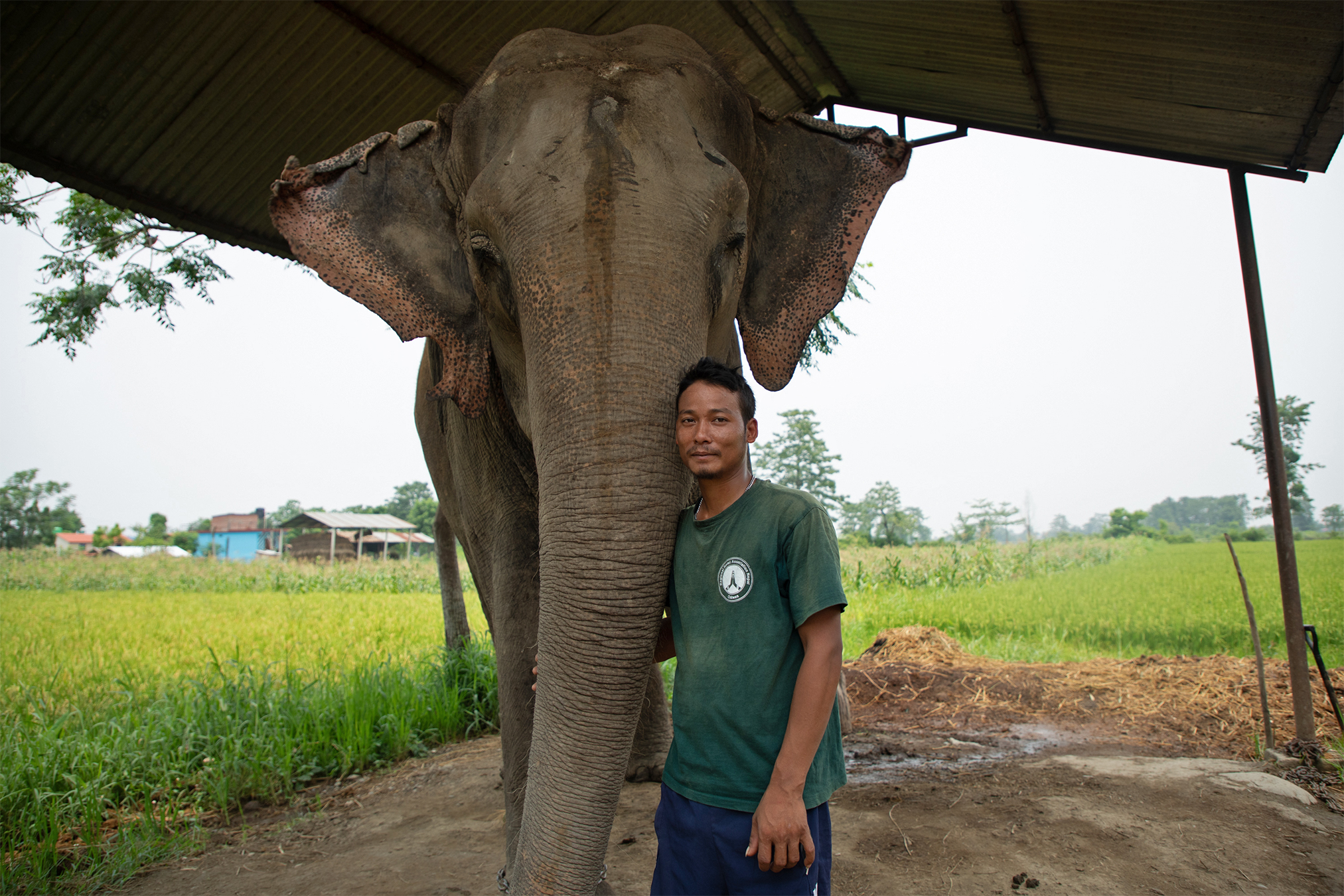
Working elephants in Nepal allow crucial access to hazardous terrain for organizations like the National Trust for Nature Conservation to manage wildlife populations.The practice of using trained elephants is controversial and poses safety risks to both the elephants and the mahouts who work with them.Nepal’s working elephant populations are maintained through a breeding center near Chitwan National Park, but there’s a risk of population decline due to factors such as disease.New conservation techniques like genetic ID-based monitoring may come to rival the direct, elephant-borne approach for work such as the five-yearly rhino census. CHITWAN NATIONAL PARK, Nepal — Perched some 3 meters off the ground, or about 10 feet, on the back of Asian elephants, workers traverse Nepal’s dense jungles and grasslands to complete wildlife counts, rescue distressed animals, and manage wildlife such as tigers (Panthera tigris) and greater one-horned rhinos (Rhinoceros unicornis). Working elephants have long played an important role in the conservation of Nepal’s wildlife and wildlands. Their height and sharp sense of their surroundings keep researchers safe from tigers and other predators, and they’re also used on patrols. But dwindling captive elephant populations and opposition to using the highly intelligent animals as beasts of burden are changing the long-term outlook for working elephants and the men known as mahouts who work with them. Dr. Amir Sadaula works closely with elephants and mahouts as a veterinary officer at the National Trust for Nature Conservation (NTNC), which operates a biodiversity conservation center on the edge of Chitwan National Park. There, NTNC employs eight trained elephants and teams of mahouts to aid in wild animal rescue and research work. “Without [the] elephant, we could not do the rescue,” Sadaula says. Mahouts Promod Chaudhary, left, and Upendra Kachadiya enter a river for their elephants to bathe while returning from grazing in Chitwan National Park, Nepal, on May 19, 2026. Image by Henry Doellinger for Mongabay. In addition to elephants that aid researchers, privately owned elephants also walk the streets of Sauraha, a community adjacent to Chitwan. Tourism companies in the gateway community often own one or two elephants and offer elephant rides to tourists as a way to experience wildlife up close. Captive elephants around Chitwan typically work with one to three mahouts. Nepal’s Elephant Conservation Action Plan (2025-2035) recognizes the importance of maintaining the captive elephant population. It also acknowledges that elephants are vulnerable to diseases like tuberculosis and elephant endotheliotropic herpes virus, and that their treatment is dependent on limited funding and resources. “Captive elephants in Nepal do not appear to have a future in itself unless strategic management intervention is made,” the plan says. “Captive and trained elephant population is crucial for the management of Tarai national parks and wildlife reserves and for special works such as wildlife population monitoring, rescue and translocations, and patrolling.” The Tarai, or Terai Arc, is the lowland expanse that straddles southern Nepal and part of India, where iconic species like tigers and rhinos roam. Mahouts use the sensitive area behind an elephant’s ear to steer the animals through Chitwan National Park. Image by Henry Doellinger for Mongabay. Mahout Promod Chaudhary returns with his elephant to the NTNC center on the edge of Chitwan National Park. Image by Henry Doellinger for Mongabay. In the field On a typical day, a couple of mahouts will take an elephant to harvest bundles of tall grass at the crack of dawn. Back at the stables, others bundle the grass with grain to feed the elephants. This structure can be hierarchical: senior mahouts ride while others work bundling food and cleaning stalls. Mahouts eat and change into fresh clothing before the bulk of their day’s work begins around 9:30 a.m. They heat water over a fire and sharpen sickles on a wet block. When they’re ready, they unchain the elephants, and command them to kneel on the grass, ready to accept a rider. The first and last stop of their day is in a river to bathe. The mahouts perch barefoot on the back of their elephant, balancing to avoid the water. At their command, the elephants roll and shower in the swirling stream. Clean and satisfied, the elephants exit the river and walk into the brush, grazing on the banks of tall grass until the late afternoon. During conservation work, the elephants’ days are busy. The NTNC facilitates a rhino census every five years across the country’s rhino habitat. The last was in 2021, employing 57 elephants and 350 people, 250 of whom conducted a count across of Chitwan National Park, according to the 2021 report by the NTNC. The next census was due this year, but has been pushed back to next year over budget delays. Mahouts pile bundles of grass in a rainstorm after a morning harvest. Image by Henry Doellinger for Mongabay. Local mahout Laxmi Das Tharu prepares food for his elephant, Jana Kikali, in Sauraha, near Chitwan National Park. He has worked with the 35-year-old elephant for 18 years. Image by Henry Doellinger for Mongabay. From the back of the elephants, census takers can look down and across the tall grasses to directly observe individual rhinos — something they wouldn’t be able to do if they were walking on the ground or driving in a jeep. Researchers say they prefer the direct observation method of counting rhinos, describing it as more accurate and effective. However, new technologies make it possible to determine the population size without actually laying eyes on each individual animal. ID-based monitoring uses field observations to create a genetic profile for each animal and allows the count to be made by analyzing dung samples or distinct markings. During direct observation, the elephant-borne census teams sweep through the forest until each rhino is found, recorded, and allowed to pass through their phalanx. This practice, according to researchers, mitigates the risk of inaccurate data. To ensure the reliability of the data, the process is intense. The elephants and staff may encounter the park’s wild elephants, such as Dhurbe, an adult bull notorious for aggressive encounters with humans. Dhurbe attacked and injured several census workers in 2021. Tigers, too, can pose a threat: one killed a mahout during the 2021 census in Bardia National Park, northwest of Chitwan. “We can’t go near elephants or tigers without elephants,” says Harindra Chaudhary, a mahout for more than three decades. “We can only dart an animal if it is within 30-foot [9-m] range only.” He adds this is important as the national parks don’t have much in the way of drivable roads. During tiger captures, the backs of elephants provide a necessary perch to locate, move, and dart the big cats. The hefty pachyderms also confer an aspect of security to the task that would not be possible on foot. “There are other animals also which can harm humans. So for the safety reason, especially, the elephant is for the safety,” Sadaula says. Mahout Promod Chaudhary’s elephant sprays water on its back in a river in Chitwan National Park, Nepal, at the end of their day. Image by Henry Doellinger for Mongabay. Mahout Upendra Kachadiya dismounts his elephant, Prakriti Kali, at NTNC’s biodiversity conservation center after hours of grazing in Chitwan National Park. Image by Henry Doellinger for Mongabay. Welfare concerns Elephants and mahouts working for the NTNC live near the biodiversity conservation center. The elephants are kept chained to posts on mounds of dirt and sheltered by metal roofs. Their living conditions are similar to those of privately owned elephants or the elephants kept separately by the military, which uses the animals in antipoaching operations. A 2022 study published in the Journal of Applied Animal Welfare Science found that captive elephants in Nepal lacked legal protection, and cited welfare concerns for both tourism elephants and those used for antipoaching and conservation work. According to a 2014 assessment, 82% of elephants in Sauraha, the tourism town outside Chitwan, lived in “unsuitable conditions.” The NTNC has now moved to improve conditions. In September, it signed an agreement with Thailand’s Safe Elephant Foundation. The first target is the breeding center in Khorsor, Chitwan, where NTNC member secretary Chiranjibi Pokheral says the focus will be on how the elephants are fed, housed, and treated by vets, and on how their welfare is measured. A sign against riding elephants sits in front of Mowgli’s Eco-Adventure Tours in Sauraha. The company makes it a point to not offer elephant rides, citing welfare concerns. Image by Henry Doellinger for Mongabay. Naturalist Basu Bidari, a guide since 2002, and former president of Nepal’s Nature Guide Association, says he believes that riding any animal is cruel, especially elephants. He instead offers jeep safaris, overnight trips, and other non-elephant adventures — alternatives that he describes as part of a successful business model. “Every living creature born here, they have to live here. We don’t want to give any punishment,” Bidari says. Despite this, he says he recognizes that elephants do provide a necessary service in the conservation field, and that the burden they bear is often less than in the tourism industry. Elephant tour groups return from jungle safaris in Sauraha. Tour companies conduct several elephant rides a day, and NTNC offers guidance on elephant health and safety. Image by Henry Doellinger for Mongabay. Elephants are taken to graze after carrying tour groups in Chitwan National Park. Image by Henry Doellinger for Mongabay. A time of change Working elephants have been used for thousands of years across Asia, and the job of handling them has been handed down for generations. Today, the supply of working animals is dwindling in Nepal. That decline makes it harder for elephants and mahouts to establish the long-term relationships that are at the heart of the working elephant trade. The work of mahouts is traditionally an ancestral job, especially in the indigenous Tharu community that was displaced to make way for Chitwan National Park in 1973. Sauraha tourism mahout Santosh Mahato came into the job through his father, and mahout Laxmi Das Tharu through his uncle. They’re usually hired on a contract basis, which leads to inconsistency in mahout staffing that can have an adverse effect on elephants, according to the action plan. “The recruitment of permanent Mahout staff on government hattisar [elephant stables] has not been done for a long time which may have impacted elephant health and husbandry due to frequent changes of Mahouts employed on a contract basis,” the plan says. A rope dangles from one of NTNC’s elephants as it’s taken to graze in Chitwan National Park. Image by Henry Doellinger for Mongabay. Mahouts say they’re not consulted regularly, according to Chaudhary, the mahout at the NTNC breeding center. Pokheral says the NTNC wants to talk with mahouts more. The Thailand agreement is about care at the existing Khorsor center, he says, not about establishing a sanctuary; the NTNC would consider a sanctuary only if the government agreed in principle, Pokheral adds. The NTNC also plans to update mahout training, with more focus on humane handling and welfare. In the research and government field, elephant populations are maintained through the elephant breeding center, which houses 21 captive elephants. But the supply of elephants for private use is less steady, and elephants are often imported from India. Both populations are at risk of disease. Seven calves died in the last decade due to elephant endotheliotropic herpes virus, according to the action plan. The NTNC offers annual mahout training and elephant health services around Chitwan. The NTNC may maintain a steadier source of elephants than the tourism industry, but ID-based monitoring and an overall change in support for the industry are driving forces behind a shift in the number of elephants it needs. Mahout Upendra Kachadiya rechains his elephant, Prakriti Kali, in its housing outside the NTNC center. When not being used for work or grazing, the elephants are kept chained under metal roofs. Image by Henry Doellinger for Mongabay. Going forward The NTNC continues to use elephants for crucial work, such as the rhino census, but researchers are exploring alternative methods that could replace them in some cases. ID-based monitoring, for example, identifies unique marks on each animal so they can be tracked without covering large blocks of forest on elephants. However, the NTNC says it doesn’t foresee a complete shift away from the use of elephants. “There might be technologies like drones that can help us to reach the inaccessible parts of a dense forest along the gorges and ravines of Churia hills,” the organization says in an email. “There might be vehicles that can transport heavy loads in rough terrains. But the efficiency and reliability of an elephant and its mahout cannot be replaced by any modern technology.” Nepal’s next rhino census is set to be in 2027, after this year’s scheduled census was delayed over budget reasons. The schedule and methodology have still not been finalized, says Sadaula, the NTNC vet. Some official reports anticipate that the census will include a mix of genetic methods in Chitwan and the elephant sweep method elsewhere in Nepal. Sadaula says he worries more about supply. “Eventually, in the long run, [if] we do not have the regular supply of the elephant in the privately owned camp, there could be a drought of elephants,” he says. “If you look around here, there will be around 41. For the next 20 years, we’ll have around 20-25 captive elephants, in 30-40 years’ time we will have only five or six. It’s going down.” Mahout Promod Chaudhary returns with his elephant to NTNC’s center. Image by Henry Doellinger for Mongabay. Banner image: Local mahout Santosh Mahato stands for a portrait with his elephant, used for tours, in Sauraha, Nepal, on May 19, 2026. Image by Henry Doellinger for Mongabay. This story is published through a collaboration between Mongabay and the University of Montana’s School of Journalism. Students traveled to Nepal in May 2026 to report on wildlife, conservation, and other environmental issues. You can read more about the program here. Citation: Szydlowski, M. (2022). Elephants in Nepal: Correlating disease, tourism, and welfare. Journal of Applied Animal Welfare Science, 25(2), 126-138. doi:10.1080/10888705.2022.2028628 Credits Topics
Photos: Elephants maintain an essential role in conservation in Nepal despite shifting norms
Full Article
Original Source
Read the full article at News →KhanList aggregates and links to publicly available news content. We do not host full articles from third-party sources. Always verify important information with original sources.