
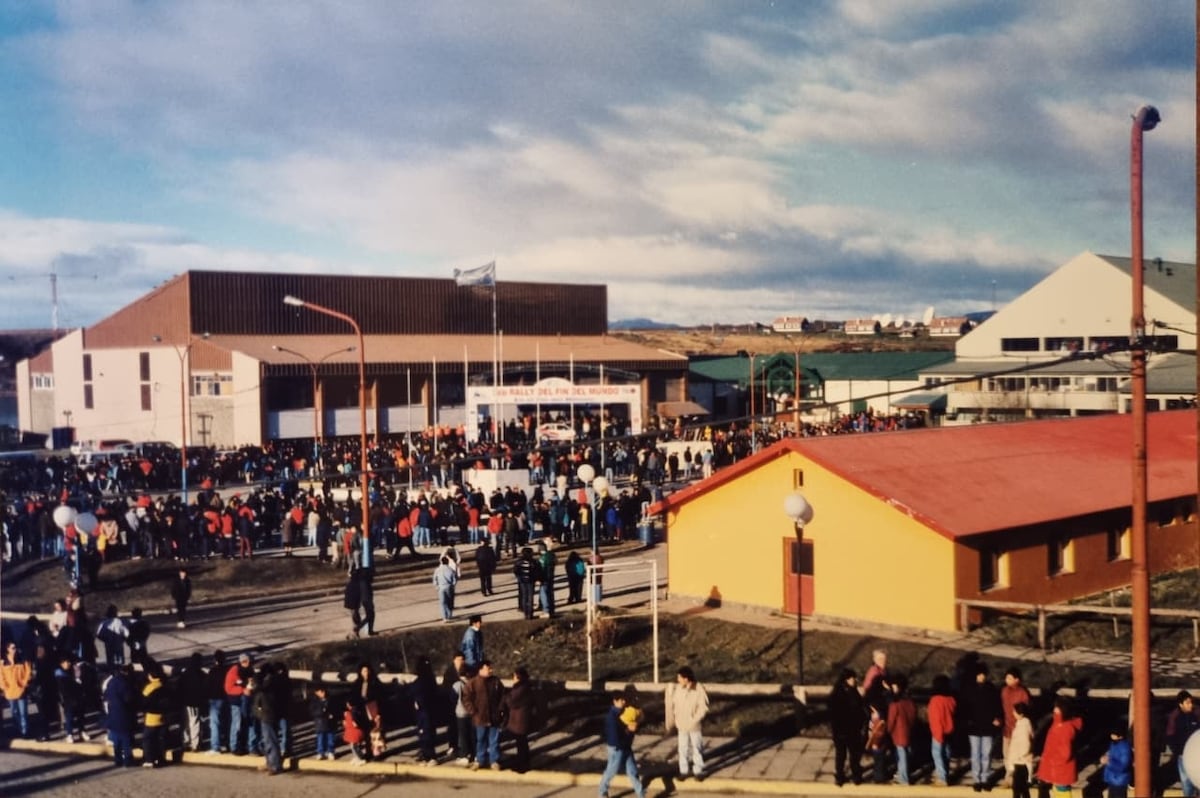
The project was, like many others, born of curiosity — a message in a bottle. A message that, in the end, someone picked up on the other shore. Carolina Bozzano de la Llosa runs an enterprise that sells brooches inspired by the identity of Tierra del Fuego, Antarctica, and the South Atlantic Islands, Argentina’s youngest and southernmost province.She decided to give some of her products to the brand’s social media followers and, in exchange, asked them to send old keepsakes from the province in Patagonia. “I thought no one would send in any material, but the exact opposite happened,” says the entrepreneur. “A huge number of photos started coming in. I repeated the call for submissions, and the same thing happened. So I thought, ‘There’s something about us Fuegians when we see our photos, our history.’”Surprised by the response, she contacted Victoria del Valle and Dina Rakhimzhanova, two artists and cultural managers from the province who run the Alpina graphic fair. The initial idea was to mount a photographic exhibition with the collected material, but they went further and created Álbum: Archivo Fotográfico Fueguino (Album: Fuegian Photo Archive), an initiative that brings together photographs and other documents about living in Tierra del Fuego between 1980 and 2000.The initiative began in February 2026 and now includes more than 450 photographs contributed by the community. A large portion of the material was added during digitization days in Ushuaia, Río Grande, and Tolhuin, where residents brought their albums to share images and tell their stories. The activities were made possible by the Futura program run by the Centro Cultural de España in Buenos Aires, with support from Fundación Williams.The project takes place in a province whose population was formed through successive waves of migration. One of the main turning points was the passage of the Industrial Promotion Law in 1972, which spurred a steady influx of new residents. Tierra del Fuego grew from 13,527 inhabitants in 1970 to 101,079 in 2001. Del Valle recalls: “People came from all over the country, and it created a very unique mix. In my family’s case, photographs were the only way to show my grandparents — who weren’t here — how we were growing up. There’s a lot of that loving gesture in the act of taking a photo to show those who are far away what the family was like.”During the digitization sessions and via a virtual form, images of everyday life began to appear. You can see families playing in the snow, workers from factories that have since closed their doors, vanished trades and farewells at the airport in a harsh winter. That family microcosm also documents the province’s economic, urban, and social transformations. “We thought it was important for people to realize that something they had tucked away at the bottom of a drawer could be relevant information for others,” adds Del Valle. “They were moved to see their photos on display and to discover that people who may not be central figures in national history are, in fact, central figures in our own history.”Tierra del Fuego, Antarctica, and the South Atlantic Islands became a province in 1991, shedding its status as a national territory. Its recent history poses the challenge of preserving a collective memory that gathers the experiences of those who arrived and helped build its identity. “Often the preservation of memory depends more on people than on institutions capable of maintaining those archives over time. Added to that is defunding, which causes part of that heritage to be lost,” says the project’s leader.When they began working on the archive, the creators also contacted Betiana Bellofatto, a photographer who specializes in image preservation. “We talked with people about how to care for photographs, what to bear in mind and which environmental factors can affect them, such as temperature and humidity,” explains the expert who, together with Florencia Díaz, runs Notro Espacio, a platform specializing in photographic preservation.Bellofatto also highlights the value of the project for reconstructing the territory’s history. “The women are creating a collective archive of photographs related to the habitat of Tierra del Fuego. It’s a way to begin reconstructing something very particular about the territory and a way of life that is different from other places.”María José Burgos is a conservator, researcher and lecturer specializing in photographic archives. She currently coordinates the conservation area of Fototeca ARGRA (Association of Photojournalists of the Argentine Republic) and advises museums, collections, and documentary holdings across the country. For Burgos, the value of initiatives like the Álbum project is that they make it possible to work on a community’s memory, identity, and heritage. “Modes of life, particular moments, spaces or places that no longer exist are recorded. Photos contain a lot of information,” she says.For the specialist, the challenge is guaranteeing the continuity of these initiatives. The tasks of collecting, digitizing, cataloging, and disseminating require technical knowledge and standards, so she considers it essential to form alliances with specialized organizations and state or municipal institutions. “Preserving memory is a political act,” she says. She also urges reflection beyond the recovered images; she invites thinking about the photographs that were never taken, the families who could not record their lives, and the place those absences occupy in a community’s memory.Álbum: Archivo Fotográfico Fueguino will continue its work with new digitization days planned for next year and the development of a website that will allow the archive to be consulted as a complement to its work on social media. Bozzano de la Llosa dreams of Álbum continuing to grow and becoming an increasingly large public and accessible archive. “Our idea was never to collect the photos to keep them to ourselves, but to share them so everyone can see them. We would like people to keep contributing information about each image because often someone recognizes a detail, a date, or a place that helps complete the story.”Sign up for our weekly newsletter to get more English-language news coverage from EL PAÍS USA Edition
Photographs forgotten in a drawer that now tell the story of Tierra del Fuego
Full Article
Original Source
Read the full article at English →KhanList aggregates and links to publicly available news content. We do not host full articles from third-party sources. Always verify important information with original sources.