
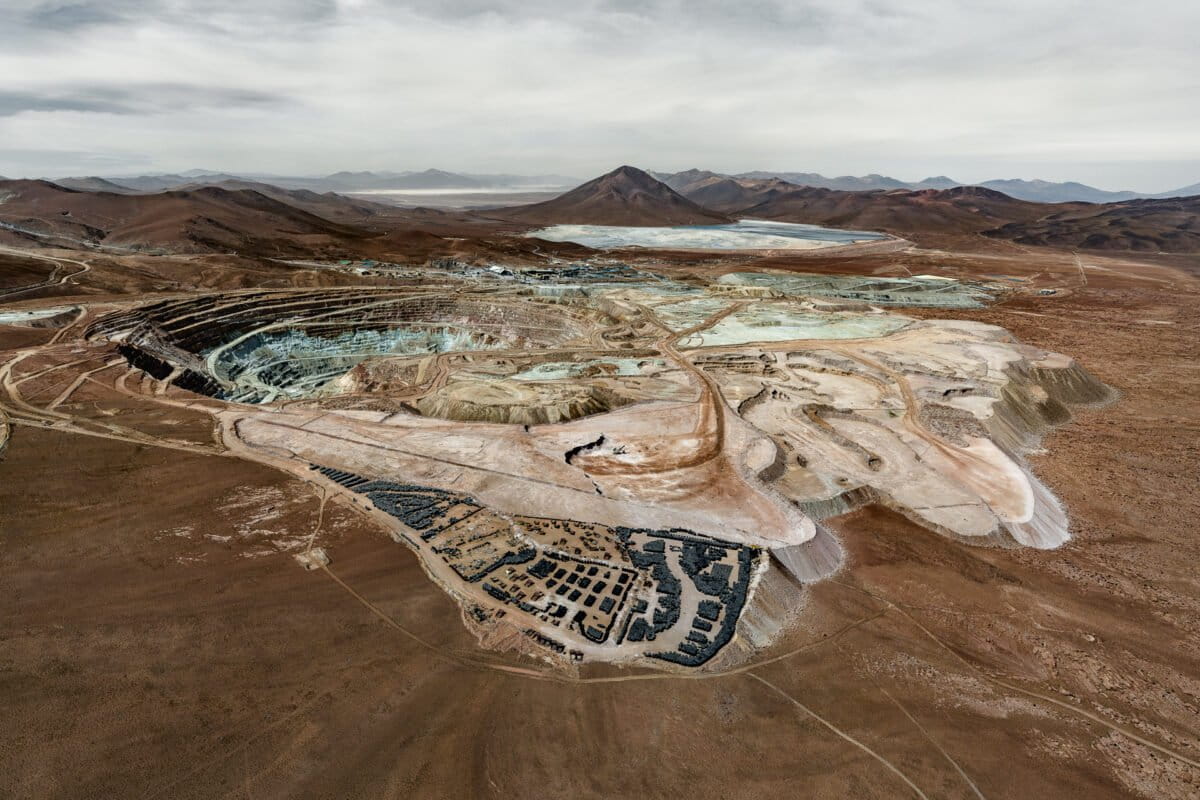
As the world shifts to cleaner energy to address climate change, demand is soaring for transition minerals such as lithium, cobalt, nickel, and rare earth elements, used in green technologies.Aerial photographer Tom Hegen has spent the past six years documenting where these critical minerals come from, exploring some of the world’s most significant mining regions.Hegen’s images reveal in meticulous and beautiful detail the wider landscapes impacted by mineral extraction, highlighting the environmental, social, and geopolitical costs.In this interview with Mongabay, Hegen says he hopes his images encourage viewers to look closer and consider how their actions and consumption habits can support greater responsibility, transparency, and accountability throughout global supply chains. From the air, the vivid lithium fields of Chile’s Atacama Desert look like an intricate computer circuit board, hinting at the technological destination of this increasingly crucial mineral. Photographer Tom Hegen has spent the past six years documenting some of the world’s most significant mining regions that supply the critical minerals needed for modern technologies and the green energy transition. Shooting primarily aerial images using small aircraft, drones, and high-resolution cameras, Hegen captures heavily impacted landscapes in meticulous detail. His images depict vast, immersive scenes of the wider consequences of mineral extraction that might otherwise remain hidden from view at ground level: snaking watercourses discolored by mercury, settlements disappearing under piles of mining waste, and coastal sediment plumes smothering artisanal fishing grounds. “An elevated perspective offers a powerful way to observe, understand, and reflect on how we have transformed the Earth’s landscapes,” Hegen told Mongabay. By creating visually striking images, Hegen said he hopes to encourage people to look more closely. Lithium mining in the Atacama Desert, Chile, 2021. Lithium is one of the key elements in electric batteries, with global demand for the metal expected to surge to 25 times the amount being mined today. Image courtesy of Tom Hegen. A prior photographic project documenting the effects of climate change in the Arctic sparked Hegen’s interest in the energy transition and the critical minerals on which it depends. Although research suggests expanded mining to meet the demands of the energy transition would require less mining overall than the current fossil fuel-based system, Hegen’s work inspires questions about who bears the costs of this shift. “What particularly caught my attention was that many of these resources are concentrated in just a handful of countries, [and] their extraction often comes with significant environmental and social consequences that receive relatively little public attention,” he said. Now having spent significant time in the field among ecosystems and communities facing pollution, health risks, and deforestation, Hegen said he’s come to realize that no type of energy comes with zero environmental or social consequences. “The central question is not whether we should pursue the energy transition,” he said, “but how we can make it more sustainable and equitable.” Mongabay’s Carolyn Cowan interviewed Tom Hegen in October, ahead of the launch of his book The Mineral Age, which features a wide selection of his photography exploring the environmental, social, and geopolitical costs of the transition to green energy. Tom Hegen operates a drone fitted with a high-resolution camera in Borneo. Image by Lennart Steffens. Mongabay: What led you to spend six years documenting mineral extraction around the world? Tom Hegen: I initially began photographing coal mining in Germany, while also exploring the visible impacts of climate change. Through this work, I came to understand that decarbonizing our economy would be one of the defining challenges of the current century. As I researched the energy transition more deeply, I found out that low-carbon technologies, along with much of our modern technological infrastructure, depend on vast quantities of minerals such as lithium, cobalt, nickel, and rare earth elements. While we are trying to move away from fossil fuels, the transition requires an enormous expansion in the extraction of these critical minerals. What particularly caught my attention was that many of these resources are concentrated in just a handful of countries, creating new geopolitical dependencies and vulnerabilities. At the same time, their extraction often comes with significant environmental and social consequences that receive relatively little public attention. This realization became the starting point for The Mineral Age, a six-year photographic project documenting mining regions around the world that supply the essential raw materials underpinning our technological progress and the transition to a low-carbon future. Mongabay: As you say, many of the minerals you document are increasingly crucial for developing renewable energies, electric vehicles, and other technologies associated with the energy transition. Has documenting their extraction changed the way you think about the idea of renewable or “clean” energy? Tom Hegen: Documenting these mining regions has made me realize that moving away from fossil fuels is far more complex than we might initially imagine. At the same time, I have no doubt that decarbonizing our economies and the way we live is essential in order to address climate change. The pressing question, however, is at what cost, and who ultimately bears that cost? As our societies become increasingly digitalized and technologically advanced, and as we accelerate the energy transition, we will need never-before-seen quantities of critical minerals in the coming decades. What I’ve come to understand is that no source of energy is entirely without environmental or social consequences. Even technologies we consider clean or renewable depend on extensive industrial processes and the extraction of finite resources. Gemasolar Solar Power Plant in Spain. Image by Tom Hegen. Mongabay: What can aerial photography reveal about the impacts of mining that might escape ground-level observations? And what might it miss that on-the-ground reporting could help reveal more about? Tom Hegen: The true scale and environmental impact of mining operations are often almost impossible to comprehend from ground level. The aerial perspective allows us to see the bigger picture, revealing how entire landscapes are transformed by extraction, infrastructure, waste deposits, and pollution. It makes patterns, dimensions, and connections visible that would otherwise remain hidden. Through my photography, I focus on the broader environmental footprint of our collective activities rather than on individual stories on the ground. At the same time, I recognize that there are many different perspectives from which these issues can be explored. Behind these landscapes are countless human stories, particularly those of miners, local communities, and people whose livelihoods and environments have been affected by resource extraction. I see aerial photography and ground-level reporting as complementary approaches, each revealing different aspects of the same complex reality. Mongabay: Once you began photographing mining landscapes, were you surprised by anything you were capturing in your images that you hadn’t anticipated when you first conceived the project? Tom Hegen: From my initial research, I knew that many of the so-called critical minerals are found in developing countries, particularly across the Global South. I also anticipated that accessing some of these mining regions would be challenging, as they are often extremely remote, heavily restricted, or shielded from public view. In some cases, such as the Democratic Republic of Congo, it took me more than two years to gain access and photograph the mining sites. Mining waste from a cobalt mine in the Democratic Republic of Congo encroaches on a village. Image courtesy of Tom Hegen. What surprised me most was just how complex the extraction of these minerals is, and the scale of the environmental, social, and political challenges involved. Many of these resources are extracted in regions where environmental regulations are weak or poorly enforced, where child labor remains a serious concern, and where mining operations can have devastating consequences for local communities and ecosystems. As the project developed, I became increasingly aware of a side of the energy transition that remains largely invisible to those of us living in industrialized countries. We tend to focus on the benefits of clean technologies, but rarely consider where the raw materials come from or the conditions under which they are extracted. Seeing these realities firsthand made me realize just how much of the environmental and social cost of our technological progress is borne by communities far removed from those who ultimately benefit from it. Mongabay: Do any landscapes or encounters stand out to you in particular? Tom Hegen: What struck me most was the scale of environmental destruction, particularly in developing and low-income countries. In places such as Indonesia and the Democratic Republic of Congo, mining often takes place under weak or poorly enforced environmental regulations, with severe consequences for local communities and ecosystems. Both large multinational mining companies and local artisanal miners are involved, although they operate under very different circumstances. One thing I came to realize is that wherever there is a valuable mineral deposit, there is a will to exploit it, even in the most remote corners of the planet, deep within tropical rainforests or beneath the ocean floor. On Bangka Island in Indonesia, for example, I documented tin mining operations that extract minerals from the seabed, damaging marine ecosystems and threatening the livelihoods of local fishing communities. On the island of Sulawesi, vast areas of tropical rainforest are being cleared to make way for nickel mines and processing facilities, fundamentally transforming entire landscapes. In the Democratic Republic of Congo, I witnessed artisanal miners digging deep underground shafts to extract cobalt, often risking their lives under extremely dangerous working conditions. Commercial and artisanal seabed tin mining, Bangka Island, Indonesia, 2025. Image courtesy of Tom Hegen. Mongabay: You photographed enormous industrial mines and also the expansion of artisanal mining. What did you learn about the different pressures and consequences for communities living in informal mining areas? Tom Hegen: An estimated 50 million people worldwide depend directly on artisanal and small-scale mining to generate income. Some are drawn by the opportunity to benefit from their region’s mineral wealth, while many others have few alternative sources of income and risk their lives to earn just a few dollars a day. So it becomes a matter of survival for them. In the Democratic Republic of Congo alone, an estimated 2.5 million people are involved in artisanal mining. Globally, around 20 million people are estimated to work in small-scale gold mining. Unlike large industrial operations, artisanal mining is often informal, which means limited regulation, oversight, or safety standards. Men, women, and sometimes children work under extremely hazardous conditions, using little more than shovels, picks, or their bare hands to extract minerals from the earth. Without adequate safety measures, miners face the constant risk of tunnel collapses, injuries, and exposure to toxic substances. The environmental consequences can be equally severe. In Borneo, for example, informal gold mining has transformed vast areas of tropical rainforest into landscapes of excavated pits, sediment-filled waterways, and contaminated soils. On Bangka Island, small-scale tin mining has left extensive scars across the landscape and contributed to the degradation of coastal ecosystems. In my work, I document all these places and make the enormous scales visible. Clandestine gold mining in central Borneo, Indonesia. The red color in the river is caused by the use of mercury to extract the gold from other sediments, contaminating the ecosystem and food chains. Image courtesy of Tom Hegen. Mongabay: Did you encounter any examples of well-regulated mining that gave you a sense of what could be done differently across the sector to minimize impacts? Tom Hegen: In some places, particularly in industrialized countries, environmental regulations for mining companies are extremely high, and they have responsibilities to restore their sites. During my research, I frequently encountered terms such as “green mining” or “sustainable mining,” which I find somewhat problematic. Mining is inherently resource-intensive and inevitably leaves an environmental footprint. Even with the most advanced technologies and strictest regulations, extracting minerals from the Earth will always involve some degree of environmental disturbance. However, that doesn’t mean the industry cannot improve. I believe there is considerable potential to reduce its environmental and social impacts through stronger regulations, more responsible practices, and greater transparency. Public awareness and political pressure can play an important role in driving these changes. Mongabay: Has photographing mineral extraction in such depth led to any reflections on what we, as humans going about our daily lives, perhaps overlook about our patterns of consumption? Tom Hegen: I think what we most often overlook is how little we actually know about the products we use every day: what they are made of, where their raw materials come from, and what it takes to extract them. Global supply chains have become incredibly complex, making it increasingly difficult to connect the devices and technologies we rely on with the landscapes their resources originate from. Particularly in industrialized countries, we have effectively outsourced many of the environmental and social consequences of resource extraction to distant regions of the world. What we don’t see, we tend not to think about. At the same time, we often don’t accept these kinds of industrial activities in our own backyards. Forests cleared for nickel ore in Sulawesi, Indonesia. Image courtesy of Tom Hegen. Ultimately, I think we need to be careful not to simply replace one extractive industry with another, shifting the environmental and social burdens of our energy transition to mineral-rich countries, often in the Global South. The central question is not whether we should pursue the energy transition, but how we can make it more sustainable and equitable. That requires far greater responsibility, transparency, and accountability throughout global supply chains, but also a more conscious understanding of our own consumption habits. We need to recognize that every product, every technology, and every form of energy comes with a material footprint, even if its consequences are largely invisible to us. Mongabay: You’ve recently been presenting some of your work ahead of the launch of your book, The Mineral Age. How has it been received so far? Has it prompted any particular interest or action from within the mining or energy industries? Tom Hegen: The Mineral Age will be published at the end of October, so the project is still at a relatively early stage in terms of reaching a wider audience. It will naturally take some time for the book to circulate and for the work to gain broader visibility. In the coming months, I’m planning to present the project through more talks and, hopefully, some major exhibitions. So far, I’ve already noticed a strong interest in the subject, which is very encouraging. It shows that people are increasingly curious about the issues related to mining. The Morowali Industrial Park in Sulawesi, Indonesia, is the world’s largest nickel processing complex, a vast maze of smelters, factories, two seaports, and a private airport. Image courtesy of Tom Hegen. Mongabay: What do you hope people take away from viewing your work? Are there particular questions you hope it spurs readers to think about? Tom Hegen: I believe that photography can spark curiosity, encourage conversations, and raise awareness of these complex issues. Ultimately, I don’t want to provide simple answers, but rather encourage people to reflect, ask questions, and develop a greater awareness of the connections between our everyday lives and the landscapes we transform around the world. Banner image: The Ujina copper mine in northern Chile, situated at an elevation of 4,300 meters (14,100 feet), is one of the highest copper mines in the world. Image courtesy of Tom Hegen. Carolyn Cowan is a staff writer for Mongabay. Her reporting focuses on wildlife, ecology, and communities responding to environmental challenges across Southeast Asia. See related story: Mining controversies: The hidden toll of green energy FEEDBACK: Use this form to send a message to the author of this post. If you want to post a public comment, you can do that at the bottom of the page. Credits Topics
Photographer Tom Hegen’s aerial eye reveals the true scale of the critical mineral age
Full Article
Original Source
Read the full article at News →KhanList aggregates and links to publicly available news content. We do not host full articles from third-party sources. Always verify important information with original sources.