
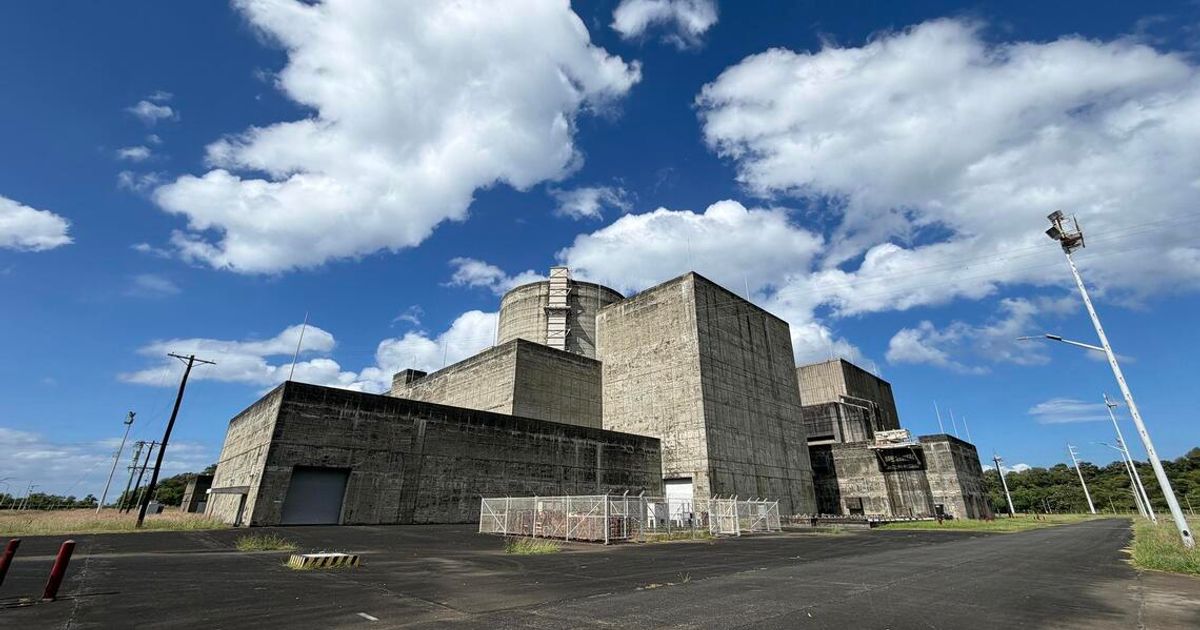
BATAAN, Philippines – Time seems to have stood still inside the Bataan Nuclear Power Plant (BNPP), where a vision of the Philippines’ energy future has lain dormant for four decades.Some of the machinery remains wrapped in the plastic it came in, while much of the original paintwork remains intact. Elsewhere, rust has crept over metal stairways and cobwebs have gathered, marking the passage of time in a facility that has never generated electricity commercially.In some parts of the plant, the lights are switched on only when visitors come through. Some original fittings have been replaced with energy-saving LED bulbs, a small concession to modernity in a facility that has otherwise remained largely unchanged since the 1980s.Now, 40 years after the plant was mothballed, the Philippines is making one of its most concerted pushes yet for nuclear energy. The government is exploring foreign nuclear technologies, identifying potential sites and drawing up plans to award a nuclear power project by the end of 2027.But the shadows of the past loom over President Ferdinand Marcos Jr’s renewed nuclear ambitions: the legacy of his father’s dictatorship, allegations of corruption that dogged the construction of the power plant, and longstanding safety concerns that have fuelled resistance to its revival.In the decades since it was mothballed, the Philippines’ only nuclear power plant has found another purpose: educating people about the technology the country has yet to harness. It continues to draw university students, journalists, politicians and nuclear energy experts from overseas.During a visit by The Straits Times on Nov 10, BNPP employee Mc Reynold Layug led a tour of the containment building housing the reactor, offering a rare glimpse into areas that would ordinarily be inaccessible to the public at an operational nuclear power plant.He explained how the building’s metre-thick concrete walls and steel lining were designed to contain radioactive material in case of an accident, contrasting its design with that of the reactor involved in the 1986 Chernobyl nuclear disaster, which lacked a comparable containment structure.“Here, we have a containment building. So if an accident were to happen, the radiation would be contained. Nothing would escape to the environment,” Layug asserted, his voice echoing across the chamber.Bataan Nuclear Power Plant employee Mc Reynold Layug (left) and National Power Corporation division manager Noel Germano in the plant’s main control room. ST PHOTO: MARA CEPEDAWhether these protective measures meet modern-day nuclear safety standards, however, would have to be established before the BNPP could be revived.But, while the staff spoke enthusiastically about the inner workings of the facility, they were noticeably more circumspect when questions touched, even indirectly, on the politics surrounding its revival. Their standard response was to refer such queries to more senior government officials.For now, their job is to preserve the plant. Its future lies in the hands of others.Marcos pushes for nuclear anewMarcos has made little secret of his disappointment over the Philippines’ decision to mothball the nuclear power plant built under his father’s administration (1965-1985).During a visit to the Singapore Nuclear Research and Safety Institute on Oct 10, Marcos lamented that the Philippines had already made considerable headway in its nuclear programme by 1986, including training professionals whose expertise was never put to use in operating a nuclear power plant.“We already managed to do the first and the second (phases), and too bad, they stopped it,” he told reporters then.Marcos also argued that the need to lower electricity prices, among the highest in South-east Asia, was changing public attitudes towards nuclear energy despite longstanding safety concerns.“We don’t care where our power comes from, but bring it more cheaper,” he said, describing the sentiment among Filipinos grappling with rising electricity bills.His renewed push for nuclear energy, reaffirmed in his State of the Nation Address in July, has taken on greater urgency amid the Iran war and disruptions to oil and gas shipments through the Strait of Hormuz.The energy crisis has exposed the Philippines’ vulnerability to imported fossil fuels and given fresh impetus to nuclear discussions elsewhere in South-east Asia, including Singapore and Malaysia, as governments seek to diversify their energy sources and reduce their exposure to global fuel supply shocks.But rehabilitating the BNPP is not the only option being explored by the Marcos administration.The Philippines is also looking at newer technologies, including small modular reactors, which have smaller generating capacities than conventional nuclear reactors and can be deployed incrementally as electricity demand grows.On Nov 20, Energy Secretary Sharon Garin told reporters that the Philippines was exploring nuclear technologies from the United States, Russia, Canada, Japan and South Korea, including those offered by Russian state-owned nuclear energy corporation Rosatom.The Department of Energy (DOE) has also identified seven potential nuclear power plant sites across five provinces – Bataan, Palawan, Masbate, Pangasinan and Camarines Norte – although none has been formally selected. One of the proposed sites in Bataan is the location of the mothballed BNPP.Patrick Aquino, director of the DOE’s Energy Utilization Management Bureau, told ST that the Philippines was moving beyond policy discussions towards institution building and project preparation.Under a draft timetable, the government aims to invite companies to bid for a nuclear power project in June 2027 and select the winning bidder by December that year, with the first delivery of electricity targeted for 2038.The Philippine Energy Plan (2023-2050) envisions 1,200MW of nuclear capacity initially, rising to 4,800MW by 2050, alongside expanded wind and solar power.While a law enacted in 2025 established the Philippines’ independent nuclear regulator, its staffing and licensing regulations remain unfinished. The country has also yet to finalise its nuclear emergency response arrangements or develop the necessary infrastructure to manage spent nuclear fuel and radioactive waste.Aquino said a large nuclear power project would require several billion dollars in investments, with the government exploring private sector participation and public-private partnerships.“The objective is straightforward: make the project bankable without writing a blank cheque either to the developer or to taxpayers,” he said.Whether rehabilitating the Bataan plant would prove more economical than building a new one remains an open question, experts say.A plant frozen in timeConstruction of the 620MW facility, designed by American firm Westinghouse, began in 1976 under Ferdinand Marcos Sr. Completed in 1984, the plant was left idle in 1986, the year a popular uprising toppled his dictatorship.Since then, the state-run National Power Corporation (Napocor) has been tasked with preserving the facility.Today, just 15 Napocor personnel are assigned to the plant, supported by 46 utility workers and about 50 security staff who guard the property 24/7.A mannequin in a protective suit, the kind workers would have worn inside the Bataan Nuclear Power Plant, stands behind glass in one of the facility’s corridors. ST PHOTO: MARA CEPEDANapocor division manager Noel Germano, a mechanical engineer, told ST that the government spends between 40 million (S$810,000) and 50 million pesos annually maintaining the plant.Until 2017, personnel could still power up some of its equipment. But after the electricity supply needed for these activities was cut as a cost-saving measure, maintenance was largely reduced to inspections, greasing and manually rotating machinery.“It is not being tested now, but the preservation work we do continues throughout the year,” Germano said.He said South Korean assessments in 2010 and 2017 had estimated that rehabilitation would cost around US$1 billion (S$1.3 million) and take four years, he added, although those estimates are now dated.Aquino stressed that reviving BNPP is not a predetermined outcome. The plant would have to meet modern safety standards and compete favourably with newer nuclear technologies on cost and construction timelines.“The same principle applies to BNPP: safety first, then technical viability, economics and financing. If a project fails any of those fundamental tests, the appropriate decision is not to force it through but to consider another technology, site or project structure,” he said.Old safety fears resurfaceFor activists in Bataan, however, the renewed nuclear push has reopened old wounds.Derek Cabe, 53, who joined the Nuclear-Free Bataan Movement in 2008, said the geological hazards that fuelled opposition to the plant decades ago remain a concern. These include its proximity to dormant volcano Mount Natib and geological fault lines.Activist Derek Cabe said the geological hazards that fuelled opposition to the plant decades ago remain a concern. ST PHOTO: MARA CEPEDAThe activist also questioned the safety of burying radioactive waste underground in areas exposed to geological hazards, and whether surrounding communities were sufficiently prepared for a nuclear emergency.These concerns are compounded by the plant’s history of alleged corruption and questions over the quality of its construction, Cabe said, adding: “I think this is also a matter of trust.”Catholic priest Mon Mariano, who has campaigned against the plant’s rehabilitation since 2010, pointed to the devastating 1991 eruption of Mount Pinatubo after centuries of inactivity. He argued that Mount Natib’s dormant status should not be grounds for dismissing the risks.He also expressed concerns over the deterioration of the ageing facility, given its coastal location and decades of exposure to salty sea air, which can accelerate corrosion.“At this present time, would you use a 40-year-old car for your daily commute?” he said.Catholic priest Mon Mariano has campaigned against the plant’s rehabilitation since 2010. PHOTO: COURTESY OF MON MARIANOBNPP personnel, however, said during ST’s visit that the facility had withstood the 1990 Luzon earthquake and the 1991 eruption of Mount Pinatubo without suffering major structural damage, based on their assessments.On how potential nuclear power plant sites would be selected, Aquino said site-specific investigations of seismic and volcanic hazards would be required before any site could be approved.“The Philippines has existing disaster response and radiological capabilities, but nuclear power-specific emergency arrangements still have to be completed and demonstrated before an operating licence can be issued.”Such arrangements include evacuation plans, radiation monitoring systems and regular emergency exercises, as well as infrastructure for the disposal of radioactive waste.For the engineers tasked with preserving BNPP, however, the intervening decades have been a source of regret.They point to similar nuclear power plants built around the same period in South Korea, Brazil and Slovenia that are now generating electricity, while the Philippine facility has remained idle.“We have been left behind,” Napocor’s Germano said.
Philippines renews nuclear push, 40 years after mothballing Bataan plant
Full Article
Original Source
Read the full article at Straitstimes →KhanList aggregates and links to publicly available news content. We do not host full articles from third-party sources. Always verify important information with original sources.