
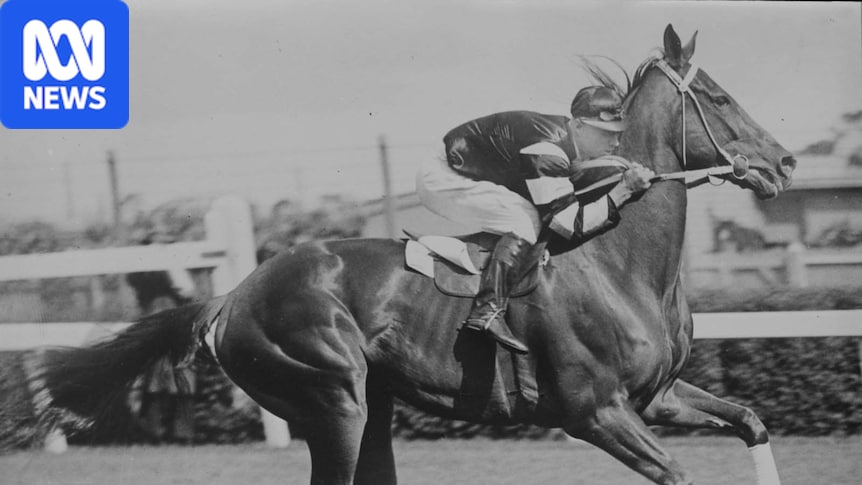
In the days and weeks before his historic win in the Melbourne Cup, champion racehorse Phar Lap spent a few lazy days in the border town of Albury, walking the streets without a care.It was October, 1930, and the Harry Telford-trained galloper had Australia enamoured ahead of a tilt at that year's Spring Carnival riches.But instead of preparing to race in the Caulfield Cup — the first of three major events in Victoria's carnival — Phar Lap and his strapper Tommy Woodcock were bunking down at a pub on the Victorian-NSW border preparing to change trains en route to Melbourne.The horse known as "Big Red" travelled Sydney to Melbourne by rail, getting off at Albury Railway Station due to the change of rail gauge between NSW and Victoria.On arrival in Albury, passengers (both human and equine) were required to get off a train, walk across the platform, and hop onto another train to continue their journey between the states.This happened for more than 100 years until the standard-gauge connection to Melbourne was completed in 1962.From 1883 and until 1962 travellers between Melbourne and Sydney would have to swap trains at the Albury Railway Station because of a change in gauge size. (ABC Goulburn Murray: Allison Jess)When Phar Lap and Tommy Woodcock stopped in Albury they stayed at Sodens Hotel, a centrally located pub, well-known to racing circles at the time.It was an experience that Woodcock would later share with family friend and fellow horseman Wayne Hinchliffe."In those days all the stables had beds above the horses where all the hay and straw were kept," Mr Hinchcliffe said."That's where Tommy slept, he would always sleep very close to the horse."Tommy Woodcock spent the last couple of years of his life at Wayne Hinchliffe's farm at Yarrawonga. (Supplied: Hinchliffe family)While it wasn’t unusual to see horses on the streets in those days, Mr Woodcock did tell Mr Hinchcliffe during the stopover in Albury, the most famous horse in Australia was not noticed. "Not one person ever pulled him up and asked him what the name of his horse was," Mr Hinchcliffe said. "He did say they walked so much he wore out a pair of boots and two shirts from where the horse used to push him on the right-hand shoulder."Tommy Woodock and Phar Lap circa early 1930s. (Supplied: Hinchliffe family)In Albury, Woodcock received a telegram from Phar Lap’s connections saying to stay in Albury until further notice.Mr Hinchliffe said the extended stay made sure Phar Lap was a late withdrawal from the Caulfield Cup, so another horse, Amounis, could win that race with better odds."They made him stay in Albury long enough... Just about everyone had backed Phar Lap as a double in the Caulfield and Melbourne Cup."The secret to cup successPhar Lap was not the only Melbourne Cup-winning horse that would stay at Sodens Hotel.At least eight other cup winners made the stop, including Prince Foote (1909), Piastri (1912), Windbag (1925), Statesman (1928), Peter Pan in (1932 and 1934) Hiraji (1947), Foxzami (1949) and Delta (1951).Today, the pub pays homage to its Melbourne Cup connection; the old stables have since been turned into a bar brimming with photographs and memories. At one stage Sodens had 30 large "loose boxes" (sleeping areas) to accommodate horses overnight. (ABC Goulburn Murray: Allison Jess)A board in the bar says Sodens was popular in racing circles because it was the first pub in the area to put electric lights in stables.Prior to that, open flames were used, something considered dangerous to horses and a distraction at night time. A friendship for lifeMr Hinchliffe, who's now based in Victoria's Raymond Island in the Gippsland Lakes district, said Mr Woodcock taught him many things including how to prepare a harness and other horse skills. "He and my dad were best mates, they used to go hunting, shooting and fishing together," he said. "When I was old enough to hold a horse, I would go to the races and lead in horses and muck out the stables at night and on weekends."I was always around him and he used to say I was always under his horses - meaning I was in the road all the time." Phar Lap pictured with jockey Jim Pike in about 1930. (Charles Pratt, courtesy State Library of Victoria)Mr Woodcock ended up living the last years of his life on Mr Hinchliffe's family farm in Yarrawonga, in north-east Victoria, before he died in 1985."He was crook and he asked if he could come live with us on the farm so I nursed him," he said. "Before the farm, we never got to talk [with him] about Phar Lap because it was busy, there were owners and people around and we'd be going to the races, to trials."[But] at the farm he told us all these lovely stories about Phar Lap."Wayne Hinchliffe nursed Tommy Woodcock before he died in 1985. (Supplied: Hinchliffe family)Phar Lap won the 1930 Melbourne Cup before becoming a horse that would define the ambition and hope of a generation. That year, the horse with the big heart — almost double the size of a normal horse — won 19 of 21 races and famously avoided an assassination attempt on the streets of Caulfield. Over his four-year career, he won 37 of 51 races, including North America's richest race, the Agua Caliente Handicap in 1932.He became sick a fortnight after that victory overseas and died from a massive dose of arsenic.
Phar Lap's little-known pre-cup trip to the country
Full Article
Original Source
Read the full article at Abc →KhanList aggregates and links to publicly available news content. We do not host full articles from third-party sources. Always verify important information with original sources.