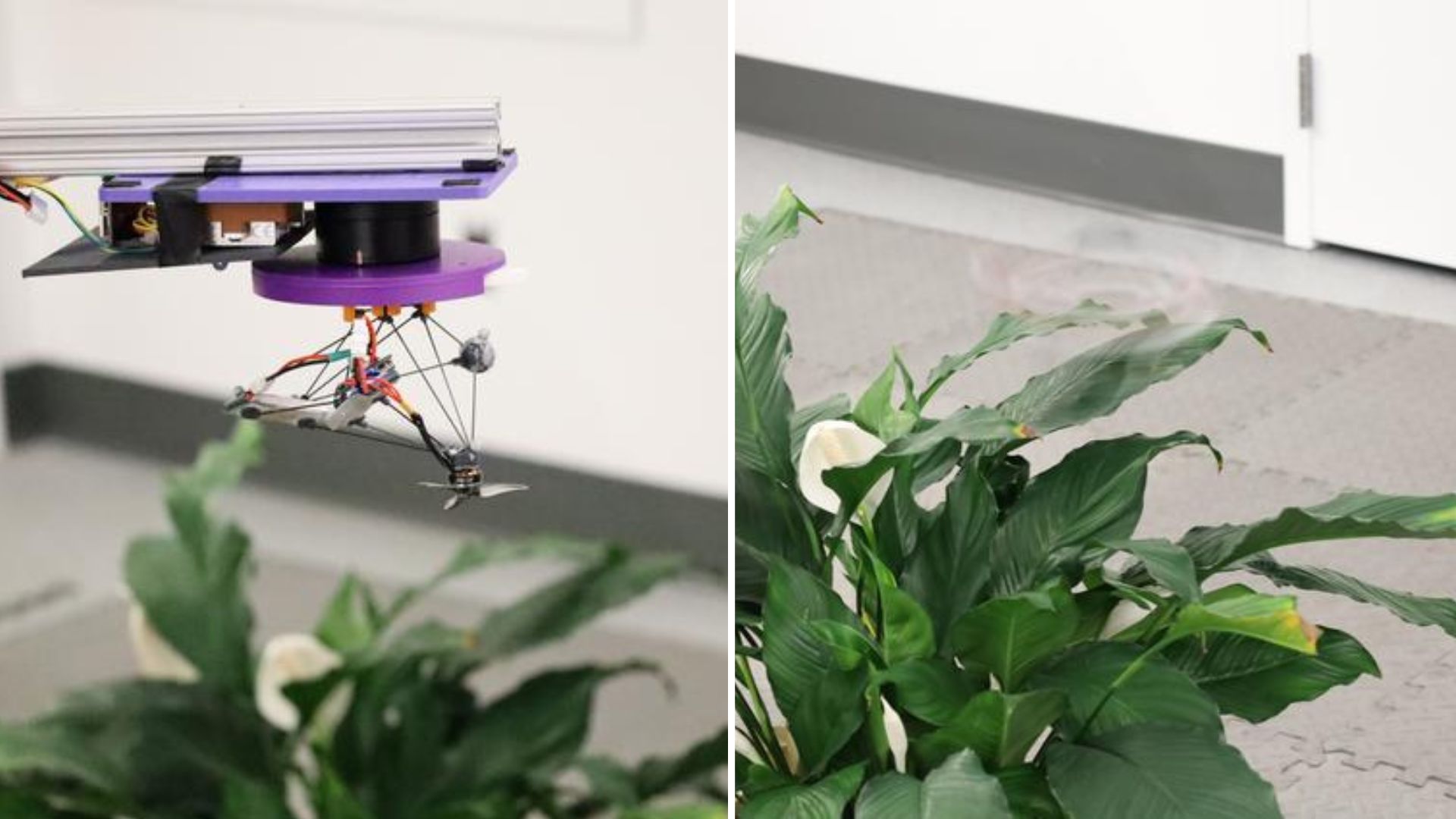
Northwestern University in the US has developed a low-visibility drone called the “Phantom Twist.” It achieves low visibility by spinning itself into visual oblivion and rotating up to 25 times per second. That is far too fast for the human eye to process. Interestingly, this motion blur transforms the drone into a faint, semi-transparent smudge that blends into its surroundings rather than achieving total invisibility. “Most efforts to hide drones focus on making them look like their surroundings,” said Michael Rubenstein, who led the work. “Instead, we asked whether we could design the drone itself around the way humans perceive motion. This idea of low visibility through persistent motion is something few people have explored.” Hiding in plain sight Conventional drones often disrupt wildlife and human behavior simply by being noticed. Scientists have tried everything from high-tech light-bending optics to transparent plastics and hyper-realistic camouflage. But a team of roboticists at Northwestern University decided to stop trying to hide the drone. The idea was to focus on altering a drone‘s physical appearance to change how it is perceived. In this development, the standard stationary-body quadcopter design was replaced with a single-motor system where the propeller and the entire drone body spin in opposite directions to minimize visibility. Quadcopters remain highly visible because their bulky central bodies stay completely stationary while only rotors spin, but the Phantom Twist mimics a fast-spinning ceiling fan. Rotating its entire structure allows the drone to blur its body into a semi-transparent disc. Emma Alexander, a computer vision expert and co-author on the study, explains that the human eye behaves a lot like a camera with a fixed exposure time. “The human eye takes time to accumulate signals, roughly analogous to the exposure time of a camera,” said Alexander. “When an object spins quickly, we perceive it as blurring out and losing distinct features. Because this new drone is almost entirely transparent, its few opaque components are visually averaged with the background for an overall appearance of a slight haze.” Perfected by artificial intelligence The development, of course, was not straightforward. The parts just can’t be mounted on a spinning stick and expect it to fly straight; balancing the entire structure is incredibly difficult. To solve this, the team handed the keys to artificial intelligence. The automated design pipeline first generated 20,000 mathematically stable configurations. Then, an optimization algorithm repeatedly rearranged the drone’s heavy essentials, such as the battery, the circuit board, and the counterweights. The goal was to ensure the components never visually overlapped while spinning. The AI then simulated these designs against 100 real-world backgrounds, scoring them using a metric modeled after human vision. The lower the score, the harder it was to see. According to the study’s testing, the new design is ten times harder to see than a conventional quadcopter. In the future, these types of drones could help in ecological and industrial surveys. Drones are vital tools for counting nesting birds, mapping wetlands, or inspecting cracked bridges. But the loud, buzzing, mechanical presence often panics wildlife and alters natural behavior. A drone that blends into the sky could watch animals without scaring them away. It is not entirely perfect yet. For instance, its propeller sound can still be heard, and if someone look incredibly closely, you can occasionally spot the faint outline of its carbon-fiber support rods. But the team is already working on the next generation. The goal is to incorporate acoustic dampening and fully transparent materials to make the drone truly vanish. The findings were presented at the Robotics: Science and Systems 2026 conference in Sydney, Australia. Recommended ArticlesGet the latest in engineering, tech, space & science - delivered daily to your inbox.Mrigakshi is a science journalist who enjoys writing about space exploration, biology, and technological innovations. Her work has been featured in well-known publications including Nature India, Supercluster, The Weather Channel and Astronomy magazine. If you have pitches in mind, please do not hesitate to email her.
‘Phantom Twist’: US team designs drone that spins to achieve near-invisibility
Full Article
Original Source
Read the full article at Interestingengineering →KhanList aggregates and links to publicly available news content. We do not host full articles from third-party sources. Always verify important information with original sources.