
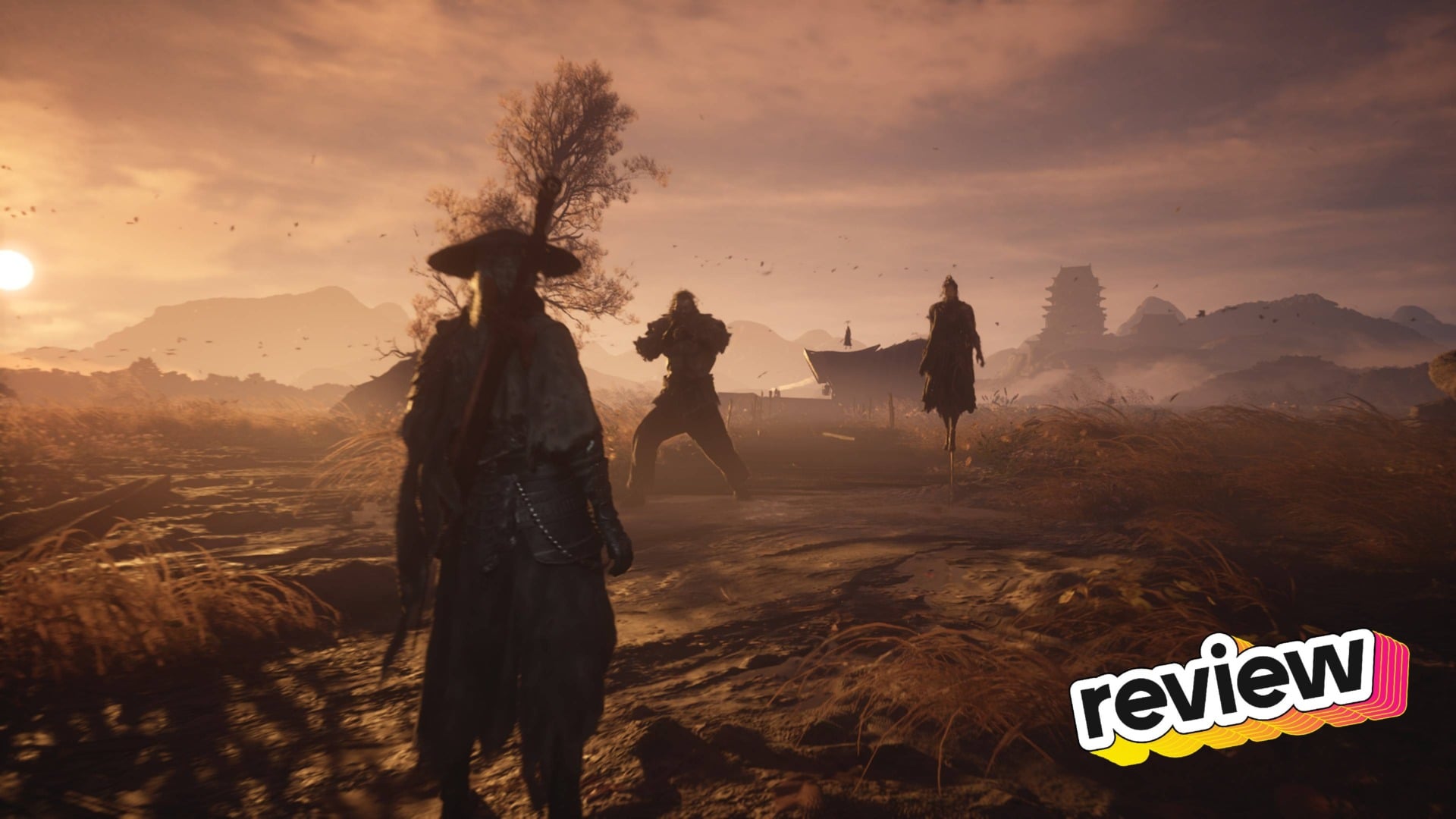
As I launched Phantom Blade Zero for the first time and began what I can only describe as a belabored compiling of shaders, I used the time to dig out a notebook buried at the bottom of a moving box containing notes I took during a preview of the game in 2024. At the time, I was tapped by another outlet to take the Summer Game Fest preview because everyone on staff was busy. No one was expecting this action game with flashy trailers and an overly wordy title would be all that worth paying attention to, so it was handed to me to see what it was all about. Two years later, sitting down to play the final game, I kept flashing back to that demo with developer S-Game, who were so desperate to get media attention on their title in the very first appointment of the very first day. They were so worried every time I died, asking me if I needed to turn down the difficulty, deathly afraid I was going to saunter over to the media room and lambast the game for my many deaths during a half-hour demo. And some part of me wonders, playing the final game, is past-me the reason for the annoyances current-me has with an otherwise incredible action game? Back-of-the-box-quote: “I’ve got Soul but I’m not a soldier.” Type of game: Extreme Wushu Simulator Developer: S-Game Release date: October 28, 2026 Liked: The feel is incredible, combat is intense, the game is content-packed, some of the boss fights are among the best I’ve ever seen. Disliked: Way too easy to miss quests and items, some gimmick bosses just don’t work, I’m conflicted on the way standard enemy encounter design functions, story is frustratingly told. Platforms: PC (played), PlayStation 5 Played: 65 hours. Despite missing a few quests, finished every side quest and got the True Ending. There’s a “second cycle” plus game for the real sickos. Phantom Blade Zero is an action game that is more 3D Ninja Gaiden than Soulslike, though it absorbs and molds some Soulslike traditions and mechanics to varying degrees of success. As a multitude of combat scenarios, Phantom Blade is an unqualified success. The core act of pressing buttons to attack, parry, and dodge feels immaculately wonderful, especially given that the premise demands you do all those things at once. Where Phantom Blade differs from, say, a Sekiro or Onimusha: Way of the Sword is in the way it expects—nay, demands—that you throw the traditional notion of balancing attack and defense out the window. Phantom Blade will occasionally present enemies that attack you utterly relentlessly, with literally only frames of breathing room between flurries. The solution is not one of timing, but of boldness. The game isn’t trying to force you to find the right opportunity; it wants you to keep parrying or keep the block button held down and also attack or dodge as the situation demands. Trusting that protagonist Soul can handle this is the first major difficulty spike to overcome, because it does not feel at all like something you should be able to do, and morphs into the only way you can perceive playing action games by the end of your journey. S-Game / Kotaku You might be tempted to take that as an exaggeration, but I insist that it’s not. Once Phantom Blade Zero’s everything-all-at-once combat clicked for me, it genuinely felt like I was going to have trouble going back to melee systems that do not require beckoning the icy touch of arthritis at a young age. It is not particularly deep—you pretty much learn to tap the parry button with a constant rhythm and time the bigger hits for combat advantages and dopamine release—but it feels exciting and active. If Phantom Blade Zero was only going to nail one thing, it’s an overwhelmingly good thing the game nailed this. One thing that Phantom Blade Zero does not nail, however, is the story. The narrative has the unfortunate combination of being both overbearing and incomprehensible for much of its dozens of hours, throwing a tome of unexplained proper nouns at you so large that it would make Final Fantasy XIII’s opening hours blush. The genre is no stranger to bad or underexplained stories; it might even be argued that the disposable narratives are part and parcel of excellent character action. But Phantom Blade Zero is not that. It does not treat its narrative or worldbuilding as something that most players will discard and ignore. For whatever reason, S-Game has decided that the story in this title must be omnipresent and decidedly interruptive, littering the game with cutscenes, lore scrolls, collectibles of magic audio logs, and pages and pages of descriptions of weapons and enemies. S-Game / Kotaku I do not wish to turn my nose up at this out of hand. A strong story can and should enhance a game, but I cannot overemphasize how spitefully Phantom Blade tells its story in its early hours. It is borderline frustrating how little the game tells you of what any of the names and terms the dialogue is constantly throwing around actually mean. It was dozens of hours before I grasped what was going on in the story, a timeframe not aided by the fact that its writers insist on forcing it to unfold like a mystery. Poring over the logs of enemies to understand who it was I was just fighting and what relationship they had to the act of Transcension, or the organization of the Order, or maybe it’s the Mandate, or perhaps he was with the Thread-Binding Sect, or the Baishan Sect, or maybe I’m just going to go take a nap because this is too much, it all ended up just making me feel like I came into a movie midway through and everyone is having a good time but me. When I did eventually wrap my mind around the ongoing plot, I enjoyed learning about the various ways the world had essentially ended, though it took me a long time to understand if it had happened a hundred years ago, or one year ago, or was currently happening, and it was not worth the miles the game dragged my captive and ignorant ass across to get there. That the game’s story has a climax that breaks down major revelations in a 20-minute Chinese Opera performed with shadow puppets leaves me scratching my head over whether I should be applauding the ambition or tut-tutting the sledgehammer taken to the pacing, but either way I was not having a good time. S-Game / Kotaku The story may be burdensome, but it is not what I’m thinking about when fighting the game’s copious amount of bosses. Soul steps into a new boss fight every few feet, often for spurious narrative reasons, and the quality of these fights varies wildly, with some extreme high points and some unfortunate low points. There are boss fights that I can truthfully say are among the best I’ve seen in an action game, both in terms of gameplay and aesthetics. One such example is the consummate rival fight, where Soul defends himself against his former student and her two bodyguards. The battle is a pitch-perfect realization of proper escalation, with you fighting the boss in a clash of swords, then tackling a second phase in which she transforms into a pugilist with fists of iron, and finally taking on all three enemies at once while the sun sets in the background and the slow piano music adds more instruments and intensity. There are some gimmick fights that try to play with the mechanics and force you to act in different ways that mostly don’t work. One fight tries to punish you for parrying, another only lets you damage the enemy after parrying certain attacks, and the novelty of these battles wears off when you’re midway through their large HP bars and realize you still have half a fight left to go. Thankfully, the good boss encounters greatly outnumber these, but they do make you feel a bit like you just slammed face-first into a tunnel painted onto the side of a wall. One boss fight has Soul taking on a troupe of Lion Dancers who spit fire and, midway through the encounter, the head Lion Dancer dances on some poles across the arena while he and Soul fling fireballs at each other as Soul gets up on his own set of dancing poles. It’s a really smart way to break up the boss fight, but I also feel like it would not have needed to break up the boss fight if it weren’t so long and the effort to chip away HP so arduous. S-Game / Kotaku Structurally, Phantom Blade has Soul running through various environments with numerous branching paths at every turn and a smattering of enemies along the way. These enemies aren’t meant to be overly difficult and nothing bears that out more obviously than the fact that, when one is defeated, they stay defeated. This means that combat with minor enemies is never an insurmountable obstacle; definitionally, it cannot be. Encounters are not puzzles for you to solve; you just throw Soul at them, defeating one member of the group and then having an easier time the next time you arrive at full health. Considering there’s no punishment for death, this design choice feels like it boils the game down to an exploratory boss rush with some enemies hanging around between them, just to keep you pressing buttons. That’s not to say you’ll never have a problem with a standard enemy, but that ultimately those problems do not really matter. Given enough time, enemies are merely rocks being shaped by erosion, and you are the wind sending waves to crash against them. Maybe that makes the game easier for some, but it’s a design decision that inherently feels like it robs you of stakes that would have otherwise been interesting. I’ve gone back and forth on whether the permanently despawned enemies make for a good idea or not. On one hand, it does make much of the encounter design feel like a conveyer belt with no sense that I was overcoming obstacles. But flipping a switch to change that one thing would not work with the rest of the game as it’s currently designed. It would be beyond wearisome to have to search for the game’s optional areas and collectibles while fighting through the respawning enemies. Phantom Blade doesn’t have many Soulslike runbacks to bosses, but those that exist would become significantly more aggravating if you had to burn a heal on the way thanks to an overly aggressive enemy swiping at you from offscreen. S-Game / Kotaku Toward the end of the game, this does change, though perhaps the pendulum swings a little too far the other way as enemies with tediously large health pools and hyperaggressive attack patterns become significantly more common. While I would have liked a more considered sense of balance in the encounter design throughout, I prefer the back half, where the game offers a bit more bite, to its early sections which hand-wave you through. The number of optional paths in the game is truly worthy of awe. Within the first half hour, you’re given a side quest that won’t t resolve until near the end of the game, you may encounter an optional boss that’ll slice Soul in half in a single hit with verbal warnings to come back later, and you can pick up another side quest to find a flower for a girl that ends up taking you multiple chapters to fully suss out. No one can accuse Phantom Blade Zero of not playing the long game, and I think that aspect on its own both feels cool and aids in making the quests feel like part of a journey. But as with many things this game does, it sometimes feels like the cool aspects are simply giving S-Game permission to do something extremely annoying on the other side of them. In the case of side quests, Phantom Blade revels in having missable objectives that can end up fully locking you out of things you might have wanted to see, up to and including the self-titled True Ending. It doesn’t take much to miss a quest, either through progressing a little too far without reaching a satisfactory movement point in the questline, answering with the wrong dialogue choices, defeating a boss you weren’t supposed to, or in one case, not talking to NPCs before picking up an item. S-Game / Kotaku Sometimes you get a warning about this happening and maybe only have yourself to blame, but many times you do not. In a breezy action game that you’ll be running through multiple times, I can get the desire to cheekily tell the player, too bad, try again on the next cycle! But motherfucker, this game is at least 50 hours long on a casual initial playthrough. If I miss a side quest, I am done. It might as well not exist at that point. This is the kind of game where you’ll have to consult a guide at the beginning of every chapter and follow it thoroughly if you want to see everything, or just make peace with the fact that you just won’t see it all. One aspect of Phantom Blade that deserves calling out is the game’s soundtrack, which is largely quiet and ambient, but occasionally comes roaring out of its self-contained cage to be a special kind of weird. Hip-hop, throat-singing, dubstep, rock guitar, Chinese opera, all of these coalesce into something more interesting like you’re listening to the most eclectic random-order playlist you can find, yet it all works together and fits. Sometimes a song will grate on you after you’ve tried a boss for the 20th time, but it certainly never stops being inventive. It’s rare to be as conflicted with a game as I am with Phantom Blade Zero. It is, on paper, exactly what most character action fans would want, but there are just a few choices it makes where I wish someone had shaken the person in charge of making that decision and set them straight, and I can’t help but let those things gnaw at me. There are several ways in which this game defies any kind of score I could give it, so I’m left with just a swirling feeling that we “merely” got a fantastic game with some decisions I think could be changed to create an even better one.
Phantom Blade Zero: The Kotaku Review
Full Article
Original Source
Read the full article at Kotaku →KhanList aggregates and links to publicly available news content. We do not host full articles from third-party sources. Always verify important information with original sources.