
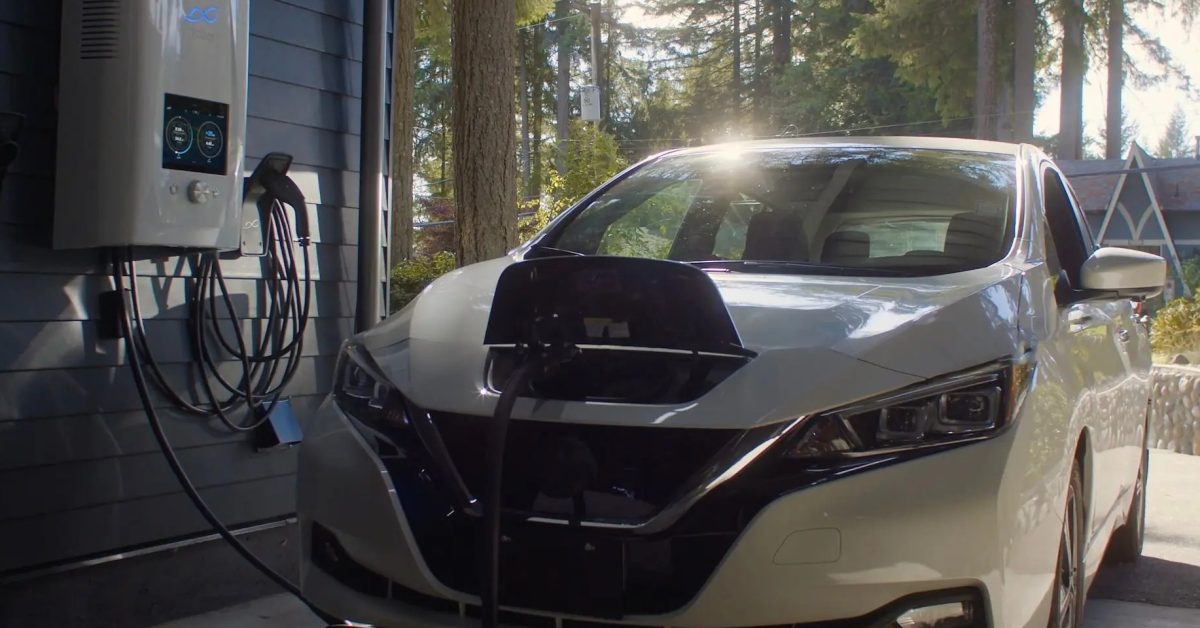
Massachusetts Vehicle to-Everything (V2X) Demonstration program Photo: The Mobility House PG&E just expanded its Vehicle-to-Everything (V2X) program, adding EVs from Tesla, Kia, Volvo, Polestar, and Nissan and opening up as much as $17,000 in incentives to turn a car into home backup power. The California utility brought in Bidirectional Energy and PowerFlex as approved partners, and drivers now have until June 30, 2027 to enroll. New vehicles, new chargers V2X lets a compatible EV work as a mobile battery. With a bidirectional charger, you can pull electricity out of the car to run your house during an outage or push it back to the grid when demand spikes, and shave your energy bill along the way. Until now, PG&E’s Eligible Products List covered Ford, Tesla, Chevrolet, GMC, and Cadillac. The expansion adds several new vehicle-and-charger combinations: Nissan Leaf (2018-2025) with a DCBel Ara charger. Volvo EX90 (2025) with a DCBel Ara charger. Polestar 3 (2025) with a DCBel Ara charger. Kia EV9 (2024 and newer) and Kia EV6 (2025 and newer), both with the Wallbox Quasar 2. PG&E also folded in three more GM models: the 2027 Chevrolet Bolt, the Cadillac Celestiq, and the Cadillac Escalade IQL. “This expansion is all about choice,” said David Almeida, Director of Clean Energy Transportation at PG&E. He said broadening the mix of eligible vehicles and chargers helps customers “turn their EV into a home backup and a grid asset.” The incentives, stacked Here’s where the money is. Residential customers get $2,500 upfront, or $3,000 if they live in a disadvantaged community, plus a $1,500 Early Adopter Incentive for the first 250 people to enroll. The new DCBEL and Wallbox combinations also qualify for up to $13,000 in additional funding through a California Energy Commission grant, subject to eligibility. Stack those and an early adopter is looking at roughly $17,000. That’s real money against hardware that still runs thousands of dollars, and it’s the whole point of a program like this. Commercial customers get their own tier: $2,500 to $3,000 for a 3-phase bidirectional charger under 50 kW, and $4,500 to $5,000 for one at 50 kW or above. V2X is finally crawling out of the pilot phase The idea of using an EV to power a house isn’t new. The Nissan Leaf has technically been a vehicle-to-grid car for more than a decade through CHAdeMO, and it’s a little funny that it’s only now landing on PG&E’s approved list. The hardware and the utility programs are what took forever. That’s been changing fast in California. We covered PG&E’s original V2X pilot with GM Energy last year, and in April the Cybertruck became the first AC vehicle-to-grid asset in the state through PG&E. Tesla’s Powershare is still Cybertruck-only for now. A 2024 California law is also pushing automakers toward making bidirectional capability standard. PG&E is running the same play on the commercial side. It’s backed electric school bus fleets in Fremont, Oakland, and San Francisco that can feed the grid. The utility notes that more than 90% of the nation’s 500,000 school buses still burn diesel or gas, putting out over 8.4 million tons of greenhouse gases a year. Electrek’s Take Is V2X finally scaling? It looks like it. This is one of the most comprehensive programs I’ve seen to date. What it lacked was compatible cars, affordable bidirectional chargers, and utilities willing to pay for the service. California is knocking down all three at once, and adding the Leaf, EV9, EX90, and Polestar 3 widens the funnel to cars people are actually buying. I am in favor of the idea that if you buy an EV, you can do what you want with its battery pack, including using it for backup power or to service the grid for revenue. If you’re powering an EV at home, pairing it with rooftop solar is how you get the fuel cost close to zero, and a bidirectional setup like this lets that car back up your house on top of it. With electricity rates up almost 10% last year and expected to keep climbing, going solar is one of the best ways to protect yourself against rising costs. And with lease and PPA options, you can do it with zero upfront cost and start saving immediately. If you want to find the best deal, check out EnergySage. It’s a free service with hundreds of pre-vetted installers competing for your business, so you save 20 to 30% compared to going it alone. No sales calls until you pick an installer. Get your free quotes here. FTC: We use income earning auto affiliate links. More.
PG&E expands V2X program with Tesla, Volvo, Nissan and $17K incentives
Full Article
Original Source
Read the full article at Electrek →KhanList aggregates and links to publicly available news content. We do not host full articles from third-party sources. Always verify important information with original sources.