
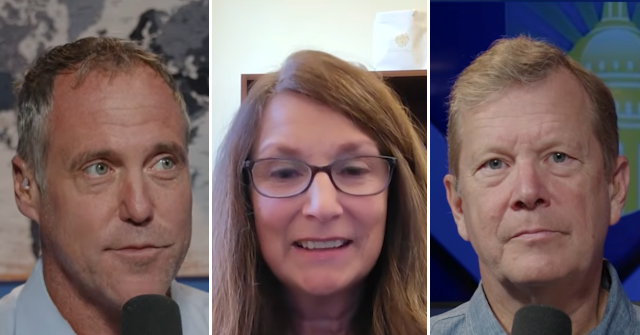
“We assume that our enemies, like the Chinese or the Iranians, want to undermine our elections,” says investigative journalist Peter Schweizer. “But a lot of the resistance has actually come from some of the states.” Efforts to improve the security of elections in the United States were once a nonpartisan issue, Schweizer notes. From securing voting machines and equipment to ballot collection and, most importantly, voter registration records, states were mostly very careful. But around the country, verifying voter eligibility has become problematic. Heather Honey, a senior counselor and former Asst. Secretary of the Department of Homeland Security (DHS), has been spearheading DHS’s efforts to help states clean up their voter rolls and make America’s elections more secure. She joins Schweizer and co-host Eric Eggers, the author of a 2018 book on various types of election fraud, to discuss the state of American voting security. While many states have participated in efforts by the DHS and Justice Department to identify and remove both deceased voters and noncitizens from voter rolls. The feds long-ago made the process easy via the SAVE system — an online tool that allows quick verification of the immigration and citizenship status of people wanting to vote, receive benefits, or access other government services. But some states, such as California, have stubbornly resisted. “For starters, President Trump made the SAVE system, which has been around for decades, available to state and local officials at no cost. They used to have to pay per transaction,” says Honey. She points out that about half of U.S. states have used the system’s bulk-upload feature to clean their entire voter registration database against federal records. “They have found almost 500,000 deceased registrants and about 30,000 aliens,” Honey tells Schweizer and Eggers. The Justice Department and DHS are now suing one of the states that have resisted using the SAVE system, California, after they determined that more than 20,000 people who are likely aliens are registered to vote in that state. Under California law, every registered voter is mailed a ballot even though it is unlawful for aliens to vote in federal elections. The Justice department last week sued California, alleging that these individuals, who are likely noncitizens, registered to vote and/or voted in a federal election. Homeland Security Investigations and its federal partners used multiple data-enrichment and verification methods to assess whether the individuals identified were likely aliens. One might ask: If California did not participate in using the SAVE system, how did the feds get the records to review? “We acquired the publicly available voter files, the ones that the states make available to the general public. We acquired those and started doing analysis of voters,” Honey tells the hosts. Most states make their voter registration records available, sometimes for a fee, to political parties, voter registration nonprofit groups, and others. “Is there anything that those states that declined to take advantage of the SAVE system have in common?” Eggers asks. “They’re not exclusively states that are governed by Democrats, though the majority of them are,” replies Honey. Some states cited privacy concerns with handing over their unredacted voter file, such as Social Security number and driver’s license information. Honey dismisses that argument, noting they send the same information to a nonprofit group called the Electronic Registration Information Center (ERIC), which includes sending their entire driver’s license database. “They’re handing the same information over to ERIC,” Honey responds. “Furthermore, they are also handing over their entire motor vehicle file, which includes people who aren’t even registered to vote. So, these are the same officials who are saying they won’t share with the Department of Justice because they’re concerned about protecting the privacy of the registered voters.” “It flies in the face of that when you look at the entities with whom they are willing to share, particularly in light of the fact that the federal government generally issues your social security number, so it’s not a mystery what the social security number is to the federal government.” In a July letter, DHS Secretary Markwayne Mullen asked California to separate but not destroy the approximately 20,000 vote-by-mail ballots “from persons identified by the federal government as likely to be noncitizens and to independently — or in collaboration with the Federal Government — verify their citizenship status before tabulating their vote-by-mail ballot.” California responded that trying to separate received ballots would be “catastrophic” to its election system, although every state already separates provisional and potentially duplicate ballots before counting them. “But they currently segregate ballots for curing (verifying missing information on a mailed ballot). California law requires county election officials to allow for curing. They segregate those ballots that are in need of curing,” Honey responds. “In addition to that, we also segregate provisional ballots as a matter of federal law. If somebody shows up to vote and they’re not in the voter roll or they’re in the wrong precinct, they must be allowed the opportunity to vote a provisional ballot.” She adds that Tulare County in California recently admitted to accidentally mailing out 7,700 duplicate ballots. “But they said, ‘Not to worry. Their system can flag the duplicates if they are returned.’ So, you would expect that that there are similar ways that you could flag these very small number that the fraud division of the U.S. Citizen and Immigration Services agency has identified as potential noncitizens.” “They should be able to flag them and set them aside so that they don’t dilute and cancel out the vote of U.S. citizens,” Honey insists. Honey agrees that automatic registration through DMV services or “motor voter laws” in many states have helped increase these kinds of problems since they require a noncitizen to check a box saying not to register them to vote when they apply for a driver’s license. Schweizer notes that those who object to election integrity efforts often argue it reduces voter confidence in the electoral system, responding, “No, that’s not what’s reducing confidence in the electoral system. It’s that we know stuff is going on… Are you blaming the thermostat or are you blaming the weather for the temperature? That’s the really the distinction.” Polls consistently show that Americans overwhelmingly support requiring voter ID and the House of Representative twice passed the “SAVE America Act,” in its recent session, though that bill was never considered by the Senate under its Republican leadership. For Honey and others in the Trump administration that are working to make elections secure, the SAVE Act would have helped, but they believe the federal government can use existing laws to require better voter roll “hygiene” already. For example, Mullin at DHS has threatened to withhold federal emergency management funds from states that do not take steps to clean up their voter rolls. She notes that enforcement of voting laws is the domain of the Justice department, but voting security is considered part of national security, which is under DHS authority. Honey has been maligned several times in the mainstream press as an “election denier,” but for her it goes with the territory. “So much of it is the media spinning a narrative. I think it tries to discourage election officials from doing what is right,” she says. Still, progress is being made, she believes. “Under Trump, our voting systems are safer than they were a year ago. And I mean the whole election ecosystem. From voter registration to campaign finance to the data that the campaigns rely on, steps have been taken,” she says. She mentions the practice of “granny farming” that Eggers described in his book, FRAUD, in which partisan political operatives show up at nursing homes to “help” the residents fill out their absentee ballots. “Dr. Oz issued guidance to long-term care facilities that is intended to protect vulnerable nursing home residents from some of the things we’ve seen happen in prior years where they’re taken advantage of in those nursing homes,” she says. “Things like that that maybe the public doesn’t see on a day-to-day basis are really making our systems much more secure,” Honey tells Schweizer and Eggers. For more from Peter Schweizer, subscribe to The DrillDown podcast.
Peter Schweizer: Inside Homeland Security’s Push to Clean Up Voter Rolls Before Election Day
Full Article
Original Source
Read the full article at Breitbart →KhanList aggregates and links to publicly available news content. We do not host full articles from third-party sources. Always verify important information with original sources.