
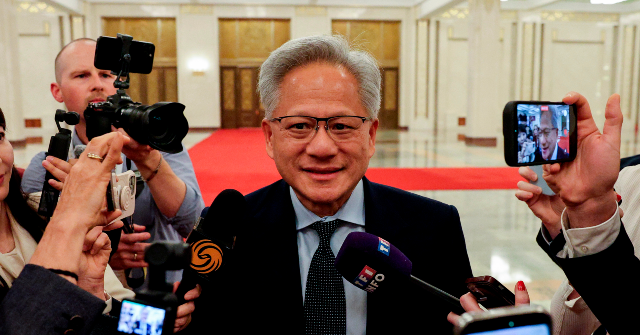
While the Nvidia spy scandal surfaced possible corruption inside his own administration, the tripartite meetings between the presidents of the U.S., Russia, and China tested Donald Trump’s ability to handle being double-teamed. “When it comes to expanding Chinese influence in the world, Russia is generally in favor of that. They don’t feel threatened by it, and they have a lot of common interests when it comes to technology controls and restrictions on the energy market,” says author and investigative journalist Peter Schweizer. If anyone could manage a two-against-one discussion, though, “it would be Trump.” At press time, no details have yet emerged of what was discussed when President Donald Trump met with two of his biggest adversaries, Russia’s Vladimir Putin and China’s Xi Jinping. “I would imagine that Trump will rather casually toss out certain issues those two might have differences of opinion on, just to keep them off balance,” Schweizer says on the latest episode of The Drill Down. Meanwhile, the developing Nvidia scandal throws deep shadows over all of this, one of which lands on Trump’s Secretary of Commerce, Howard Lutnick, whose family appears to have benefited from his department’s reluctance to ban the sale of Nvidia’s most advanced chips to Singapore-based Megaspeed. That company is run by Alice Huang (no relation), a Chinese national who was carrying on an extramarital affair with Nvidia CEO Jensen Huang and has been accused of being a spy for Beijing in what spies call a “honeypot operation.” “Howard Lutnick’s family and company are heavily invested in those same Southeast Asia data centers,” Schweizer says. “And Lutnick supposedly blocked regulatory enforcement against Nvidia… This stinks to high heaven. There are a lot of questions around Howard Lutnick and his family deals and his former firm. That all needs to be looked at.” Stakes for the meetings are high for the U.S. and China, whose economy has faltered recently under U.S. trade pressure. Meanwhile, Russia under Putin needs a way to end its disastrous war on Ukraine, while the U.S. is seeking to end its war with the Iranian regime. Co-host Eric Eggers likens the tense meetings to another November ritual: “I like that this week is Thanksgiving-adjacent. This meeting is like a dysfunctional family, all doing their own thing. There’s a history of bitterness and strife, but they’re all going to come together and pretend none of it happened,” Eggers jokes. “Yeah, and I think Trump is probably the dad,” adds Schweizer. “Xi is the scolding mom, and Putin is the rebellious teenager who lit the neighbor’s house on fire,” he laughs. Schweizer notes a key difference between the U.S. and China on artificial intelligence growth is that the U.S. favors closed AI models, such as Anthropic and Open AI, which sell access to their systems. The Chinese, on the other hand, favor open AI models, which give users access directly to the underlying code, allowing them to customize results and override any built-in guardrails. “There’s no question the Chinese wanted influence over Jensen Huang,” Schweizer says, because Huang was important to China not just for the chips. He was also among the very few people in the tech industry favoring open AI models. Schweizer explains the difference. “Closed models are ones that are developed in secret, the algorithm is secret. These are easier to monetize, because you’re not sharing your secrets with anyone,” he explains. “But if there are problems with it, they’re harder to expose because you don’t know its biases.” “Open models are where you share the algorithm and information,” he says. “But people can turn them into hacking machines and use them for nefarious purposes.” The U.S. favors closed models because they play to our advantages and can be more easily monetized. China, Schweizer says, wants open models because they play to their strength — stealing information. As the now-ousted CEO of Nvidia, Jensen Huang also favored open AI models because they help Nvidia sell more chips. Schweizer suspects Trump knew about Jensen Huang’s vulnerabilities for more than a year. When he went to China earlier this year, Trump brought several tech CEOs with him on Air Force One. Jensen Huang, however, was apparently a “last-minute addition,” picked up in Alaska during the refueling stop on the way to China. “There are literally photographs of him with a backpack climbing aboard Air Force One,” Schweizer notes. He wonders, as others have, whether there may have been some “tradecraft” happening there. “It’s very possible [Trump was] engaging in what sometimes is called ‘playback’ in the world of intelligence,” Schweizer says, in which you give deliberately bad information to a potentially compromised person in order to see where it winds up. “You pretend that everything is fine, but you’re selective of what you share with him, and you might even share [false] information with that source who’s going to pass it along maybe to the mistress or whoever,” Schweizer tells Eggers. In fact, administration spokesmen have backtracked from saying Alice Huang might have been a direct employee of China’s spy agency, the Ministry of State Security. Yet, as Schweizer has noted in his books on Chinese efforts to compromise America, every Chinese citizen is obligated under a 2017 law to cooperate with government demands from the ministry of state security for information. The show closes on a casual comment from Trump saying he might even stop in to see North Korean dictator Kim Jong Un while he’s in the neighborhood. “Trump believes in his ability to persuade and reach people,” Schweizer says. However, he believes this kind of flattery will fail with the North Korean dictator, as it has before. “I don’t think Dennis Rodman got anywhere with him, and I doubt that President Trump will either,” Schweizer says. For more from Peter Schweizer, subscribe to The DrillDown podcast.
Peter Schweizer: Beijing’s Spy Play Against Nvidia CEO Jensen Huang Cost China Its Top Tech Ally
Full Article
Original Source
Read the full article at Breitbart →KhanList aggregates and links to publicly available news content. We do not host full articles from third-party sources. Always verify important information with original sources.