
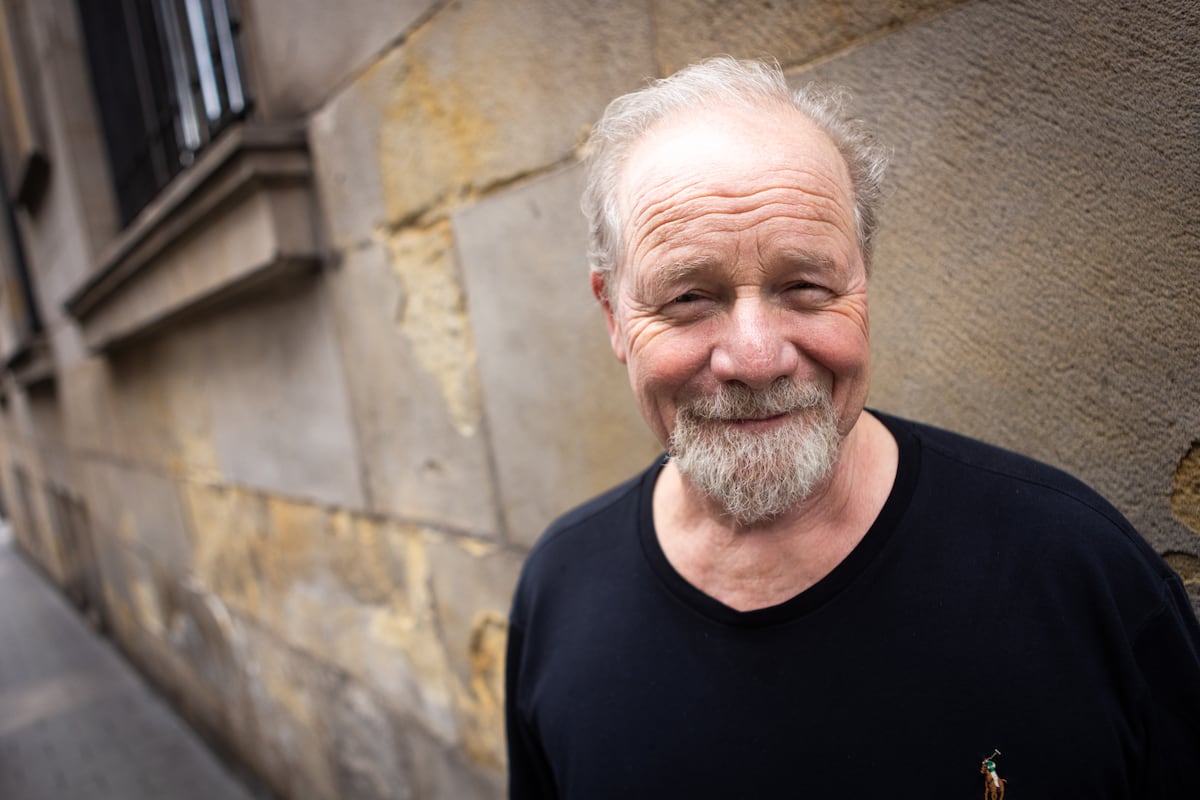
Although the Scottish actor Peter Mullan, 67, is better known for his acting work in the 1990s (Riff-Raff, Shallow Grave, Braveheart, Trainspotting, My Name Is Joe, Miss Julie or Ordinary Decent Criminal), a streak he has managed to sustain through this century (War Horse, Children of Men, Redemption, Sunshine on Leith and dozens upon dozens of other credits), there is a striking detail in his résumé of around a hundred screen performances. He has directed only three feature films — and all of them were highly successful: with Orphans (1998) he won several awards in Venice; The Magdalene Sisters (2002) took the Golden Lion in Venice; and Neds (2010) won the Golden Shell in San Sebastián. After that, there was silence as a director. Not as an actor, though — he has always been versatile and used his rugged looks and roguish gaze to his advantage, even in fantasy series like The Lord of the Rings or The Witcher. Still, that itch remains, and although he accepts the lifetime achievement award being given to him by the Gijón Film Festival — he won with Orphans at this event — having the conversation about his past as a director elicits a couple of gestures and some bitter jokes.Question. After winning with Neds in San Sebastián, you said you would never retire but that directing strongly appealed to you, since you started in the film industry directing shorts. What happened?Answer. They didn’t give me any dinero [he says the word in Spanish]. I wrote several scripts for film and television. One about corruption in the administration of George W. Bush. Another one about the life of Alex Ferguson, and how a poor Glaswegian ended up face to face with the millionaires of the English league during his 27 years as Manchester United manager. With him, I also went through the social history of Scotland and England. Another one was about the film industry. Nothing — nobody gave me money.Q. Ken Loach will not make films again, and with him the voices of a generation of left-wing filmmakers are fading.A. For as long as I can remember, left-wing people have suffered, we have been constantly challenged. So today all that remains is the struggle, fighting to find other ways to make our films. It has never been easy. Ken hasn’t had box-office hits, but he had a loyal audience and always tried to reach as wide a public as possible. And though it’s not a new complaint, now militant left-wing filmmakers are on the verge of extinction.Q. Global polarization doesn’t help, either.A. I’m not so sure. I sense things are changing, because people are no longer attracted to Trump’s toxicity. My God, he was aligned with Putin and called him “my friend.” And both of them alongside Xi Jinping... Anyway, there is now a generation of young people who don’t want to resemble, as the previous cohort did, those who lead this neoliberal garbage. Billionaires like Musk, Zuckerberg and Bezos — cruel, selfish types. These kids think: “These people would literally kill us all.” They’re so implausible in their positions you wouldn’t even buy them as Bond villains [and he gestures as if holding a cat in his lap].Q. How much choice have you been able to exercise in your acting career?A. Quite a bit, because alongside roles close to my own views and cinematic tastes, I’ve done many fantasy series. Right now I’m on the series A Knight of the Seven Kingdoms, and that kind of entertainment lets me work on low-budget films. Last year I was in I Swear, which its director, Kirk Jones, paid for out of his own pocket and, despite being a big hit, hasn’t generated a single pound of profit for him because movie theaters kept 70% of the revenues. So how can you dedicate three years of your life to that? I’ve just shot Mountain, and we didn’t even get to three weeks of filming.Q. How do you build small but pivotal roles like the one in I Swear or the father of Andrew Scott in Elsinore? You have to weave intense emotional relationships in two days of shooting.A. And in that one I had to cry in a parking lot. I haven’t seen the film — is that sequence in it? [The reporter confirms it]. Well, it’s a good example. The director didn’t know if I could cry, so you go, you risk it, you satisfy him and you leave. And you don’t even know whether they’ll respect you in the edit.Q. I suppose Loach is one of your most beloved directors, but have you worked with anyone detestable?A. Except for one occasion, I’ve always encountered talented people, directors exceptional both creatively and humanly. The exception was Brett Ratner — an unpleasant fellow. And yes, Loach stands above them. When I won the best actor award at Cannes for My Name Is Joe, Martin Scorsese chaired the jury. At the closing ceremony he ran up to me and said [he imitates the unmistakable New York voice]: “Tell me, Peter, tell me. How does Loach do it? How does he get those performances?” I told him the truth. Ken doesn’t stare at actors. He stands to the side and listens to them. And if the dialogue sounds honest, the take is worth it. That’s why he’s a director of actors. When Krzysztof Kieślowski [the Polish auteur genius] retired, he said he would only return to cinema to act in a Loach scene, even if it was just to make tea. Those two anecdotes give you an idea of his greatness.Q. You’ve always said you’re a fan of Luis Buñuel.A. I’m fascinated by him! I love his work. What I like most about Buñuel is that he wasn’t afraid to place the camera and let the dream flow— without tricks, without high-minded pretensions. He was wonderfully subversive. I watch his films all the time. The Exterminating Angel blew my mind. And when I read that he directed soap operas in Mexico, I thought: “Fuck! This guy couldn’t care less.” He wasn’t snobby or elitist. When you direct soap operas, you’re down there in the mud; they treat you like dirt. What film festival would invite a Mexican soap-opera director? I love that he did it. Think about it. He began with An Andalusian Dog, worked with Salvador Dalí, his great friend was Picasso... and he ended up directing Mexican soap operas! So when he returned to Europe and began creating his masterpieces in France and Spain, there was something different in his way of working that I adore. I watch his films now because they’re entertaining and because they tackle issues like class differences, death and politics. Much like today’s Korean zombie films. You watch them and say: “My God! They’re dealing with economic inequality and discrimination. And it’s not social realism but a zombie movie!” With great actors. Why aren’t we in Europe making things this interesting? And that brings us back to left-wing cinema: we’ve been too obvious. Like singer-songwriters who play the Spanish guitar. Can’t you use an electric guitar and get closer to young people? No — we’re purists. And that’s how it’s gone for us.Sign up for our weekly newsletter to get more English-language news coverage from EL PAÍS USA Edition
Peter Mullan, actor and director: ‘Militant left-wing filmmakers are on the verge of extinction’
Full Article
Original Source
Read the full article at English →KhanList aggregates and links to publicly available news content. We do not host full articles from third-party sources. Always verify important information with original sources.