
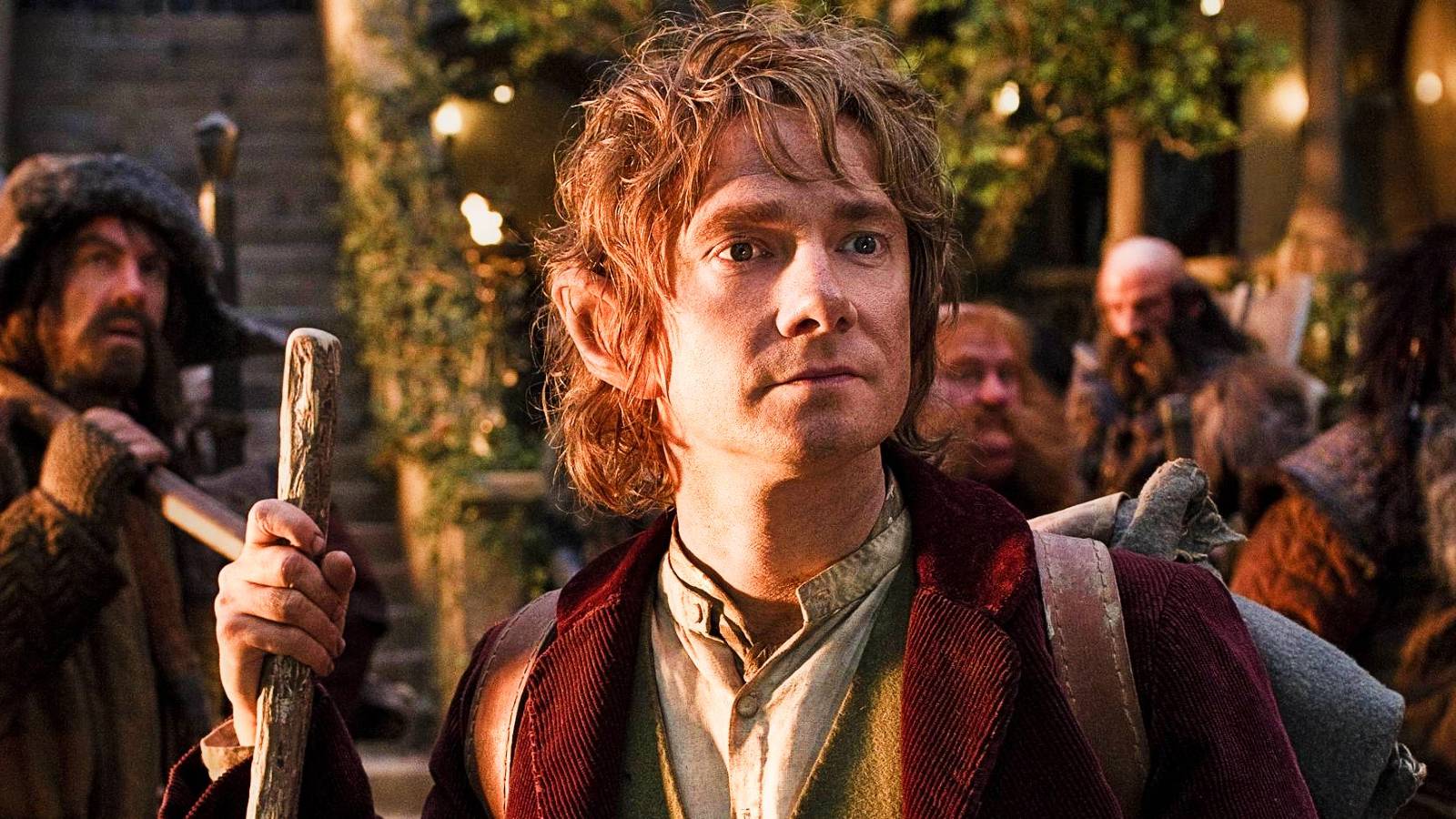
Published Oct 31, 2026, 1:00 PM EDT Peter Jackson should have looked at The Princess Bride for inspiration The Hobbit movies forgot The Lord of the Rings' fairy tale roots Bilbo looking to the distance in The Hobbit: An Unexpected Journey I couldn’t have been more excited for a movie adaptation of J.R.R. Tolkien’s The Hobbit. The story of Bilbo Baggins is my favorite book — I even prefer it to The Lord of the Rings — and I try to read it again every year. By virtue of being less ambitious, The Hobbit lets Tolkien deliver a compact narrative that makes his talent as a worldbuilder and writer shine. That is also why, when I learned Peter Jackson would adapt The Hobbit as a trilogy of movies, I realized something was quite wrong. The results speak for themselves: The Hobbit movies are a CGI-riddled mess that, for the most part, fail to translate and portray the magic of Tolkien’s book. But blaming it all on the corporate greed that turned what could have been one great movie into a drawn-out trilogy would be too simple. After all, Jackson and creative partner Philippa Boyens agreed to expand the originally planned two movies into three. The problem with The Hobbit movies isn’t just that they add an inordinate amount of “original” material; it’s that they forget what this story was in its conception: a bedtime fairy tale. The Hobbit began as a bedtime story Tolkien’s illustration of an eagle and its eyrie in The Hobbit. Art: J.R.R. Tolkien Tolkien would call The Lord of the Rings a fairy tale, too. For the author, “fairy stories” are those that entail the creation of a “secondary world.” They are what we today describe as “fantasy,” and Tolkien himself used that definition. Of course, the matter is much more complex, and fairy stories have more defining elements for Tolkien, who describes them in the essay On Fairy-Stories (written in 1937 and first published in 1947). However, The Hobbit’s peculiar origin makes it stand out as the most “fairy story-like” among the author’s vast production. Between 1930 and 1931, Tolkien sat down at his desk and wrote a single line: “In a hole in the ground, there lived a hobbit.” That wasn’t the beginning of a great tale that already existed in Tolkien’s mind, just waiting to be put on paper. It was just a moment of blissful inspiration, much like Stephen King’s Dark Tower saga began with a sentence that popped into his mind: “The man in black fled across the desert, and the gunslinger followed.” Years later, Tolkien began weaving that single sentence into bedtime stories for his children. Image: Wizards of the Coast But the children, and Christopher in particular, weren’t happy about the lack of consistency between the stories. Poor Professor Tolkien started being nagged about details like the color of Bilbo’s door or the material of Thorin’s tassel, as Christopher recounted in his introduction to The Hobbit’s 50th anniversary edition. So, Tolkien decided it was time to sit down and start writing all of this down, also spurred by the encouragement of friends and colleagues like C. S. Lewis, the author of the Chronicles of Narnia. However, the difference between those bedtime stories and The Hobbit as a book was mostly formal. Tolkien had much respect for children and always refused to categorize them as the recipients of a somewhat inferior form of entertainment. “Children aren’t a class,” he said in a 1967 New York Times interview. “They are merely human beings at different stages of maturity.” Tolkien further elaborated that he disliked the parts of The Hobbit that were written “as for children instead of just for people,” and his own children disliked those parts too. So, The Hobbit is a great fairy story that was originally told to children. The movies turn it into a sprawling, padded epic that takes the least Tolkien-like parts of The Lord of the Rings movies and doubles down on them. But given the nature of the source material, was this always a doomed endeavor? There was actually a much more interesting way to adapt The Hobbit into a fantasy movie, if only the filmmakers had taken inspiration from a classic of the genre. The Hobbit movies should have learned from The Princess Bride Image: Criterion Collection The 1987 movie The Princess Bride adapts William Goldman's 1973 novel of the same name. Both the novel and the movie (whose screenplay Goldman wrote) employ a peculiar narrative framing. In the book, a surrogate version of Goldman declares that he’s writing an “abridged version” of a (fictional) book his father used to read to him as a kid. The movie simplifies things, opening with a grandfather reading a novel called The Princess Bride to his sick nephew. The framing serves various purposes; one, common to both the novel and the movie, is to give the story a strong fairy-tale vibe. As Tolkien wrote in On Fairy-Stories, the true magic of Faerie resides in the transition between our “primary world” and the enchanted “secondary world” where the wonders happen: an “escape” that Tolkien defended as both “practical” and “heroic.” True magic consists in making the elements of that secondary world believable, and thus “real,” and framing them as an ancient tale from a faraway country or a story-inside-the-story is a sure way to achieve that. Not coincidentally at all, The Princess Bride also began as stories Goldman wrote for his two daughters, aged 7 and 4. The similarities with The Hobbit don’t end there, and the two works also have many striking differences, but I could easily imagine The Hobbit movie adaptation beginning similarly to The Princess Bride. Professor Tolkien, a little tired after a long day, enters his children’s bedroom. Young Christopher sits up and eagerly asks his father to tell once again the story of Bilbo and the dwarves, “but this time keep the details straight.” Image: Twentieth Century Fox From there, viewers are spirited into Middle-earth. At key moments, the movie pans back to the Tolkien children’s bedroom. Perhaps, just like the nephew in The Princess Bride, they ask questions or find parts of the story not likable. Christopher and Michael Tolkien actually helped their father in shaping The Hobbit (they even helped with typing and editing), and it would have been great to see that process in the movie. It’s not necessarily wrong to focus on the more epic aspects of The Hobbit, as the movie trilogy did, but having the real-world “anchor” of Tolkien telling the story would add some much-needed balance. Ironically, adding elements of the real world makes the fictional one much more believable. It’s a lesson that Tolkien and Goldman both understood.
Peter Jackson's Worst Lord of the Rings Sin Was Forgetting the Story's Fairy Tale Roots
Full Article
Original Source
Read the full article at Polygon →KhanList aggregates and links to publicly available news content. We do not host full articles from third-party sources. Always verify important information with original sources.