
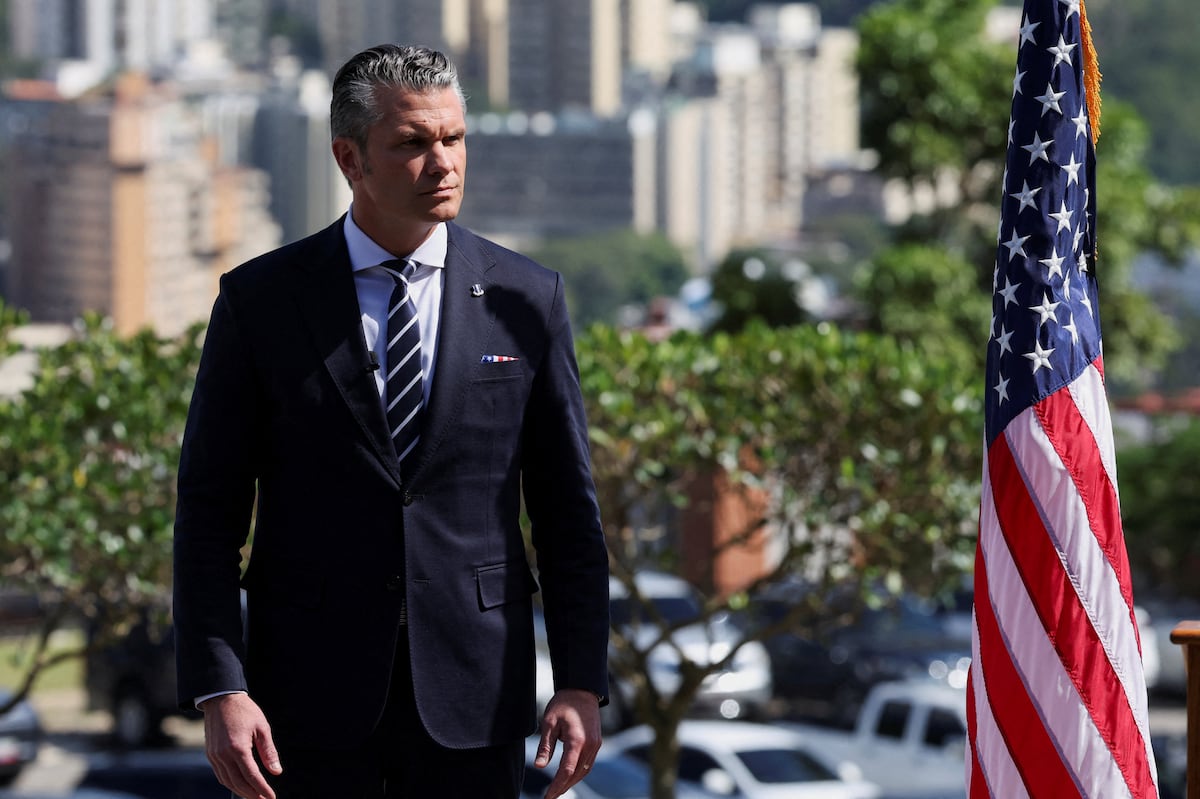
There is a reason why Pete Hegseth visited Caracas last week. That reason is not to renew strategic military cooperation between the two governments — although the renewal announced by Hegseth and Delcy Rodríguez is in earnest — but to implicitly proclaim absolute domination over what his boss calls a new acquisition. He said it at the U.S. embassy in Caracas: “Venezuela has gone from our most aggressive regional threat to a compliant security partner.” Hegseth praised the Trump corollary to the Monroe Doctrine and promised to hunt down drug traffickers wherever they are. To close the visit with a flourish, he ran a victory lap through Fuerte Tiuna, the emblematic Venezuelan military installation that U.S. forces stormed on January 3 to kidnap Nicolás Maduro. His shirt said it all in large black letters: “This is war.”The Venezuelan government’s compliance has been built day by day, piece by piece, for almost eleven months. First came the Secretary of Energy to strengthen U.S. control over oil. Then the Secretary of the Interior came to negotiate access to minerals and the submission of the executive, another step in the slow dismantling of the regime. Hegseth’s visit staged the subordination of Venezuelan military power to Washington.“Almost one year ago, America’s best and bravest warfighters solved a 27-year problem for this hemisphere in a matter of hours,” he declared, referring to Operation Absolute Resolve. Hegseth recalled Maduro’s challenge: “Come for me.” And he boasted that the United States had ended that challenge in 48 minutes and without a single American casualty. As Hegseth recounts, it was enough to remove Maduro from Fuerte Tiuna to end one era and begin another. Today we are in post-Maduro era, but Venezuelans still cannot choose their government.We know that a country’s sovereignty has been confiscated when a foreign power controls its main sources of livelihood and oversees its institutions, and when those who govern are accountable to that power rather than to their own society. Venezuela today meets all three conditions.It is no surprise that some Venezuelans view all this favorably. As the Secretary of War said, the Chavista regime has been a problem for the entire region for decades. Among those who approve the incursion there are even those who would like Venezuela to become the 51st U.S. state. They defend their position arguing that Venezuela was already a victim of plundering by Cuba, Russia, China, and Iran. They are not wrong. It is hard to understand, however, why the remedy would be for Washington to now dispose of those resources as it pleases.Latin American history is full of examples that invite distrust. The United States took more than half of Mexico’s territory in 1848 through the Treaty of Guadalupe Hidalgo. Then came Cuba’s tutelage, the capture of Puerto Rico, Cold War interventions in Central America, and support for dictatorships in the Southern Cone. Panama is often cited as an exception because the 1989 invasion ended the dictatorship of Manuel Antonio Noriega. But celebrating the fall of a dictator is one thing, and offering a country’s sovereignty in return is another.The Venezuelan case presents an aggravating factor: besides occupying a strategic position, the country has the largest proven oil reserves in the world, the largest gas reserves in South America, abundant minerals, and a broad potential to generate clean energy. Trump and his hawks simply see the country as an infinite mine, the loot they have conquered by force. Hegseth said it bluntly in Caracas: the oil agreement with Venezuela makes the Strait of Hormuz an irrelevant factor for the Western Hemisphere.It is hard to imagine Venezuela soon regaining control of those resources. Delcy Rodríguez is negotiating with Washington in a weak position, from an almost laughable asymmetry. Dinorah Figuera, president of the National Assembly that was elected in 2015, and María Corina Machado, each from their positions in the opposition, also need the boss’s blessing. The Rodrigato, the power shared by the siblings Delcy and Jorge Rodríguez, already governs under that pressure. The risk is that tutelage, once established, will be prolonged and become a habit.Venezuelan philosopher Rafael Tomás Caldera summed it up bluntly: “Venezuela, for the first time in its history as an independent nation, has a de facto government imposed by a foreign power. So we have to go to a presidential election to start recovering our sovereignty. I say ‘start’ because the negotiation with the foreign power, which has shown a predatory interest in Venezuela’s natural resources, will be costly.” Caldera fears that the tutelage will generate lasting resentment. “This is not noticeable at first and is spoken of with a joy that surprises me about a possible annexation to the United States. That makes no sense. Neither in history nor in the future.”Delcy Rodríguez’s interim term ended in July. There is still no date for the presidential election, and Trump’s endorsement cannot last beyond 2029. Elections would not end tutelage, but a legitimately elected president could negotiate with Washington with a mandate from Venezuelans.Regarding Hegseth’s visit a few days ago, essayist Hugo Prieto ironically recalled a scene from the 1998 presidential campaign. A journalist asked the U.S. ambassador, John Maisto, what his country would do if Hugo Chávez won. Maisto looked at him in surprise before answering: “What is the United States going to do? No. What are you Venezuelans going to do?” Almost 30 years later, the Secretary of War has answered that question has he jogged through Fuerte Tiuna.Sign up for our weekly newsletter to get more English-language news coverage from EL PAÍS USA Edition
Pete Hegseth’s victory lap (around Venezuelan sovereignty)
Full Article
Original Source
Read the full article at English →KhanList aggregates and links to publicly available news content. We do not host full articles from third-party sources. Always verify important information with original sources.