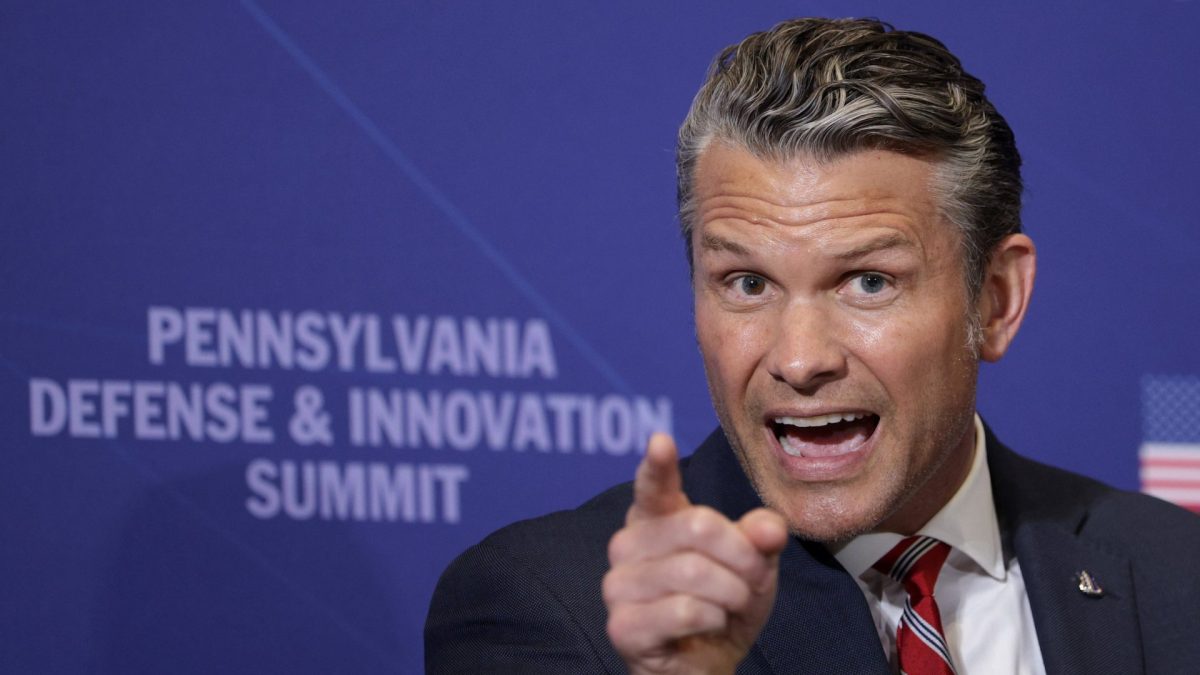
This is Dispatches with Patrick Cockburn, a subscriber-only newsletter from The i Paper. If you’d like to get this direct to your inbox, every single week, you can sign up here. The criminalisation of journalism is part of a wide-ranging assault on freedom of expression moving ahead with frightening speed in the US and rest of the world. Dictators, in place or aspiring, from Ankara to Washington and Moscow to Delhi, offer the same mendacious reasons for targeting news gatherers by accusing them of posing a threat to national security. Securing a monopoly of important and unimportant information is a fundamental weapon of state control, which 250 years ago the founding fathers of the United States renounced in keeping with the core principles of the age of enlightenment. Taking only developments in the last week, these principles are being subverted by the relentless suppression of criticism of the autocratic state being constructed by President Donald Trump. The US War Secretary, Pete Hegseth, says that the Pentagon and the Department of Justice are establishing “a joint taskforce to identify and prosecute… unauthorised disclosures of sensitive” information to the press. In words that could have come from President Recep Tayyip Erdogan in Turkey, Hegseth said “the security of our nation cannot be a bargaining chip for those who seek momentary headlines, [because] access to confidential and secret information is a sacred trust, and those who betray that trust will be met with the full force of the law”. A few days earlier, federal law enforcement officers had visited the homes of New York Times reporters to serve legal documents requiring them to appear before a grand jury after they had written a story about Trump shifting from a Qatari-gifted Boeing 747 Air Force One aircraft to the previous presidential plane for unstated security reasons. This does not seem like an Earth-shattering piece of information, but autocratic regimes are grossly over-sensitive to any unauthorised disclosure about their activities, regardless of whether or not these are anodyne or culpable. The newspaper also said that a senior FBI official contacted the newspaper to demand the presidential plane story not be published on security grounds that he refused to disclose, and also asked for the identity of the sources on which the article was based. Optimists might counter that all US administrations have wanted to plug leaks and punish leakers, notably during the Watergate scandal in the 1970s when president Richard Nixon was in the White House. But the current clamp-down is far more serious because Watergate happened when the mainline US newspapers and television stations were at the peak of their power, fully capable of defending themselves. Since then they have been in decline, even before the internet platforms began to syphon off the advertising revenue that had previously financed the press. For the last 20 or more years, there has been a catastrophic diminution in the number and quality of news outlets in America and across the world. When I was a correspondent in Washington in the 1990s, I would regularly look up reports in the big state newspapers from Louisiana to Rhode Island to find interesting stories that had for some reason not become part of the national news agenda. How come, for instance, the chief justice of Rhode Island had once been the pallbearer at the funeral of a notorious Mafia chief? I could not do that today because most of those excellent newspapers are a shadow of their former selves, where they have not disappeared entirely. Some 2,500 newspaper titles closed and 40,000 newsroom jobs were lost between 2004 and 2022 alone. The Mob connections of the Rhode Island chief justice had been exposed in a series of articles in a local newspaper, but few of these now have the resources to carry out such an investigation. The same shrinkage is depressingly visible in the mainline press: The Washington Post, the heroic exposer of presidential wrongdoing at the time of Watergate, cut its editorial staff by a crippling one third earlier this year. All told, just six companies control most of the US media. Unsurprisingly, the annual index for press freedom published by Reporters Sans Frontières shows the US dropping to 64th on the list, better than Panama but worse than Botswana. Trump is behaving no differently than other “strongmen” – perhaps his closest resemblance is to Spanish and Latin American caudillos past and present – but his path to absolute power is eased by the implosion of the media as a reliable source of news under the effect of the internet. It is not that good newspapers and television channels no longer exist, but they are a beleaguered and much diminished band. What is true in the US is true to a lesser degree in the UK. Media deserts have been advancing everywhere. It is more difficult to find out what is happening in detail at a local level – including in London – than at any time in the last 200 years. When Charles Dickens sent his fictional hero Mr Pickwick to attend a by-election back in 1837, it was normal to assume that the little town where the poll was taking place had two rival newspapers. I spent most of my career as a foreign correspondent abroad, but in this branch of journalism too there has been a sharp reduction in numbers and professional capabilities. The money is no longer available to support permanent correspondents in foreign bureaus. This de-skilling can be masked by visiting journalistic firemen or by well-informed commentary at home, but at the end of the day nothing can replace expensive eyewitness reporting. As the old newspaper adage has it, “comment is free, but facts are expensive”. I do not want this lamentation about the state of the media as a source of credible news to be a tearful acceptance that nothing can be done to fill this giant vacuum of information. One way or another the hunger for genuine news important to people’s lives will be met. Moreover, the old media landscape may have been better than what we have today, but much of it was determinedly partisan, reflecting the political views of the owners. Other weaknesses in the traditional news business include a diluted and selective version of complex events which is inevitable in order to attract a wide audience. The best antidote for such weaknesses is for the reader, listener or viewer to treat all news with a degree of scepticism. Believe Nothing Until It is Officially Denied was the title of a biography I wrote about my radical journalist father. In my experience, there are very few journalists busily engaged in manufacturing false facts, whatever Trump may allege. The New York Times responded to the Trump bid to censor and intimidate it by saying “our journalists simply report the facts”. Since there are an infinite number of facts in the universe, the journalist uses his or her best judgement in selecting those few facts, out of the millions available, they consider important. As The New York Times has made clear, national security should not be the criterion by which those facts are chosen. If it is, and the government can exert control over which facts are chosen, the journalist turns into a propagandist. This development is dangerous but also comforting because absolute rulers – Kim Jong-un Vladimir Putin and Trump – invariably believe their own propaganda, which lures them into unwinnable wars and similar disasters. The bad news is that millions of others will share in their self-inflicted ruin. Further thoughts Are the US and Iran engaged in competitive military escalation which will inevitably return the two countries to full-scale warfare? This has not happened yet, but we are heading fast in that direction as the US threatens to target the Iranian power grid, and other parts of its infrastructure, in what might be called the “Gaza-ification” of its bombing campaign. Short of this, it is difficult to see either side winning a decisive advantage, though each holds high value, if not necessarily match-winning, cards. The US can degrade the Iranian military capacity and economy, but Iran will still be able to make the Strait of Hormuz too dangerous for commercial shipping. Similarly, Iran does not have to fire many drones or missiles at its Arab neighbours on the south side of the Gulf to damage their vastly expensive energy infrastructure as well as their giant airports and international business hubs. Iran is also highly vulnerable because it cannot defend its own airspace. Trump is threatening to destroy its power stations, bridges and oil refineries. The war might also expand horizontally in a geographic sense with Iran asking its Houthi allies into Yemen to close the Bab el-Mandeb Strait at the entrance to the Red Sea if the US hits civilian targets in Iran – a strait through which tankers take 70 per cent of Saudi oil exports diverted from the Gulf. This would most likely precipitate a tremendous surge in world oil prices just before the midterm elections in the US. This is probably a card the Houthis and Iran would like to wave in front of the world but not play until they have to. Curiously, little attention is paid to the way in which the US-Iran conflict is destabilising Iraq – the chief arena of previous wars in the Gulf. Iraq has a population of nearly 50 million and was the largest oil exporter in Opec after Saudi Arabia prior to the US-Iran war. The strongest US leverage in the struggle for Iraq is the fact that Iraqi oil revenues are paid through the US banking system and can be stopped by the US government. For the last 20 years, Iraq has had weak governments, while the US and Iran have exercised a covert joint hegemony, both countries having quietly to agree the name of a new Iraqi prime minister before he was appointed, but this arrangement is now over. “The situation in Iraq is getting close to a showdown,” one well-informed Iraqi source told me. The newly appointed Iraqi Prime Minister Ali al-Zaidi has just visited Washington where he saw Trump and appears to be siding with the US against Iran in the regional conflict. Iraq has just cut off subsidies to Hezbollah in Lebanon. Zaidi is a political neophyte with little personal authority, but the Iraqi executive and the judiciary by and large side with the US. The big question now is whether Iran will retaliate to the US taking a dominant position over the largest Arab state with a Shia majority in Iran’s own backyard. Iran does not want a crisis in Iraq, which acts as a sort of economic lung for Iran, but it may get one anyway. Beneath the radar The public is frightened by mental illness, but has little understanding of its nature, imagining it to resemble physical illness in having a definable cause, which, once diagnosed, can be treated. In reality, mental illness is in each case identified primarily by symptoms, making diagnosis an uncertain business. There are deep divisions about what “mental illness” really means, and about fresh categories of distress more recently included under this definition, a development which has helped boost the soaring numbers of people – 3.8 million in the UK in 2024 – in contact with the NHS mental health services, a rise of two-fifths since before the Covid-19 pandemic. One in five girls aged 16 are today in touch with mental health services. Mental disability does not necessarily mean mental illness, yet some 1.3 million people or 44 per cent of those claiming disability benefits do so because of mental or behavioural disorders. Why are the figures rising so quickly? Are more people becoming mentally ill or is it that the definition has changed? Once mental illness carried such a stigma so that few people would admit to it unless they had florid and undeniable symptoms. They did not want to be labelled as “crazy” and demonised as something less than human because of a perceived loss of rationality. But changes in medication and culture have largely transformed attitudes to mental illness since the 1950s, so that people may now admit to being mentally unwell who would have denied this in the past. Mental illness is decades behind physical illness in terms of what is known and not known, and its study is full of mysteries and unresolved problems. Much of the evidence stems from self-reporting. A full-blown psychosis is easy to diagnose but not the milder variants of anxiety and depression. Unlike physical diseases, there is no cancerous tumour, bacterium, virus – or even errant gene – to be tracked down as the guilty party. Deep unhappiness may be recognised by one group in society as mental illness while another will view it as a normal response to adversity. A danger is that in this frequently ill-informed debate, the simple fact is lost that many people are depressed because they have very good reasons for depression. High deprivation and high suicide rates go together. Poverty combined with debt is a prime motivator for suicide, according to research. There is now a backlash against what is seen as a costly and unaffordable over expansion of the definition of mental illness to more minor forms of mental unwellness, which leads to an underestimation of how truly horrifying and disabling a true psychosis can be. This will further reduce the already inadequate facilities and benefits available to victims whose lives have been shattered. Cockburn’s picks A good entry point into understanding the profound uncertainties among experts about the nature of mental illness is to read this eloquent paper by Sir Robin Murray, former head of the Institute of Psychiatry, entitled “Mistakes I Have Made in My Research Career”. For confidential support, Samaritans are available 24 hours a day, seven days a week. Call for free on 116 123 or visit samaritans.org.
Pete Hegseth’s crackdown will help autocracy flourish
Full Article
📰 Original Source
Read full article at Inews →KhanList aggregates and links to publicly available news content. We do not host full articles from third-party sources. Always verify important information with original sources.