
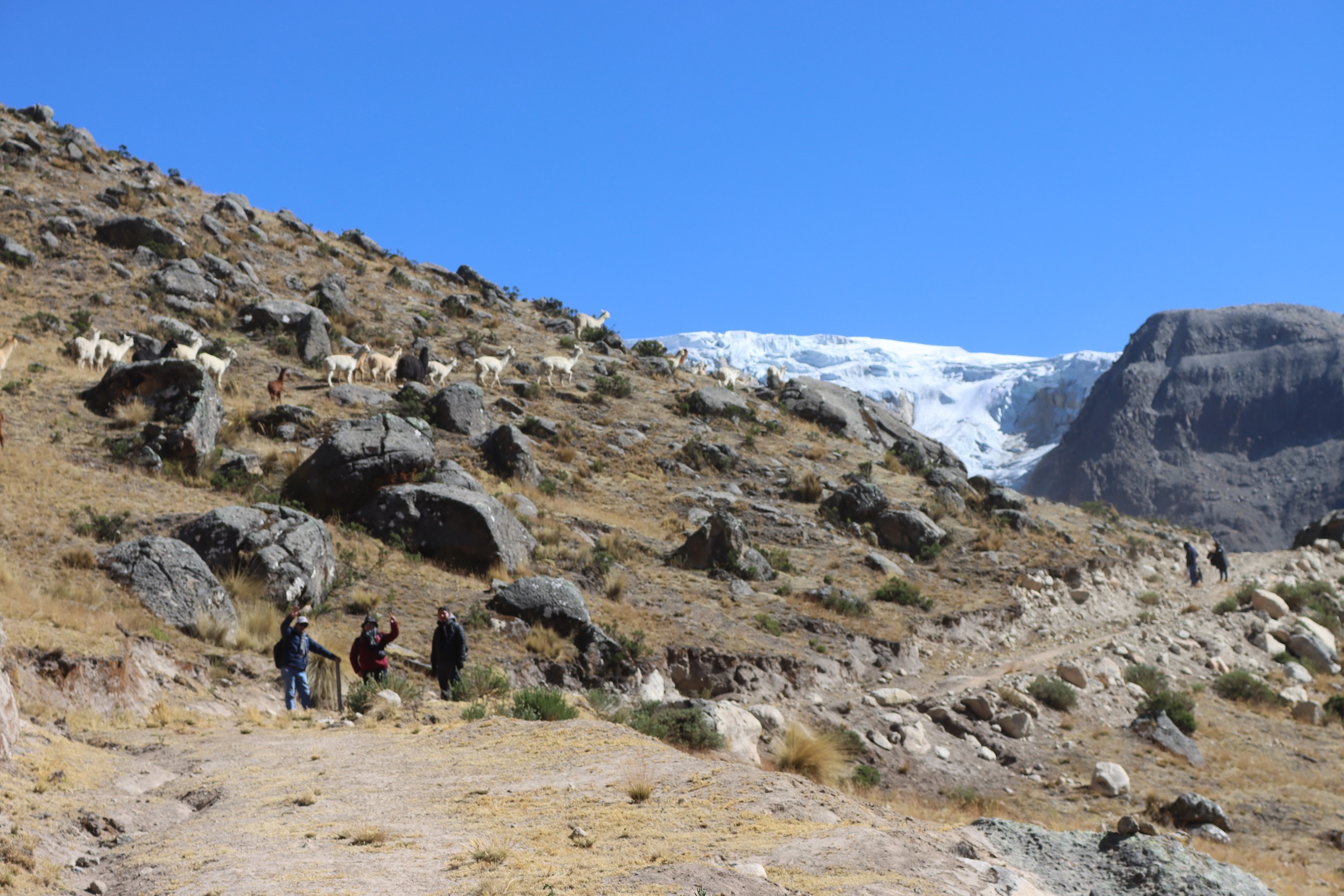
Peru’s recently-inaugurated President Keiko Fujimori has joined the international push for transitional minerals, signing a regional agreement with Argentina, Bolivia and Chile to deepen cooperation and investment.Activists fear that Peru’s energy transition could lead to the acceleration of lithium and uranium projects close to the Quelccaya glacier –— the second largest tropical ice cap in the world —– while questions remain over whether the country’s regulatory framework is ready for uranium mining development.According to scientists, the Falchani, Macusani and Quelcaya projects, all owned by Canadian firm American Lithium, could accelerate the effects of climate change on the already disappearing glacier, a vital source of fresh water for much of the country.Communities around Quelccaya remain divided. While some fear the consequences of mining development, others hope that it will bring much needed employment and investment to one of Peru’s poorest regions. Like many in the community of Phinaya, in southeastern Peru, Donato Bermúdez makes his living from alpacas. His flock of 500 roams the slopes beneath the vast Quelccaya glacier, the site of the second-largest tropical ice cap in the world. Reaching 5,600 meters (18,400 feet), its white peak is home to centuries of tradition. “We believe the glacier is essentially alive,” Bermúdez, a lifelong resident and former community president of Phinaya, told Mongabay by phone. “We say it gives us the water, the lifeblood that flows to the community.” But he and other Phinaya locals now fear that a threat may be looming from the other side of the mountain. In the shadow of Quelccaya, long-delayed lithium and uranium mining projects are gaining fresh momentum under President Keiko Fujimori, who is determined to put transition minerals firmly on Peru’s economic agenda. “Lithium and uranium mining would be catastrophic for the Quelccaya glacier,” said Yolanda Quispe, 44, a community leader and park ranger from Phinaya, who has spent a lifetime beneath the glacier. “The fauna and flora that exist around it, the people — all of this would be destroyed,” she told Mongabay over the phone. Through Peruvian subsidiary Macusani Yellowcake, Canadian firm American Lithium controls major deposits of lithium and uranium — two minerals the Peruvian government describes as critical to the clean energy transition — across at least 174 concessions covering more than 1,090 square kilometers (421 square miles) in the department of Puno, beneath the Quelccaya glacier. The Quelccaya glacier. Image by Corani Territory, with the Quelccaya Glacier in the background. Image courtesy of Red Muqui, photo by Rony Ramos – IDECA Perú . The Falchani Lithium project, an open-pit mine that includes four of those concessions and expands more than 2,800 hectares (6,900 acres) a few kilometers east of the Quelccaya glacier, is set to begin construction in 2028. The project is expected to produce 25,000 tonnes of lithium carbonate per year and generate more than $6 billion over its lifetime. But scientists and activists fear Peru’s push for transition minerals could threaten the glacier and communities that depend on it. “What’s at stake here is the very existence of this glacier,” said Bladimir Martínez, an environmental engineer working with Red Muqui, a Peruvian network of organizations monitoring the impact of mining, in a video call with Mongabay. But while some communities fear the consequences of mining development, others are hopeful that it may alleviate the poverty that blights Peru’s third-poorest region. In Carabaya, the province where the concessions are located, hopes are that mining could provide as many as 5,000 jobs. With communities divided, and the new federal administration aiming to fast-track mining projects, Puno’s mineral-rich earth is fast becoming a battleground for the future of Peru’s energy transition — and for its disappearing glaciers. The threat to the glacier Covering the eastern flank of the Quelccaya glacier, American Lithium’s Peruvian concessions are split between three projects: Macusani, one of the world’s largest uranium deposits; Falchani, the world’s sixth-largest hard rock lithium deposit; and Quelcaya, a third lithium exploration project. American Lithium’s published economic assessments have described the Falchani project as being “highly amenable” to open-pit mining, which activists fear will result in large quantities of metal-rich dust being discharged onto the Quelccaya glacier. “We’re convinced that the dust generated here is going to fall on the glacier,” Martínez said. “That means a rise in temperature and accelerated deglaciation.” Martínez also believes that the presence of uranium in this dust could pose a risk to the surrounding area. “Our biggest fear is that the population, the animals, and the tourists who visit the glacier will be exposed to uranium radioactivity,” he said. The glacier supports 56 plant species and 76 bird species — including the glacier finch, (Idiopsar speculifer) one of only two bird species known to nest directly on ice — as well as endangered species like the Andean mountain cat (Leopardus jacobita). Corani communities, in the vicinity of the Quelccaya glacier. Image courtesy of Red Muqui, photo by Rony Ramos – IDECA Perú. Quelccaya’s meltwater is a vital source of fresh water for the Amazon basin and the departments of Cusco and Puno. According to Peru’s National Research Institute for Glaciers and Mountain Ecosystems, the ice cap holds 2.43 billion cubic meters of water — enough to supply Cusco for a century. But over the last 40 years, Quelccaya has lost 58% of its ice. “There is a lot of fear,” said Vito Calderón, head of communications at environmental and human rights NGO DHUMA, speaking over the phone to Mongabay. “If the glacier disappears, it’ll be even worse. There will be a water crisis across this whole area.” According to American Lithium’s website, the company adheres to the “highest standards” of environmental stewardship, while baseline studies show that no endangered species or habitats are present within the areas of the Macusani and Falchani projects. American Lithium did not respond to Mongabay’s request for comment. Mining gains momentum Originally explored as a uranium-only deposit, the area was found to be rich in lithium in 2017. When American Lithium acquired the concessions in 2021, the projects were already mired in controversy. A year prior, Macusani Yellowcake had been sanctioned for unapproved exploration; while in 2019, 32 of the 149 concessions were declared invalid by the Peruvian government due to missed payments. The ensuing legal dispute was finalized in August 2025, when Peru’s Supreme Court dismissed the case and confirmed American Lithium’s ownership of the disputed concessions. The decision would usher in a wider governmental effort to promote transition mineral mining. In June 2026, Peru formally declared lithium and uranium minerals of national importance. A month later, more than 1,100 people attended the First International Forum on Lithium and Uranium. “The time has come to start talking about a fourth country that leads energy development with lithium and uranium,” said Luis Arroyo, Peru’s prime-minister at the time, at the event. Hailed by American Lithium as a positive step for critical minerals development, the subsequent inauguration of conservative President Keiko Fujimori further cemented the advance of mining interests in Peru. “It must be understood that Peru is a mining country,” she told Peruvian outlet El Peruano, “so we have to promote it.” On Aug. 28, she would follow up on this promise, signing an agreement with Argentina, Chile and Bolivia to deepen cooperation and investment in strategic minerals. But as Peru joins the regional push for mining development, some experts are concerned that accelerated development could come at the cost of adequate regulation. “The approach is clearly one of lowering social and environmental standards,” said Roger Merino, an expert in environmental governance and professor at the Universidad del Pacifico, speaking on a video call. “I’m worried that this kind of push will happen and projects will get approved without necessarily having clear standards.” Compounding experts’ concerns is the lack of clear regulation around the mining of uranium. “The studies say that since uranium is especially radioactive, it needs special handling protocols,” Merino said, “but everything is very vague and general, precisely because there’s no approved law or technical regulation.” A lagoon in Macusani, with the Quelccaya glacier in the background. Image courtesy of Red Muqui, photo by Rony Ramos – IDECA Perú. Some critics believe that ongoing regulatory uncertainty is responsible for the historically slow progress of the Macusani uranium project. “The uranium project is completely stalled,” Martínez said. Those complications explain why the company has sought to separate the uranium and lithium projects, according to Martinez, despite evidence that Falchani also contains uranium. In 2023, Macusani Yellowcake CEO Ulises Solís denied that Falchani contains uranium, but a 2024 study from the Pontifical Catholic University of Peru found uranium among several trace minerals in the site’s lithium-rich rock. “They wanted to separate lithium on one side and uranium on the other because uranium was more complicated,” Martínez said. “If they want to extract lithium in Puno, they are going to extract uranium too. It is inevitable.” The future of Quelccaya Despite the concerns of civil society, communities close to the projects are reportedly in favor of mining. “Most of the local communities were in favour of the activity,” Merino said, referring to his 2024 fieldwork in Corani, where Falchani is located. He said some communities, lacking state support, feel they have nowhere else to turn. “Their only chance of having a better standard of living than what they have now is the mine — they don’t have another option,” Merino said. But other communities dependent on Quelccaya fear they will bear the consequences without sharing the benefits. “I’ve already talked with people from Puno,” said Quispe, whose community of Phinaya sits on the opposite side of the glacier. “I told them: You can’t just sell yourselves so easily, right?” Wetlands in Corani. Image courtesy of Red Muqui, photo by Rony Ramos – IDECA Perú. As a park ranger, Quispe has already witnessed Quelccaya’s deterioration due to climate change. Now, she feels that mining could accelerate its decline. “Each time I arrive on my patrols, I see it further and further retreated,” she said. “With climate change alone it’s already advancing a lot. Mining on top of that would be catastrophic.” Lonnie Thompson, a paleoclimatologist and research scientist at the Byrd Polar Research Center in the U.S. state of Ohio, has been working on the Quelccaya ice cap since 1974. Using a solar-powered drill of his own design, Thompson himself drilled the first ice cores to be taken from glacier. “If [mining concessions] were to develop fully, the whole ice cap is at risk,” he told Mongabay over video call. Thompson believes mining development could combine with the predicted super El Niño to rapidly accelerate melting on Quelccaya — and he is advocating for legislation to prevent this. “There’s really no other option. If you want to protect it from future mining, you’ve got to turn it into a national park,” he said. According to Thompson, stringent protections will buy communities more time to adapt to the loss of Quelccaya’s water resources — but it won’t save the glacier he has spent his life studying. “When I look at Quelccaya, it’s like going to see a terminal cancer patient. I document the change taking place, but I can’t stop the change,” he said. “We need to preserve it as long as possible.” Banner image: The Corani territory, with the Quelccaya Glacier in the background. Image courtesy of Red Muqui, photo by Rony Ramos – IDECA Perú. FEEDBACK: Use this form to send a message to the author of this post. If you want to post a public comment, you can do that at the bottom of the page. Credits Topics
Peru’s drive for critical minerals threatens a disappearing glacier
Full Article
Original Source
Read the full article at News →KhanList aggregates and links to publicly available news content. We do not host full articles from third-party sources. Always verify important information with original sources.