
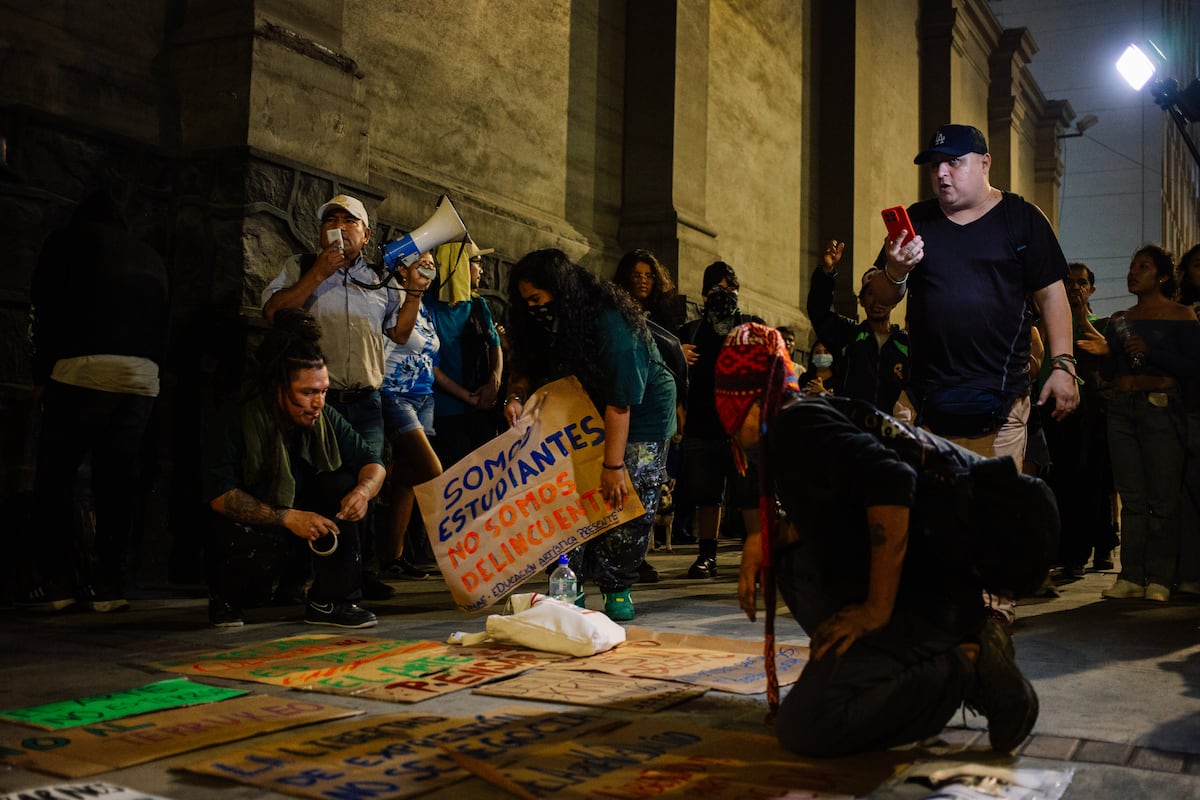
As extortion and murders rise in Peru, Anti-Terrorism Police officers are reviewing the Facebook, Instagram, X, TikTok, and YouTube accounts of left-wing activists, artists, and groups to look for evidence linking them to terrorist groups. Official reports refer to this monitoring as “virtual patrolling,” according to a document from the Peruvian Attorney General’s Office.The monitoring is carried out by a special team from the Metropolitan Terrorism Investigation Division (DIVTM). Since at least 2025, its members have been examining photos, videos, and comments posted on social media about protests, public forums, and cultural activities as part of terrorism investigations. A radical political slogan, a call to protest, or a reference to a former subversive group can end up being included in police files as evidence of terrorist activity.One of these investigations led to the 15-day detention of rappers Pedro Mosqueira and Brenda Mejía, known as Pedro Mo and Brenda Jah. The Prosecutor’s Office is investigating them as part of a new terrorist organization it believes is linked to the Túpac Amaru Revolutionary Movement (MRTA), the guerrilla organization dismantled nearly 30 years ago during the regime of Alberto Fujimori (1990–2000), the father of Peru’s right-wing President Keiko Fujimori.The arrests have sparked criticism from artists and human rights organizations, who denounce this as a new manifestation of terruqueo — the term used in Peru to describe the practice of accusing those who protest against the government or advocate leftist positions of being terrorists. The term dates back to the conflict between the terrorist groups Shining Path, the MRTA and the state, which left nearly 69,000 people dead and missing between 1980 and 2000. “Terruqueo has become widespread and is now used as a tool to instill fear, to label a citizen with a title that does not apply to them, but whose purpose is to silence them,” says Tania Pariona, executive secretary of Peru’s National Human Rights Coordinating Committee.The arrests have also raised concerns among three United Nations special rapporteurs. Gina Romero, the special rapporteur on freedom of assembly and association, warned that “the shrinking of civic space” in Peru is taking on “alarming proportions.” Andrea Bolaños, the special rapporteur on human rights defenders, denounced the stigmatization and criminalization of artists and activists who support peasant and grassroots causes. Leopoldo Maldonado, the special rapporteur on freedom of expression, noted that the freedoms of expression, association, and assembly, as well as the right to defend human rights, “cannot be arbitrarily restricted.”Rap and eco-workshopsPedro Mo, 42, who was arrested in Cuzco, has been rapping protest songs against inequality, racism, and corruption for more than two decades. Brenda Jah, 30, who was arrested in Lima, is a drama student, feminist, and rapper. She participated in independent festivals and used her music to accompany protests against the government of Dina Boluarte, which left some 50 people dead as a result of repression between 2022 and 2023.The case began in 2025 when a Facebook group called Cahuide Liberation Force posted a video of hooded individuals with weapons in the Peruvian jungle. According to the police, the footage shows one of two terrorist training sessions that an alleged organization linked to the MRTA is said to have conducted between 2024 and 2025 in Indigenous communities in the Amazon region of San Martín.To link Pedro Mo to those training sessions, the Prosecutor’s Office relies almost entirely on a single confidential witness, identified under the pseudonym “Carlos Campos,” who claims to have infiltrated the group. He claimed to have recognized the rapper among the hooded figures in the video and submitted seven audio recordings in which he says he identifies his voice. The arrest warrant was issued without expert reports or other independent evidence to corroborate that account. Mo’s defense denies that he was there and asserts that he has never used a weapon.The police also reviewed Pedro Mo’s Facebook posts from 2022 to 2025 and concluded that sharing public announcements from the Saturnino Huillca Rebel School — a cultural and political collective that champions peasant struggles — constituted “agitation and propaganda.” To portray the group as a front for the now-defunct MRTA, the agents cited a 2023 television interview with a former intelligence chief and highlighted phrases from its charter such as “people’s power” and “political autonomy outside the state.” They even interpreted four letters in which the rapper offered artistic and ecological workshops to schools in Cuzco as a subversive strategy “for local positioning.”“It’s absurd. There is no behavior in this case that implies affiliation with terrorism,” says attorney Julio Arbizu, who points out that Saturnino Huillca (1893–1987) was a historic Quechua peasant and union leader who stood up to the landowners. “He was nearly 90 years old when the MRTA was founded,” he notes.In the case of Brenda Jah, the police cited her Facebook interactions with Pedro Mo and other left-wing groups as evidence. The prosecution also links her to an attempted act of railway sabotage during a July 2023 protest on the outskirts of Lima, a charge her defense denies. Although damage to the rail was confirmed, the prosecution’s case once again rests on the account of “Carlos Campos” and an anonymous document sent two years later. The judge acknowledged that there is no “objective evidence” of her involvement in that incident, but ordered her detention on suspicion of terrorist affiliation and cited a risk of flight because the rapper does not have a steady job.The investigation involves 10 people, but the judge authorized the detention of only five for 15 days. In addition to the rappers and a Colombian artist, the order includes brothers Polidoro and David Tapullima, the father and uncle of Jacqueline Tapullima, a congresswoman from the left-wing opposition party Juntos por el Perú. The Prosecutor’s Office accuses them of providing logistical support and instruction during the training sessions in the Amazon. According to his family, Polidoro is blind and did not receive the ruling in Braille. The judge refused to detain the other five, including two former MRTA members who had already been released from prison, ruling that their speeches and social media posts were protected by freedom of expression.Indira Rodríguez, the attorney for the Tapullima brothers and the two rappers, told EL PAÍS that the arrests were carried out without prosecutors or attorneys present, in violation of the legal requirement to ensure legal representation during searches. The detainees are being held incommunicado in small cells, sleeping on a concrete slab, and have received only one family visit, the attorney reports. She filed an appeal on Friday against the court order, citing lack of evidence.Last week, the Epicentro TV website published a “highly urgent” police order that included the Peruvian Anti-Terrorism Police among the units deployed to monitor a demonstration called for November 15 in Lima by feminist artists and to gather information on possible crimes.Warning messageThis is not the first time the police have linked protests to terrorism. During the demonstrations in 2022 and 2023, various intelligence units attributed the marches to alleged agitators from Shining Path and the MRTA to justify military intervention.Arbizu states that citizens with no political affiliation — some of them elderly — have come to his office after being summoned by the authorities to testify on charges of alleged glorification of terrorism following the publication of left-wing political comments on social media. He maintains that behind several of these cases lies the very same “cyber patrol” conducted by the Anti-Terrorism Police. Neither the Prosecutor’s Office nor the police responded to EL PAÍS’s requests for an interview.The lawyer fears that the arrests of the rappers foreshadow increased police persecution against those who criticize Keiko Fujimori’s government. “I think it’s a clear message of what may lie ahead in the coming months for those of us who have at some point been part of the opposition and have spoken out,” he warns.Sign up for our weekly newsletter to get more English-language news coverage from EL PAÍS USA Edition
Peru monitors social media accounts of left-wing artists and activists for signs of terrorism
Full Article
Original Source
Read the full article at English →KhanList aggregates and links to publicly available news content. We do not host full articles from third-party sources. Always verify important information with original sources.