
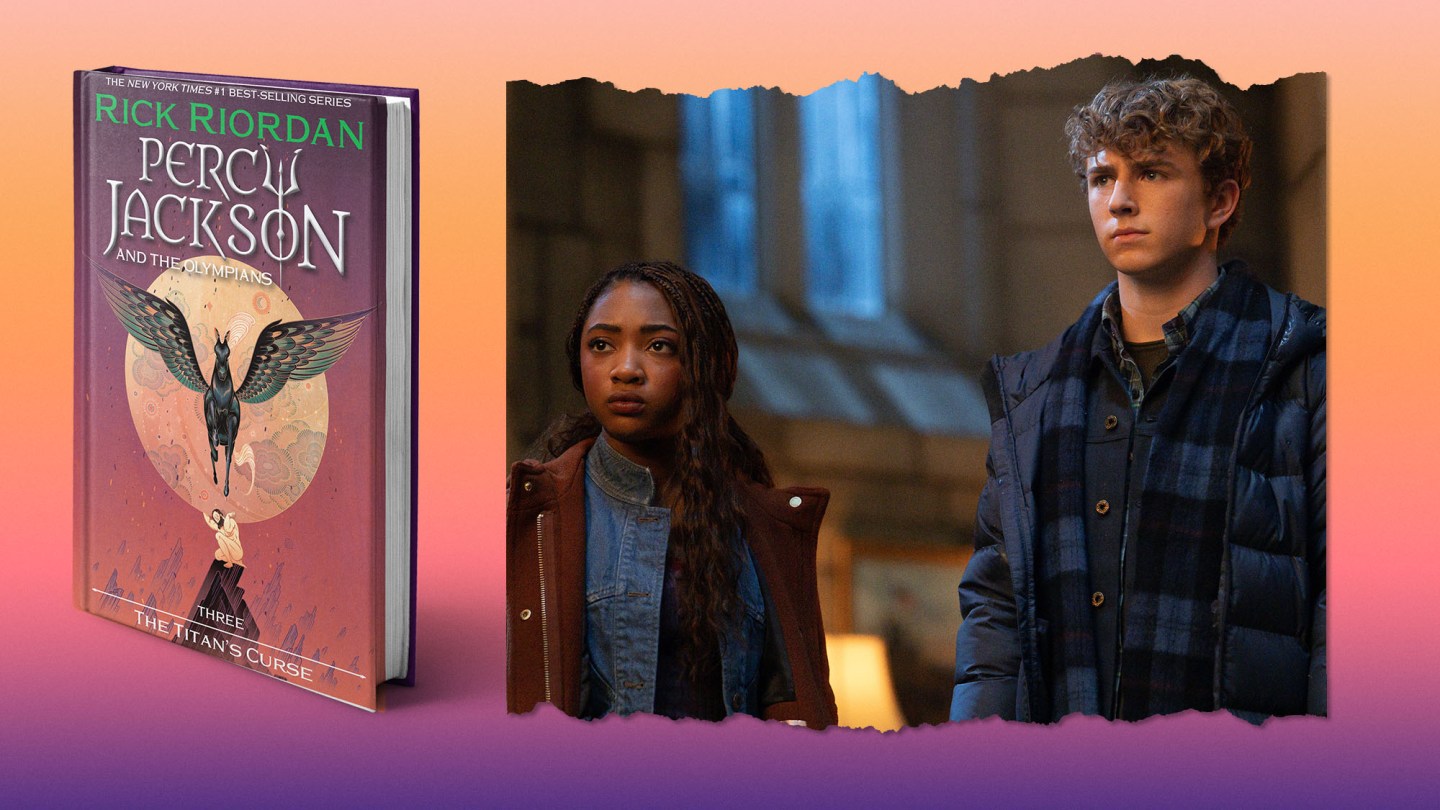
Logo text Some stories refuse to stay on the page. The Hollywood Reporter’s Beyond the Book column explores what happens when books make the leap to screen and beyond — unpacking what stayed, changed, how it was done and why it matters with the creatives who made it. *** Percy Jackson is back. Season 3 of the Disney+/Hulu series Percy Jackson and the Olympians continues the saga of the Greek gods, their demigod offspring and the mission to prevent the rise of the Titans. The storyline is based on The Titan’s Curse, the third book in Rick Riordan‘s bestselling series. The plot finds Annabeth Chase (Leah Sava‘ Jeffries) captured by the forces of Kronos, leading Percy (Walker Scobell) to embark on a perilous journey to rescue her. He must free a goddess in chains, confront the Titan’s curse and avoid triggering the fall of Olympus. He’s joined by his friend, the satyr Grover Underwood (Aryan Simhadri), and some unlikely others on his quest. Co-creator/executive producer Jonathan E. Steinberg tells The Hollywood Reporter that Percy and Annabeth’s friendship continues to be central to the story this season. “In the first two seasons, we were very aware that while we were watching a story about two lonely kids become best friends, there were other things in the offing between them, and that eventually, they would mean more to each other,” he says. “Some of that is a romantic story eventually, and some of that is just how best friends they are. Getting to test that and watch them both deal with the idea of losing the other, and maybe never getting them back, is sort of core to the experience of investing in Percy and Annabeth’s relationship.“ Steinberg praises the season‘s handling of the maturity as “exciting.” “Ultimately, it doesn’t matter how tall that monster is, if you don’t care about the two people in the center of the story, it’s just not going to be exciting. This season really answers both of those calls and doing its work on a grand scale and also putting these people through a trial and interrogating how important they really are to each other,” he says. As the third season rolls out, the cast and creatives — including Scobell, Jeffries, Simhadri, Steinberg and EPs Dan Shotz and Craig Silverstein — sat down to talk with THR about the making of the show, bringing the book’s epic moments to life and what fans can expect. Leah Sava’ Jeffries and Walker Scobell in Percy Jackson and the Olympians Season 3. Disney/Eric Milner Sourcing the Source Material Each season of the show has corresponded with a book in the series. (Season 1 was adapted from 2005’s The Lightning Thief, Season 2 from 2006’s The Sea of Monsters and now Season 3 from 2007’s The Titan’s Curse.) The books feature monsters and battles and mythical creatures, much of which make for an ambitious adaptation to a TV show. For the producers, their challenge is bringing all of that to life. “Rick doesn’t make it easier for us with each book,” Shotz quips. “It just gets bigger and bigger as we go. But the benefit of doing a series is you get to keep building and learning from what you did before, and have the show grow.” He gives credit to the entire team for “making this the biggest, best version of itself,” including the “massive set pieces.” “You want to deliver on kids’ imaginations and deliver these creatures, but do it unique to Percy,” Shotz adds. “So every time we’re trying to build a creature or create a set piece, it’s like, what makes it unique to this show? How do you take mythology that’s been around for a long time? How do you take what Rick put in his books, and then how do we make it into something that is really special? And it just takes incredible craftsmen and women who just put their best feet forward and deliver on it. The artistry that we got to see this year really felt like it was second to none, and we just went for it.” Scobell in Percy Jackson and the Olympians Season 3. Disney/David Bukach Silverstein gives credit to Steinberg and Shotz for envisioning something bigger than the small screen. “It starts with the ambition of John and Dan at the outset of this, to say, ‘OK, this isn’t just the TV version. This is the thing,'” he shares. “We all love big movies. It’s not holding back. These guys really went for it to put this thing up on [a big] scale.” Aryan Simhadri, who plays satyr Grover Underwood, says fans will be pleased this season. “We talk a lot of about the tone shifting, but I’m really proud of how we adapted a lot of the fan-favorite moments from the book,” he says. “I think we really did a good job of visualizing these sets and like adapting these moments to screen. It really just looks stunning this season.” Meanwhile, the actors share that they do a deep dive into the books before filming each season. Asked how much they draw on the source material, Jeffries is quick to reply: “Oh, I drew so much.” Scobell offers his own take. “I feel like it’s really important to start off every season rereading the book that you’re doing,” he says. “I reread Book 3 before we went into it and and I’ve reread Book 2 before we started that [season], and I think that’s really important.But at the same time you have to be willing to kind of let some things go because some things are going to get cut, some things are going to get added. It’s going change the story a little bit, so you kind of have to keep the core of their character but be willing to change according to the script.” Shifting Beyond Percy’s POV One of the challenges for the production team is that that the entire book series is a first-person narrative as told by Percy. “Everything in the book is from Percy’s point of view,” Silverstein says. “We’ve long taken the camera off from around his shoulder, and put it out with other people. It’s kind of been a slowly widening process of that as the story progresses.” But it’s not that easy just to show other characters’ points of view without changing the story. “If the camera cuts to something else that he did not see happen, or someone else he did not see, how does that affect the story of the book?” Silverstein continues. “And in surprising ways, it affects quite a bit. [For example], Percy sees a lot of things through his dreams, but if he doesn’t see those things, then the story’s ahead of him, and sometimes the audience is ahead of him. Sometimes that’s good, and sometimes that’s not good. The challenges to the adaptation begin to present themselves, and then you’re always trying to steer back to what the core of the story is, what made us excited when we read the books, and hoping that that lines up with what made any reader excited when they read the books.” Scobell in Percy Jackson and the Olympians Season 3. The Annabeth Dilemma Annabeth isn’t in the third book very much, but she’s obviously one of the main characters of the series. For that matter, Clarice (Dior Goodjohn) isn’t in it at all — but she also appears in the third season. So how do you tell a story around characters who have little to no presence in the source material? “It’s about taking cues from the book,” Silverstein says. “Just because Annabeth’s not in the book doesn’t mean she’s not in the story. She is, and it’s about taking the camera to her. We’re trying to build the story out. She’s up there on Mount Othrys with Luke. Well, what are they talking about? What’s going on there? And that’s something that colors within the lines of the grand narrative that doesn’t change it in a huge way.” As for Clarice, she’s not in the book because she’s working on a secret mission for Chiron, but it’s not clear what that mission is to the reader until later. “If you read the later books, you find out what she’s doing,” Silvertein adds. “So [in the series], we’re going to find out what she’s doing a little earlier. Which is what we would have done if we had taken the camera and put it over her shoulder, right? It’s fleshing that stuff out.” The producers do consult with Riordan on these types of changes. According to Shotz, the author loves exploring “all these different avenues” as well. “It gives him an opportunity to dive deeper into this world and make suggestions about what he thinks, is happening, that he didn’t get to explore when he started this process,” Shotz adds. And, of course, Annabeth is crucial to the overall story. “That’s what’s amazing about adaptations is, once you have a character like Annabeth, you can’t keep telling this story without Leah,” Shotz says. “It doesn’t work. We must tell her story, so that’s really the fun part of it, but also for an audience who’s not only going to get their book series honored, but they’re going to get all these new things that will excite them. And that makes it really interesting, so that it’s not just a book report. You’re getting so much more.” Jeffries in Percy Jackson and the Olympians Season 3. Disney/David Bukach For Jeffries, not having source material to draw on actually allowed a bit more freedom in portraying the character. “I really feel like it was kind of up to interpretation for me because I could do a lot of acting improv, not with words but with reactions and how she plays certain scenes, which is a good thing,” she says. “It’s more of a raw reaction now because when you’re playing a part or you’re doing a certain scene that’s really important in the books, and you know what’s in there, it’s kind of like you expect it. But with Annabeth and with me especially, it was kind of harder I’m also figuring it out. I wanted to make sure that I still stayed in Annabeth’s character, even though she’s not in the book [much].” Still, she admits that she was a bit nervous as a result of not having the anything in the books to draw on. In Season 3, Annabeth also spends much of the story separated from Percy and Grover, which meant Scobell and Simhadri weren’t really there to witness Jeffries acting out her scenes, and vice versa. They were only able to see one another’s performance once the series started coming together, and they have nothing but praise for one another. “Once I watched it and saw everything come together — especially you guys, because I wasn’t with you guys, so I didn’t really get to see what you were doing — you guys looked really good. I’m actually really proud of you guys,” Jeffries says. “it is weird because there were two separate whole stories going on basically at the same time,” Scobell adds. “So, not be there for part of it and then see what’s going on afterward.” “And to see how much you’ve grown at the end of the season,” Simhadri adds of Annabeth. Thalia Joins the Action Thalia, the demigod daughter of Zeus, has been present throughout the books and series but as a tree for much of the story. In the books, the story goes that Zeus did this to protect her after she sacrificed herself to save her friends. But in a twist, the series diverted from the books; viewers learned in the season finale that he actually transformed her as a punishment after she confronted him about his intentions to use her as a weapon. She’s been mentioned through the books and series up to this point, looming large in the characters’ consciousness. We briefly met her in the Season 2 finale after she was transformed back to her human form, but now she’s a much bigger part of the story. This season finds Thalia (Tamara Smart) joining forces with Percy, but it’s a rocky alliance as he is wary of her loyalty to Luke, the demigod who betrayed Percy way back in Season 1 and has been trying to overthrow the Olympian gods. “Rick has a phrase about this book, and it applies to this season as well: All of the major chess pieces are coming onto the board,” Silverstein says. “Thalia has been talked about since Season 1, but now she’s really coming into the story, and when he’s talking about the chessboard, what game is it? Well, it’s this war between the gods and the Titans. And Thalia is right at the center of all of that. Thalia and Percy and any other potential children of the big three gods who may be out there.” Scobell and Tamara Smart in Percy Jackson and the Olympians Season 3. Disney/David Bukach The overall saga of the books comes more into focus in the third book/Season 3, he adds, versus just focusing on “the quest of the year.” “And what Thalia decides to do will affect not just all of the people she loves and her friends, but the entire world and all of her parents and all of her grandparents,” he adds. “She’s got a big role.” As for how the dynamic changes with Thalia around, the actors say it introduces a rivalry between the characters. Simhadri begins, “We all wanted to be — ” “the biggest and baddest,” Jeffries finishes as he nods. (The cast often finishes each other’s sentences.) Scobell expands: “Thalia is kind of in competition with Percy for his spot in that kind of group. But she can’t just show up and join us. It’s not like [Percy’s cyclops half-brother] Tyson, where he and Grover can exist. There can be only one.” Simhaddri echoes that sentiment: “It’s one or the other.” Art Imitating Life Percy has arguably the biggest growth of any character up to this point, as he started off the series thinking he was a regular boy before learning he was a demigod and becoming a hero. “The most important part about playing Perseus Jackson is also experiencing my own life in the same way,” Scobell says. “He goes to camp every summer and then he goes back to school and back to his real life. I do the same thing. We take a big break in between every season.” But now, Scobell finishing his last year in high school and still awaiting word on a fourth season. “So I’m kind of moving into uncharted territory because before, I could look forward to next season and really just be comfortable going to school and living my own life, but this is going to be a big change for me because it’s so uncertain.” For Simhadri, he also felt like Grover grew a lot of over the course of the season, as did he, not only as a person but as an actor. “I was an adult on season 2, but I never ended up working that many hours per day,” he shares. “But in season 3, I was back every day filming and I was working with a ton of adults, so we would all just shoot for as long as we could in well into the night and really just like push ourselves every day. So I feel like not only did Grover grow over the course of the season, I think I grew in tandem alongside him.” Simhadri in Percy Jackson and the Olympians Season 3. Disney/David Bukach Why Greek Gods Are Having a Moment This year has seen not only more Percy Jackson but also the box office blockbuster The Odyssey. Why are people suddenly gaga over the Greek gods? “It’s timeless,” Steinberg says. “Those stories have evolved to be about universal experiences that just kind of live really deeply in everybody. I think it’s really not surprising that they never quite go away, because they apply to everybody. We’re happy that it’s in the zeitgeist, but not surprised.” “And Percy did it a lot faster than Odysseus,” Shotz quips of the latter’s 20-year journey back home. *** Percy Jackson and the Olympians is streaming on Disney+ and Hulu.
‘Percy Jackson and the Olympians’: How Season 3 Brings Epic Moments to Life and Deals With Annabeth’s Absence in the Books
Full Article
Original Source
Read the full article at Hollywoodreporter →KhanList aggregates and links to publicly available news content. We do not host full articles from third-party sources. Always verify important information with original sources.