
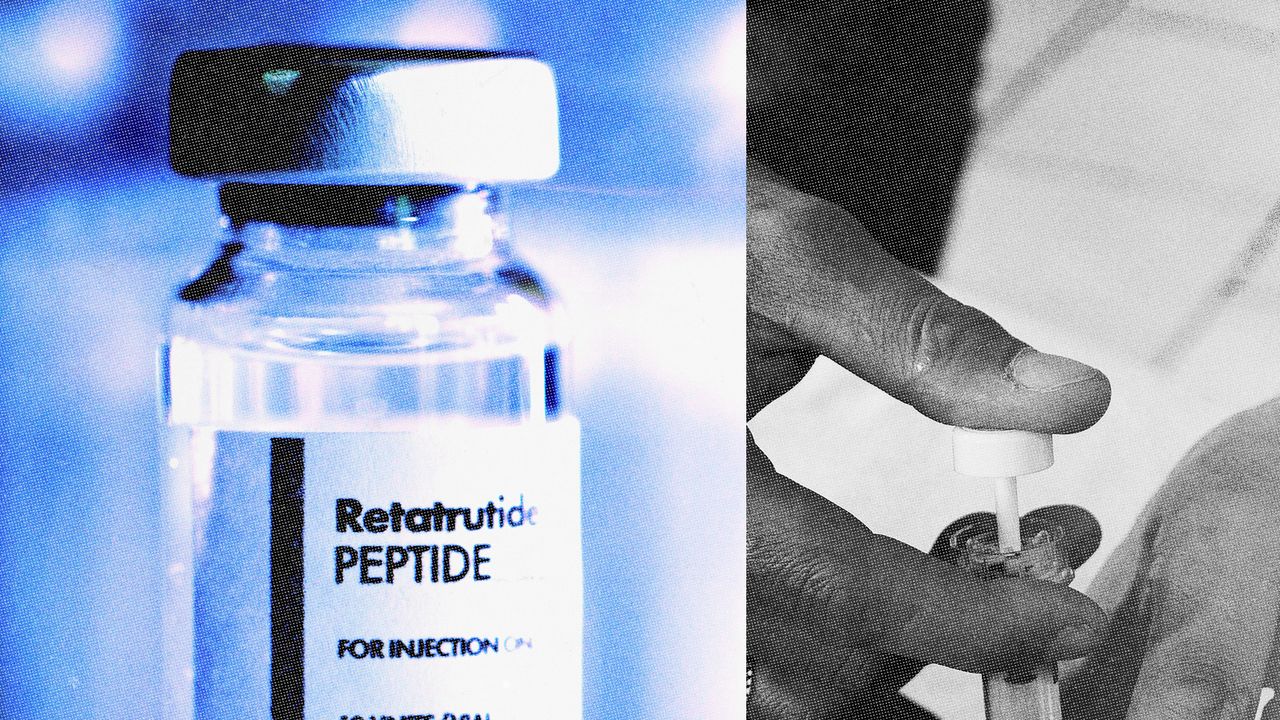
This past February, Health and Human Services secretary and MAHA Final Boss Robert F. Kennedy Jr. made it known during an interview with Joe Rogan that he intended to direct the FDA to lessen restrictions on a handful of peptides that had previously been banned under the Biden administration. The peptides in question, which included influencer favorites BPC-157 and TB-500 (collectively dubbed the “Wolverine stack” for their reported regenerative properties) had been placed on the FDA’s “do not compound” list, effectively barring pharmacies from providing them to patients, for reasons including serious safety concerns and a general lack of comprehensive human trials. No new research had emerged to prompt RFK Jr.’s announcement. Rather, the HHS head, a self-proclaimed “big fan” of peptides, believed the drugs should never have been banned in the first place—a decision that, in his view, was responsible for the subsequent explosion of a thriving black market for peptides online. So, for the past eight months, healthcare professionals have been waiting with baited breath for the other shoe to drop.And then this past Wednesday hit with a thud.In a seemingly unilateral decision—one that flies in the face of FDA scientists who warned earlier this year of the potential, largely unknown implications of effectively releasing scantily researched injectables into the wild—RFK announced that patients (or anyone with a prescription) would now have access to six of these previously outlawed peptides through a loophole-like policy called “enforcement discretion.”To explain exactly what that means, I called up Edgar J. Asebey, a life sciences regulatory and transactional attorney and partner at the Frier Levitt law firm who leads the FDA Practice Group. “I always tell people I speak three languages: English, Spanish, and FDA,” he says. “Enforcement discretion means that the FDA will not enforce a certain regulation. And in this case, it's the prohibition against compounding these six peptides. That's what it boils down to.”Enforcement discretion is typically considered a break-in-case-of-emergency avenue for freeing up availability of certain drugs when warranted, Asebey says. “For example, when the GLP-1s were in shortage, pharmacies could lawfully compound exact copies of Ozempic and Wegovy.” In other words, the six peptides in question—BPC-157, TB-500, MOTS-c, Semax, KPV, and Epitalon—are still categorically unapproved by the FDA for human use, but Kennedy is going to allow pharmacies to dispense them as if they were, until further notice.While this may seem outrageous, not everybody is outraged. For one, obviously, peptides are big business. (Market research firm Grand View Research valued the global peptide industry at over 140 billion in 2025, with North America accounting for more than 60% of that revenue.) Aside from that, however, one of Kennedy’s stated motivations is to reduce people’s incentive to procure peptides from regulation-skirting med spas and the dark corners of the internet, where substances like BPC-157 can be ordered to your door with the same ease as buying paper towels on Amazon. Since July, the Alliance for Safe Online Pharmacies (ASOP Global) has tracked nearly 21,000 peptide listings across more than 300 websites, including upwards of 8,800 listings for BPC-157 alone. As you might imagine, quality and safety present serious concerns to anyone choosing to go that route—that is, beyond the potential risks of using these peptides even in their purest forms—hence the burgeoning cottage industry of peptide purity trackers and testing services.“My view is simple,” says Meena Verma, MD, MPH, a board-certified internist and nephrologist, and founder of Blue Coast Longevity in Newport Beach, CA. “People are already using these peptides, and there is an urgent need for harm reduction. Allowing licensed pharmacies to compound them under physician guidance means patients can now have an accountable channel with assurance of safety.”But how this policy change plays out may not be quite that simple. Whereas purveyors of these six peptides—whether operating online or in person—were previously identifiable as unlawful simply by virtue of offering the unapproved drugs, Kennedy's mandate to usher these peptides into the broader health marketplace muddies the waters, making it harder for consumers to tell which providers are legit. "The online market is already flush with illegal actors who now can more easily hide amongst the masses with limited risk of getting caught,” reads a statement that ASOP Global released within hours of Kennedy’s announcement on Wednesday. “Without enhanced and consistent new enforcement of the market, today’s policy will allow criminals to hide amongst the newly compliant.”Kennedy’s plan notes that compounding pharmacies will be subject to specific safety criteria, like requiring that the peptides are manufactured in an FDA-registered facility, but as The New York Times has pointed out, “the step basically only requires a manufacturer to notify the agency of its address.”When you consider the scale of the peptide market alongside the reality of what the FDA is actually capable of policing with its post-DOGE workforce—following the laying off of 3,500 workers—it begs the question of whether the criteria laid out in Kennedy’s plan will even matter at all."For one, if you're going to have guardrails, you're going to need to enforce them,” says Leigh Verbois, PhD, ASOP's global board chair and the former director of the FDA’s Office of Drug Security, Integrity, and Response. “There needs to be resources to actually take action, full stop. And two, the organizations that are intended to utilize those guardrails may not even look at them. There are too many [compounding pharmacies] to be able to enforce against."But I’d argue there’s something far more dangerous, and more consequential, than the possibility that this latest decision might inadvertently feed the back-alley peptide market rather than curtail it. After all, not everyone is out there looking for peptides. (I know I’m certainly not.) But we all need to go to the doctor at some point—something that could now conceivably land you on the receiving end of a prescription for a drug that has never even been researched in a human being.“To classify this as safe would just be irresponsible,” says Motisola Lewis, MD, an Internal Medicine physician and the founder of Lewis Medical NY. “If you have a cancer patient—say, a woman who just had breast cancer—and she wants to fix her knee that just got injured, and she ends up getting an injection of BPC-157. This is known to promote tissue growth. This is known to promote vascularization. We don't know what effect it has on a patient who has had cancer. Does it promote cancer growth? We don't know.”The inescapable irony here is that not long ago it was the MAHA movement that was encouraging people to be skeptical of mainstream medical providers, to do your own research before just allowing your doctor to jab you with a COVID-19 vaccine. And now, by injecting these six potentially harmful peptides into mainstream medicine, where they will be readily available to physicians with varying degrees of familiarity with the substances themselves and the politics surrounding them, the administration has gone ahead and given the rest of us a very real reason to do our own research. Sure, this only applies to peptides at the moment, but a precedent has been set. And you can no longer afford not to pay attention. None of us can.“When patients walk into their physician's office, or talk to a telehealth provider, they have an assumption that there will be a positive outcome—that the patient is seeking and that the physician is intending to meet,” says Dr. Verbois. “But without any of the quality, safety, or efficacy, it's completely the wild, wild west. If anyone in my family, in need of a drug for treatment, were to ask me if they should go down a path of utilizing a peptide of this sort, my response to them would be, ‘Never. Instead, seek out a treatment for that disease that's been shown to be safe and effective. These have not been, and you are putting yourself in harm's way.’”
Peptides Are About to Flood the Market. And Bro Science Is Coming for Us All
Full Article
Original Source
Read the full article at Gq →KhanList aggregates and links to publicly available news content. We do not host full articles from third-party sources. Always verify important information with original sources.