
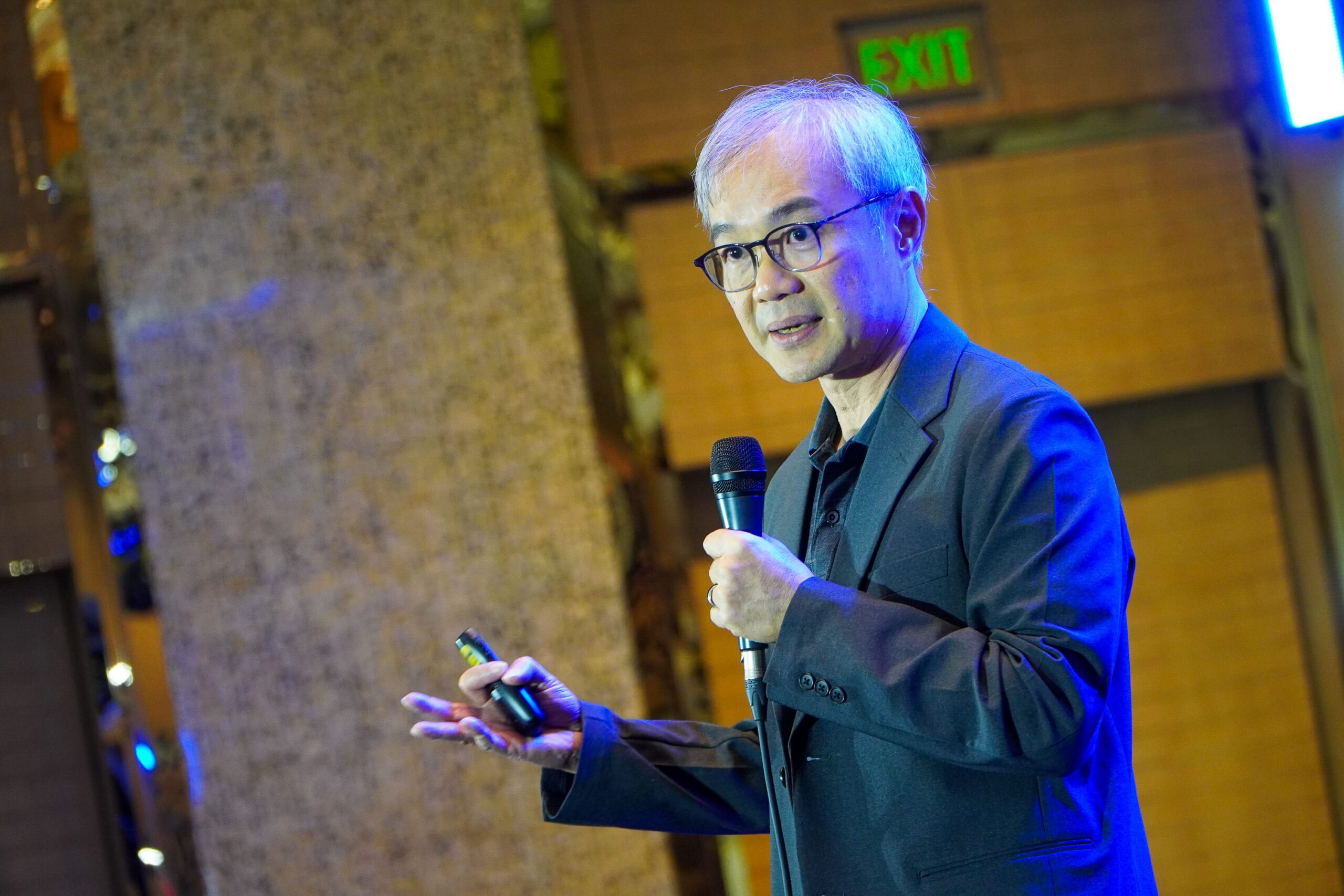
'AI is a powerful tool we should build, we should share, but we should always make sure that humans — all stakeholders — have a say in this future that we create,' Leslie Teo says at the 2026 Social Good Summit MANILA, Philippines – “What can you do to make sure our future, our children’s future, is one that we would wish, not one that is imposed on us?” Leslie Teo, a Singaporean economist and artificial intelligence executive who serves on the UN Independent International Scientific Panel on AI, posed that question during his speech at the 2026 Social Good Summit on Saturday, November 21. He outlined ways to develop AI as a positive force for society. Teo challenged the notion that AI is beyond people’s ability to shape and control. “Today AI gives us powerful possibilities, but, just like the ideas of economists, the future is for us to determine,” Teo said. Teo compared the potential benefits of AI development to a pie that economists envision growing larger. “The fact that the pie grows doesn’t mean that you as an individual benefit. The fact that a consumer benefits doesn’t mean that a society grows. And even if the pie is larger, who gets the slice? Who chooses? Who has a say?” Teo explained. He said responsible AI development could help address gaps in expertise and efficiency, along with other problems countries face. An open approach to solving local problems Teo advocated for open access to AI tools, saying this would allow communities to shape how the technology is developed and build tools that address their own needs. “We all don’t need to build frontier models; in fact, that would be very foolish. But many AI tools — many things that matter when it comes to real impact — are open and free,” said Teo. He added, “If we don’t understand the technology, we can never trust it, we can never use it.” Teo said learning about AI and building tools to solve specific problems may be easier than people imagine. Developers can also set their own criteria for measuring the tools’ success. Defining their own benchmarks for success, Teo said, allows developers to retain control over the tools they build. “If you give someone else the ability to define what is success, you are giving away your sovereignty,” Teo said. As an example, Teo said there were 8,000 languages in the world, with 1,300 languages in Southeast Asia, but that most models can do 10 at best.” He asked, “What happened to the rest? Who defines what is good?” Teo said communities can maintain their sovereignty and address local problems by developing specialized tools that reflect their own needs, rather than relying on Western standards of what is “good.” Teo also envisioned a future in which AI development becomes more like Linux: frontier models would continue to exist, but open-source and free models would become more widespread as developers share and build on existing technology. Who has control of tech? Teo also emphasized that humans should remain in control of AI and other emerging technologies, rather than allowing these systems to dictate how people can act. To illustrate his point, he compared two call centers with different approaches to using AI. In the first call center, technology helps human agents find accurate information about customers’ problems, acknowledge mistakes, and resolve issues. In the second, AI monitors agents’ productivity and time spent on calls. They must follow a script and cannot or do not deviate from it. “AI is a powerful tool we should build, we should share, but we should always make sure that humans — all stakeholders — have a say in this future that we create,” Teo said. This human-centric approach to AI, he explained, is meant to keep AI development sustainable and pointed toward future growth, ‘Not about the pie’ Teo ended his speech by returning to the pie analogy, saying his vision of a better world was not about who got the biggest slice. “It’s about relationships. It’s about society. For me, this is what we want to build with AI. We want to build a better place for our children, where relationships matter, creativity — notwithstanding all the things AI can do — is still very much a human thing, and so is understanding meaning,” Teo said. “It’s not about a bigger pie. It’s about a meaningful world — much, much more important than just the pie.” The 2026 Social Good Summit, themed “We, The Humans,” focuses on promoting and defending human rights, community, and shared values as artificial intelligence becomes increasingly widespread. – Rappler.com
People should shape AI’s future, says UN panel member Leslie Teo
Full Article
Original Source
Read the full article at Rappler →KhanList aggregates and links to publicly available news content. We do not host full articles from third-party sources. Always verify important information with original sources.