
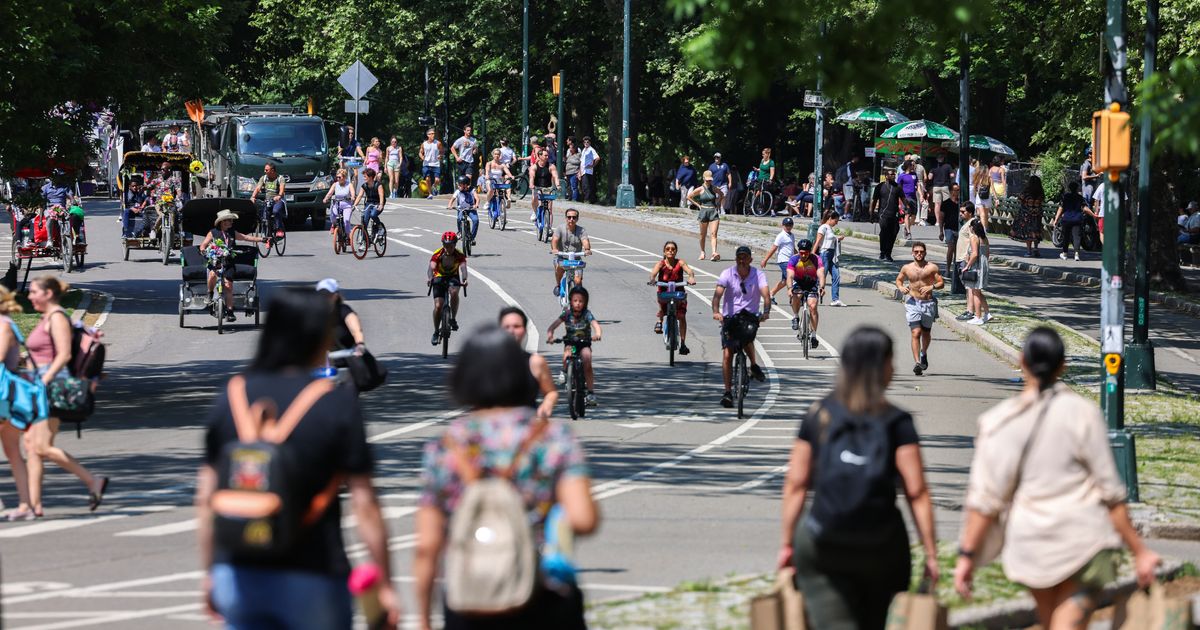
People Keep Dying on Central Park Drive The park’s main roadway encourages speed; a redesign must slow it all down. By , New York Magazine’s architecture and classical-music critic since 2007 and was the recipient of the Pulitzer Prize for Criticism in 2002. Photo: Charly Triballeau/AFP/Getty Images Photo: Charly Triballeau/AFP/Getty Images On September 23, Richie O’Brien was walking his bicycle across Central Park’s East Drive at 84th Street, near the Metropolitan Museum, on his way to his job as a steamfitter, when another biker crashed into him. O’Brien died. Less than two weeks later, a golden retriever darted out onto East Drive near the same spot, and a 71-year-old cyclist slammed on the brakes, flew over the handlebars, and was killed. I feel for everyone involved in these incidents, since I have biked along that stretch, crossed it on foot, or watched my dog sprint off toward traffic there. The fact that none of my experiences ever resulted in a crash is mostly a matter of luck. A few days ago, I found myself at the East Drive at 97th Street, the spot where, in June of last year, Salvador Nico-Garcia was thrown from his e-bike and died after colliding with a pedestrian. This time, a large group of bicycle neophytes led by a teacher pulled up slowly and politely paused at the crosswalk. A police van stopped with them. Reassured by the pause in momentum, I stepped out into the roadway to cross — and nearly got bowled over, once by a speedy cyclist who sliced through the crowd on the cop van’s passenger side, then by a second who chose the driver’s side. I jumped back, and the breeze from the passing rider blew through my hair. The six-mile Central Park Drive that loops around the park’s edge was built as a carriage road, later requisitioned for cars, temporarily cleansed of motorized vehicles, and is now a chaotic conduit for one- and two-wheeled vehicles, electrified and not. Early mornings, flocks of road racers in matching jerseys treat the 20-mile-per-hour speed limit as a challenge and slower riders as underbrush. E-bike riders gun the throttles on their silent engines. Scooter jockeys zip through crowds with the music in their ears muffling pedestrians’ protests. The Drive accommodates less frantic rhythms, too: Joggers and power walkers have their own wide lane. Families on holiday, seeing the roadway as a safe space for a leisurely two-wheeled amble, spread out, swerve, and stop to pant at the top of a hill. Every now and then, a diehard inline skater saunters along in a backward dance. The trouble is that members of the two large groups, the slow and the fast, collide with bone-crushing regularity. Death is a rare result, but its specter is ever-present. So far, the Central Park Conservancy and the NYPD have tackled those threats with an ineffectual combination of pleading, finger-wagging, and a few tickets a week. In 2024, the conservancy and the city collaborated on a Safety and Circulation Study of the Drive and implemented the least demanding of its recommendations, like repainting lanes and crosswalks, and stamping “Look!” signs for pedestrians on the roadway. That didn’t come close to eliminating conflict or confusion. A proposed reduction of the speed limit from 20 mph to 15 mph was blocked in court, and bikers continue to move as fast as they did before. Just recently, the conservancy’s president, Betsy Smith, reacted to the latest fatalities by endorsing the enforcement of existing rules (and new bike lanes on the impossibly narrow transverses, which would be an improvement if there was actually enough space to squeeze them in without adding to the hazards). None of that goes far enough. Even physically dividing the Drive into express and local lanes like a suburban highway will only aggravate the problem for those trying to get across. In the end, making the Drive less scary means promoting the one thing most New Yorkers loathe: slowness. London installed granite rumble strips at Hyde Park corner in an attempt to slow speeding bikes. Photo: Dukas/Universal Images Group/Getty Images London’s menu of bike-slowing measures includes speed bumps at key pedestrian crossings. Photo: Maxmust/Wikimedia Commons Serenity is a design problem. A few other cities have tried to achieve it in green spaces that have been roiled by speed. London installed granite rumble strips in Hyde Park, raised crosswalks across bike lanes at bus stops, and ran snaking paths through Van Gogh Walk in Brixton. Last May, Amsterdam banned fat-tire bikes in Vondelpark, and so far the count of at least that invasive species has come down. New York’s designers need a thorough catalogue of these techniques and a willingness to try them all. But the most radical move is also the most necessary: altering the geometry of the Drive. Cyclists, like drivers, speed where they can, or rather where the road encourages them to pick up the pace. In Central Park, they get their permissive signals from the Drive’s broad straightaways (at East 84th Street, say), exciting downslopes (like at East 97th Street) and curves wide enough for a speeding bus. They all need to change. Curves should get snakier, lanes should narrow and widen at intervals, speed bumps and planters should be deliberately placed in the way. All of these moves will infuriate those who value the Drive’s openness and fluidity, especially the road racers who consider it their natural preserve. I sympathize — but Central Park can no longer grant the privilege of being able to rocket along unimpeded. Horse racing, dog racing, and NASCAR don’t get to take over parks and streets either. Amsterdam focused on ridding Vondelpark of fat-tire bikes, a campaign that began last May and has so far been a ringing success. Photo: Lina Selg/AFP/Getty Images So far, neither the city nor the conservancy seems willing to see speed itself as the enemy, but maybe another fatal crash or two will convince them. After a runaway horse killed 18-year-old Romanch Mahajan on June 17, City Council finally took the step that it had been mulling for years: banning horse-drawn carriages. Now we need to get out of that reactive stance and reinforce Central Park’s role as a laboratory of urban living — a “proxy for how the rest of the world sees the city as a whole,” as Smith put it in her essay. She’s right that friction over the use of roadways and paths is hardly unique to Central Park. Rather, it’s a disappointing byproduct of the long effort to make New York a safer and more pleasant to get around. As the city built out bike lanes, deployed Citi Bikes, and made efforts to curb cars, I believed — hoped — that new populations of commuters, kids, grandmothers, and tourists on two wheels would crowd out the speed demons. I anticipated that e-scooters would be a boon to people with the desire but not the leg strength to bike. Bikers and pedestrians are not really distinct groups, but the same people at different times of day, and so I figured their interests would naturally overlap. I envisioned a more civil culture of the streets, in which New Yorkers of varying speeds, abilities, and lifestyles could share asphalt on equal terms. In London, Isabel Street was transformed into Van Gogh Walk, deliberately designed for peace and slowness. Photo: Jonathan Harbourne/Alamy Instead, we have a free-for-all. Sidewalks, footbridges, crosswalks, parks, esplanades, car-free plazas — just about every public space where pedestrians should feel at ease has been infested by a chaotic swarm of vehicles, both electrified and not. Vision Zero, the set of traffic-calming goals and strategies shared by every mayor for the past 20 years, was supposed to give pedestrians a greater sense of ownership of the public realm; not just with bike lanes, but also wider sidewalks, better-marked intersections, clearer turns, more rational traffic patterns, and so on. It’s done the opposite. “I’m walkin’ heah,” the battle cry of the New York pedestrian since time immemorial (or since 1969, anyway), has become an even more plaintive chorus. There’s a vast gulf between the fear and fury of New Yorkers and the indolence of many leaders, who continue to treat e-bikes as little more than a minor annoyance. During a City Council hearing last September, several speakers advocated for Priscilla’s Law, which would require registration and license plates for e-bikes. That bill, which remains stalled at both state and city levels, is a reasonable if cumbersome way to discipline the proliferation of anonymous machines and make someone accountable for who rides what and how. Officials deflected the argument by pointing out that cars are far more dangerous than bikes, which is true but not especially relevant. But the issue is less the presence of batteries than about habits of recklessness. The rise of delivery services made the situation exponentially worse: Everyone who steps outside these days shares the psychic cost of getting that burrito rushed, still hot and melty, to your door. Many delivery riders, especially undocumented immigrants, value their invisibility, and so they speed around the city like bats in a cave, swooping silently, lightlessly along unpredictable paths, practically undetectable until they crash. They are required to wear high-visibility clothing and turn on their lights, to stay off sidewalks and obey one-way streets, to be respectful of pedestrians and cautious in traffic. Few do any of that. Instead, they adopt strategies of desperate risk-taking, shrug off the yells, and, realizing that the likelihood they’ll ever get ticketed is low, continue flouting the rules while everyone is forced to duck out of their way. The Mamdani administration blames their cumulative menace on the economics of delivery apps and the ever-present fear of deportation. Rather than crack down on vulnerable workers, the city would rather require training and target the bosses by ensuring “that delivery companies face repercussions for encouraging unsafe behavior,” as the latest plan puts it. Unfortunately, negotiating with Uber and DoorDash takes time, money, and lawyers, and though those repercussions might show up eventually, and maybe even prove effective, e-bike cowboys are getting bolder, faster, and more defiant by the day. In 2024, then–Deputy Mayor Meera Joshi floated a proposal for a Department of Sustainable Delivery, a fresh bureaucracy that would start bringing order to the industry sometime in 2028. The Mamdani administration has since dramatically scaled back that plan. The city needs to recognize — now, not sometime in the 2030s — that pedestrians’ sense of vulnerability is a major quality-of-life issue. Its gravity is not measured by a relatively short list of maimings and deaths, nor can it be written off as perception unsupported by data. Even as crime drops and car crashes recede, New York’s streets and parks have grown increasingly hostile to those who are frail, slow, disabled, or small. As of 2022, seniors represented less than 15 percent of the city’s population but accounted for approximately 45 percent of pedestrian fatalities. And even in parks, parents and guardians have to keep children stiflingly close, out of the path of all the bionic combos of muscle and machinery barreling through. Since Central Park doesn’t have (very many) cars, the Drive can be used as a workshop to figure out ways to calm the anarchy through a coherent combination of design, enforcement, and regulation. Techniques can be tried out, tweaked, and refined in the park, then translated to streets where cars still rule. Planners and advocates have spent years developing ways to speed bikes up. Now we need to focus that same energy on slowing them down. Otherwise the public realm will grow safer in exactly the wrong way — because people are too scared to use it. People Keep Dying on Central Park Drive Your product is saved! You’ll receive emails when your saved products go on sale. Manage preferences.
People Keep Dying on Central Park Drive
Full Article
Original Source
Read the full article at Curbed →KhanList aggregates and links to publicly available news content. We do not host full articles from third-party sources. Always verify important information with original sources.