
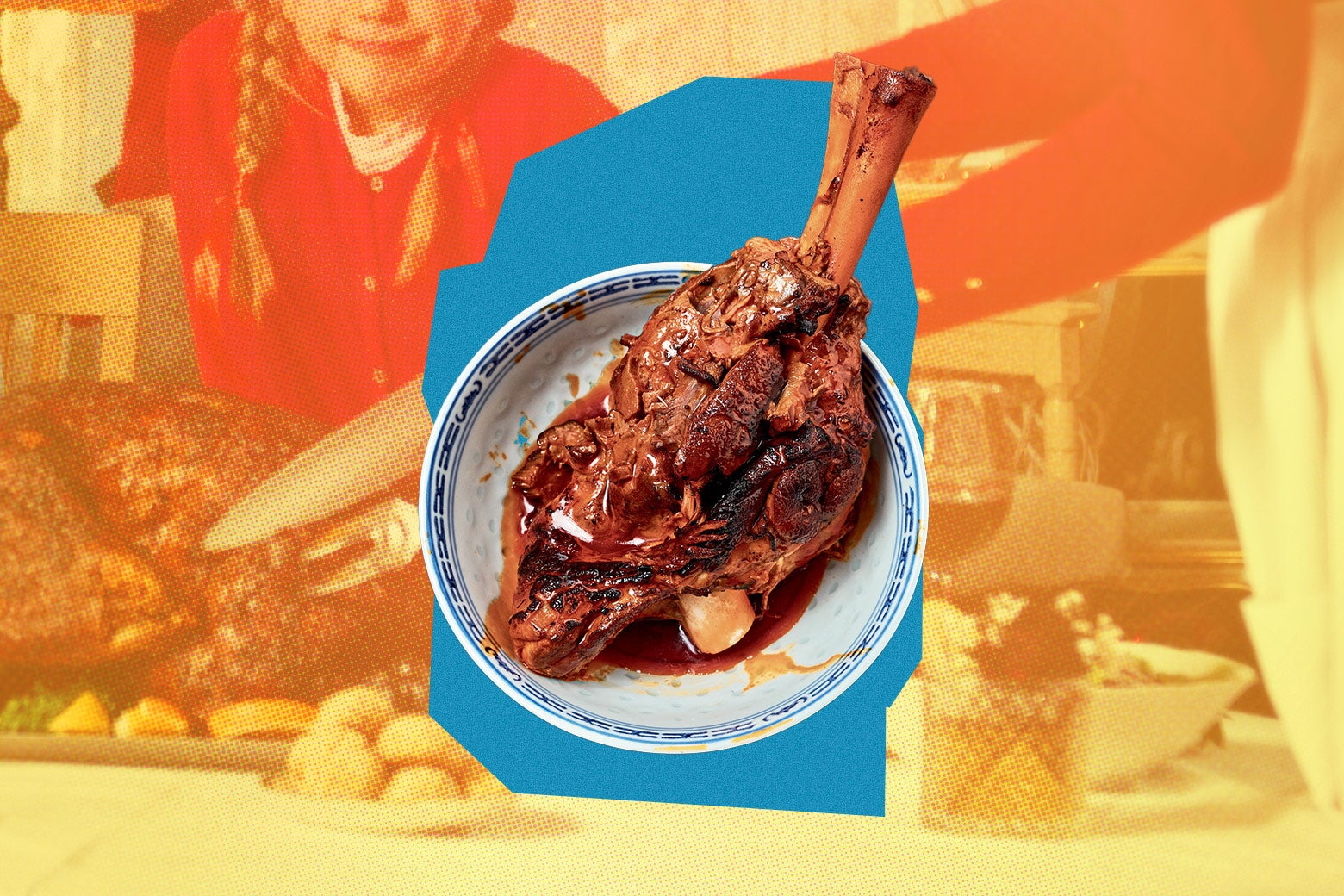
Food The New Holiday Table: Lamb Adobo Plenty of people want to banish turkey from the Thanksgiving table. But what’s impressive enough to replace it? I’ve found the answer—and it’s a stunner. Photo illustration by Slate. Photos by Tijana/Adobe Stock and Justin Walker. Recipe developers have been working overtime to freshen up our dusty holiday menus. In “The New Holiday Table,” we present five dishes from the past 10 years that have undeniably earned their reputation as modern classics and deserve a pride of place at your next celebration. Don’t let the vise grip of tradition keep your festive food flat! Read the rest of the series here. Thanksgiving doesn’t stray too far from its vaunted main course. Unlike Christmas, where the centerpiece allows for prime rib, tenderloin, glazed ham, beef Wellington, and even a goose, November is dominated by turkey. And hey, maybe you like that. Some see turkey and bask in its comforting consistency. Others gaze upon it and feel monotony. Personally, I’ve never been tied to the bird. Growing up, members of my family thought it too dry, and in turn demanded additional red-sauce-soaked main courses like spinach-and-ricotta manicotti, lasagna, or ravioli. My mom recently told me that sometimes my grandma would garnish her stuffed manicotti with meatballs because, and I quote, “people wanted meat.” The lengths we would go to avoid a roast! Today I continue that tradition of turkey abstinence by proposing a new main course for Thanksgiving, or any of the festive winter gatherings that follow it, this year: Nicole Ponseca’s lamb adobo. Back in 2018, I purchased a copy of Ponseca and Miguel Trinidad’s I Am a Filipino: And This Is How We Cook. At that point, I had been a resident of Los Angeles for a year, and my enthusiasm for Filipino food was boundless. I had fallen for delicious, hearty dishes like sizzling pork sisig, crispy lumpia, and pancit, but my heart swooned most for fatty, acidic flavors in dishes like adobo and kinilaw. After all, Filipino food boasts its acid proudly. “The high acidity from vinegar is what links all Filipino food,” Ponseca writes in the cookbook. It’s a cuisine that sings when it embraces rich cuts of meat, bright flavor enhancers like calamansi juice, coconut vinegar, and additional funky amplifiers like fish sauce or liver paste. One dish that hits all three of these notes—sour, savory, funky—is Ponseca’s lamb adobo. And it’s a stunner. Slate receives a commission when you purchase items using the links on this page. Thank you for your support. In Tagalog, the dish is named adobong pula achuete, or red adobo with lamb shanks and annatto. I simply call it lamb adobo, because it’s the only lamb adobo I’ve ever made, and it’s the only one I ever will make. It comes in handy at home, but if you’re at one of those casual, boozy, more-party-than-family Thanksgivings that encourage a progressive potluck attitude, I highly suggest bringing a pot of it over to wow your friends. Hell, just making this dish is a sensory experience. The pot of lamb stewing with aromatics and sharp, fruity vinegar creates an intensely fragrant swirl. Sure, turkey smells good on Thanksgiving, but the smell of adobo is intoxicating. I just adore the smells this braised lamb dish conjures; it’s the type of thing your neighbors will catch a whiff of and wonder, What the hell is going on in there? As Ponseca writes, this adobo comes courtesy of the Ilonggo people, that is, natives to the Visayas region of the Philippines. This adobo utilizes an amber-red achuete oil (that is, oil that’s been infused with toasted annatto seeds) instead of soy sauce, which imbues the coconut vinegar–braised lamb with a deep red hue, plus some earthy bitterness to boot. It’s quite different from the other adobos in her cookbook—which address chicken, duck, and even squid. This one feels a bit more modern, maybe even a bit more fine dining–ish. The lamb adobo yields not one but two delectable rewards: tender, fall-apart lamb shank and a luscious, rich-in-flavor adobo sauce that can be poured over anything. “It’s rich, a little gamey, and dominant,” Ponseca says of her choice to include lamb. “Rather than trying to tame that character, the adobo marinade embraces it. The lamb lends richness and depth to the sauce, while the acidity, salt, and aromatics of the adobo cut through that richness and reveal something new in the meat.” To procure the ingredients for this adobo, you’ll have to do some online shopping. Or, if you live in a city such as L.A., pay a visit to your local Filipino grocer. Normally, I’m visiting the Italian deli during the holidays, but last week I found myself at the Island Pacific Supermarket to secure my coconut vinegar, annatto seeds, liver paste, and fish sauce. I walked past my new favorite restaurant name, Crab Mentality, and found the overall shopping experience to be joyous and festive. The market even had a karaoke machine set up near the food court, where a man was stationed, singing crooner hits like “The Girl From Ipanema” and “Fly Me to the Moon.” Funny, this is exactly what my Greek Uncle Mike used to do on Christmas. Once the ingredients are acquired, Ponseca’s lamb adobo comes together almost effortlessly. It starts by browning each lamb shank in a Dutch oven. Then, in a separate bowl, whisk together the fish sauce, garlic, vinegar, achuete oil, miso, and liver paste. Add the onions (uncooked), peppercorns, and bay leaves to the liquid and shank. The whole thing bakes in an oven for two and a half hours, until the shanks are fork-tender and fall apart easily. Sounds easy, right? Maybe even easier than a turkey (AHEM!), and with much more flavor to boot. But wait, because some more magic happens after the lamb is done cooking. Remove the shanks, then cook the sauce for an additional 10 to 15 minutes, reducing until it easily coats the back of a spoon. This additional cooking time transforms the dark red, vinegary braising liquid into a full-blown sauce, ready to be spooned over rice or, as I’ve done in the past, pasta. Oh, and if the adobo sauce should happen to find its way onto some oven-roasted potatoes, green beans, root vegetables, or even mashed potatoes, you’ll be rewarded with Filipino-inspired side dishes. Come to think of it, you know what red adobo sauce would really brighten? Turkey. The point is, this isn’t just braised lamb you’re making but a rich, wonderful Filipino gravy to accompany your other sides. “I wanted to challenge the idea that adobo belongs to a particular protein, or that its authenticity is somehow dependent on using the ingredients we’re most familiar with,” Ponseca says. “To me, adobo is so much bigger than chicken or pork. It’s a technique, a flavor philosophy, a way of cooking that has always been adaptable. And that adaptability is precisely what makes it so extraordinary.” The lamb itself is tender and fatty once braised, and the achuete oil adds a great visual element in addition to some earthiness, but it’s that coconut vinegar that sings most. Ponseca’s adobo section of her cookbook contains a subheading that reads: “Cooking With Vinegar.” And I find that to be the biggest reason to go adobo this Thanksgiving. Thanksgiving food itself desperately needs tang. It needs brightness. You can’t rely on cranberry sauce as the only source of sour. I find that Thanksgiving—and the holidays in general—is a great time to cook outside your comfort zone. (It’s why, on recent Christmases, I’ve skewed toward steakhouse vibes.) I’ve been to some wild Friendsgivings out here in Los Angeles, the kinds where everyone brings something from their personal culture or experience. I’ve seen Thai fried rice, fried shrimp, Cajun rice and beans, and fried oysters all grace Thanksgiving tables. Normally I contribute to this cultural hodgepodge with manicotti, a little red-sauce heritage in honor of my folks. But this year, I’ll be bringing Filipino adobo. The lamb will be a welcome change, but it’s that amber-red, vinegary, earthy adobo sauce that I think people will enjoy most. This is truly a pot into which everyone will be more than happy to melt. Adobong Pula Achuete (Red Adobo With Lamb Shanks and Annatto) Excerpted from I Am a Filipino by Nicole Ponseca and Miguel Trinidad (Artisan Books). Copyright © 2018. Photographs by Justin Walker. This red adobo is an Ilongo dish—specifically from the Hiligaynon people, one of the many ethnic groups in the central Philippines. This adobo uses amber-red achuete oil instead of soy sauce, giving the dish a vibrant red hue and an earthy bitterness. Achuete is the Filipino word for annatto seeds. Though lamb isn’t common in Filipino cooking, lamb shanks are outstanding slowly cooked in this rich red sauce fortified with a spoonful of miso and some liver paste. Serves 4 Ingredients:3 tablespoons vegetable oil2 bone-in lamb shanks, about 1½ pounds (680 g) eachKosher salt and freshly ground black pepper1 cup (240 ml) coconut vinegar1 cup (240 ml) Achuete Oil (recipe follows)3 to 4 tablespoons fish sauce5 garlic cloves, smashed with the side of a knife2 tablespoons red miso paste⅓ cup (80 mil) liver paste or liverwurst spread1 small white onion, thinly sliced10 whole black peppercorns5 bay leaves4 cups (800 g) cooked white rice (see recipe), for serving Directions:Preheat the oven to 350° F (175°C). In a large skillet, heat the vegetable oil over medium-high heat. Season the shanks on all sides with salt and pepper and cook until browned on all sides, about 6 minutes per side. Set the shanks aside on a large plate. In a Dutch oven or roasting pan, whisk together the vinegar, achuete oil, 2 tablespoons of the fish sauce, and the garlic. Whisk in the miso and liver pastes until they are completely incorporated. Add the onion, peppercorns, and bay leaves. Add the browned lamb shanks to the pan, pressing them under the liquid. Add water as needed to submerge the meat and onion. Cover the pan tightly with a lid or several layers of aluminum foil and bake for 2½ hours, or until the shanks are fork-tender. Transfer the shanks to a large plate, then place the Dutch oven over medium-high heat and cook until the liquid has reduced and is thick enough to coat the back of a spoon, about 10 minutes. Stir in 1 tablespoon of the fish sauce and taste; add more until the taste is to your liking. Return the shanks to the sauce and heat them through, if necessary. For the best flavor, refrigerate the adobo for a few hours before serving, then reheat it and serve it in deep bowls, with rice. Achuete Oil Like garlic oil, you can use achuete oil to add luster and flavor when finishing a dish. Or you can drizzle it on anything you like—eggs, rice, grilled meats, tomato sauce-based dishes like kaldereta or afritada—or use it to add a slightly nutty undertone to stews. This recipe is easy to scale up or down as you like. Makes 1 cup (240 ml) Ingredients:¼ cup (70 g) annatto seeds1 cup (240 ml) vegetable oil Directions:Heat a skillet over medium-high heat. When it is smoking hot, add the annatto seeds and toast them, stirring frequently, until they just begin to smoke and pop. This should take only a minute or so. Add the vegetable oil and simmer, stirring frequently, until the oil takes on the deep red color of the seeds—again, this takes only a minute or two. Remove the pan from the heat and let the oil cool. Strain the oil through a fine-mesh sieve set over a mason jar and discard the seeds. Store the oil in the tightly-sealed mason jar for up to 1 month. Note:I used a combination of lamb shanks and lamb loin chops, equally 3 pounds in total. Lamb loin chops braise beautifully in 2 hours, and fall off the bone just as the shank does. You may use ground annatto seeds and skip the fine-mesh sieve and mason jar. Ground annatto seeds are fairly common. Read the rest of the New Holiday Table series here. Cooking Food Holidays Thanksgiving New Holiday Table
People Have Been Trying to Fix Thanksgiving’s Biggest Problem for Years. I’ve Finally Found the Solution—and Trust Me, You’re Going to Want a Bite.
Full Article
Original Source
Read the full article at Slate →KhanList aggregates and links to publicly available news content. We do not host full articles from third-party sources. Always verify important information with original sources.