
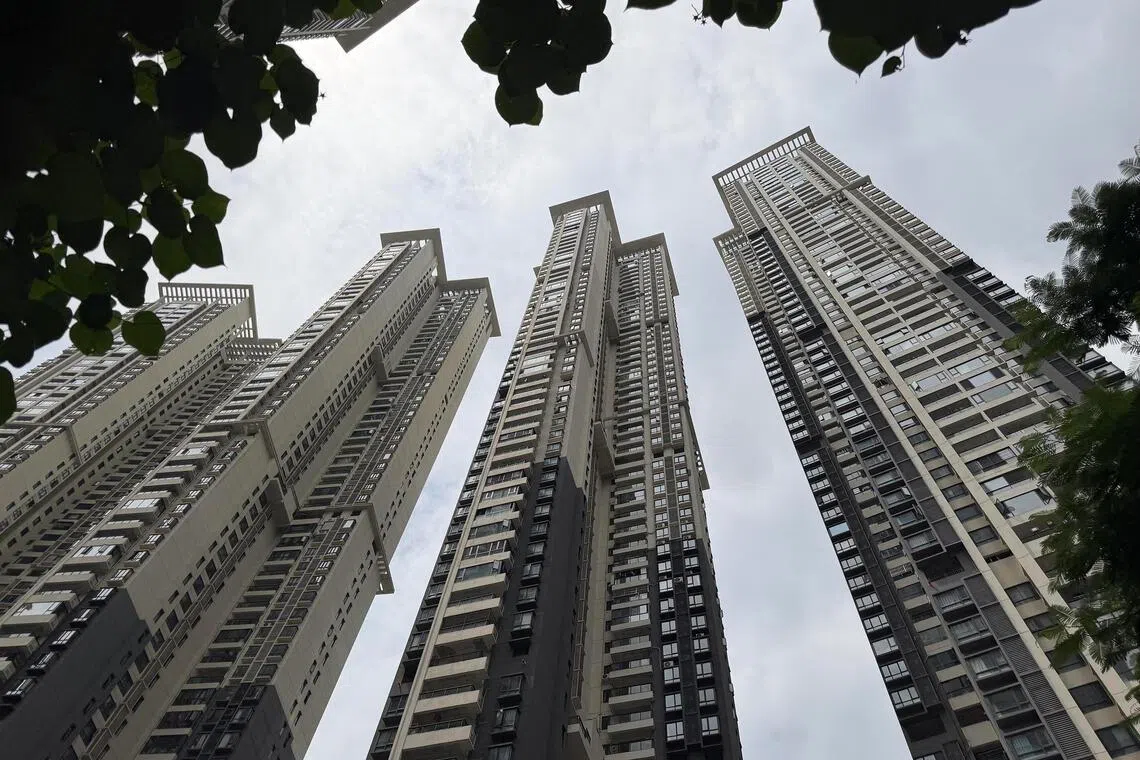
– The door was shut, the curtains drawn and everyone was told to put their phones away.Charles (not his real name), a Singaporean in his 30s, was taken to the high-rise apartment one morning in 2024 by a friend for a “briefing” on how he could get rich.The four-bedroom unit was in Skyfame Byland, a sprawling 22-block waterfront condominium in Nanning, the capital of southern China’s Guangxi region. Some blocks rise as high as 64 storeys, making the estate a prominent feature of the city’s skyline.“The first thing that struck me was how spacious it was, and how lucky the Singaporean who owned this unit must be. I was envious,” he told The Straits Times.Had the curtains been drawn open, he might have been able to see panoramic views of a horseshoe bend in the Yong River, its silt-yellow waters snaking through the city. He described the apartment as comfortably furnished with a homely vibe, without the oversized chandeliers and gilded flourishes associated with ostentatious living.More than 10 participants, mostly Singaporeans, piled into the living room, listening as promoters talked up Nanning’s prospects during the morning session. Their “hosts” – one for each participant – kept close watch from the adjoining dining area.All the promoters seemed to be Singaporean, Charles recalled. They looked respectable and spoke fluent English. One silver-haired man introduced himself as a doctor.After lunch, the group was taken to another unit in the condominium, where the afternoon session revealed how the scheme worked: pay a subscription fee to join, recruit others, and be promised a handsome return. “I realised they were not investing in anything real. Whatever returns they promised were merely coming from later joiners,” Charles said, describing what is essentially pyramid selling, banned in China since 1998.“I could tell by looking at the faces of other participants that some were confused, and others like me didn’t buy the story. But even so, bizarrely, nobody stood up and left.”“I think it’s because there were more of them than us in the apartment. Our hosts hovered around us all the time. I felt slightly threatened,” he said.Charles said being abroad heightened his sense of vulnerability. He felt caught in a legal no man’s land.“We are not in Singapore. I don’t know where we can get help. I assume Singapore police can’t reach into China to save us, and Chinese police can’t catch the perpetrators once they go back to Singapore.”A view of Skyfame Byland, the Nanning condominium where some Singaporeans were given briefings of suspected pyramid schemes, overlooking Yong River. ST PHOTO: YEW LUN TIANCharles had been taken to the briefing by a long-lost friend – a primary school classmate he had not seen since they were 12. He and the others were allowed to leave after the full-day briefing ended in the evening.After he left, Charles texted his classmate to say he was not interested. He never heard from him again.“It’s sad that instead of looking out for each other overseas, we have to guard against our fellow Singaporeans,” Charles said.Had Charles not walked away, he might have ended up poorer, not richer.People who spoke to ST said they knew of others who had sunk tens or even hundreds of thousands of dollars into similar schemes, and struggled to claw their money back.On Sept 4, Singapore authorities revealed that 52 Singaporeans had been arrested in Guangxi by local police over their suspected involvement in pyramid schemes.Investigations are ongoing. Several Singaporeans previously interviewed by ST said they were taken to condominiums such as Skyfame Byland to attend recruitment sessions.Launched in 2015, Skyfame Byland is part of the much larger Skyfame ASEAN Maker Town, a mixed-use development earmarked as a base for business, technological innovation, and trade cooperation serving South-east Asian nations, but never did take off fully. It is 15km from the city centre.Known as China’s gateway to ASEAN, Nanning has been hosting the China-ASEAN Expo (CAEXPO), a trade fair, annually since 2004. Singapore’s ministers-of-state have attended the opening in previous years. This year’s rendition will take place on Sept 17.The ‘Nanning dream’When ST visited the condominium complex on Sept 6, birds chirped in the trees in front of the blocks, while children cycled and played badminton in the open spaces below.“I’ve seen many Singaporeans come and go in my block. They move around in groups and don’t seem to be living here permanently,” a woman surnamed Zhou told ST as she played with her two-year-old daughter at a pavilion in the condominium’s courtyard.“Lately, I don’t see them anymore.”The living room of a river-facing, four-bedroom unit at Skyfame Byland. The unit is not known to be linked to the alleged pyramid schemes involving Singaporeans. PHOTO:PEI EN RENTAL DIARY/XIAOHONGSHUDespite several blocks enjoying river views, the condominium remains mid-range. It is high density – more than 4,000 units across 22 towering blocks – with basic facilities. There is no clubhouse or indoor gym, only a scattering of small playgrounds, a running track and a half-size outdoor pool that charges per use and closes during winter.A high-floor, four-bedroom unit with a river view fetches less than 1.4 million yuan (S$264,000) on the resale markets, just a tenth of a similar home in bustling Shenzhen in the neighbouring Guangdong province.A stone’s throw away is a Singaporean-run eatery selling not just Singapore food, but also the Nanning dream, apparently.Joy (not her real name), who had been living in Nanning for several years, was craving a taste of home. In February when she spotted a new Singapore food stand on Douyin, the Chinese version of TikTok, she made a beeline for it.The Singaporean couple running the stand seemed friendly and chatty when she ordered Hokkien mee and char kway teow. Then they tried to press her to learn more about the “exciting investment opportunities” they had discovered, Joy told ST.But the Nanning they described – a city brimming with opportunity and poised for growth – did not square with the one Joy had come to know.“Frankly, there just isn’t much happening here,” she said. Alarm bells went off. She left and never went back. “The food was too oily and salty anyway,” she said.When ST visited the stall, there was only one middle-aged man running it. He spoke few words. He served us food and beer, then left us alone.The layout of Skyfame Byland. ST PHOTO: YEW LUN TIANBack at Skyfame Byland, Zhao Yingzhe, the condo’s cleaning services manager, was surprised to hear that Singaporeans may have been engaging in pyramid selling in the compound, right under his nose.“I thought chuanxiao had been wiped out already,” he told ST, using the Chinese term for pyramid or multi-level marketing (MLM) schemes.Nanning was a hotbed of pyramid schemes, including the notorious “1040 Sunshine Project”, from the late 2000s to the mid-2010s.Operators exploited the development of the Beibu Gulf Economic Zone, a trade and transport hub linking China with ASEAN, to sell recruits the promise of riches from an impending boom.After Chinese police stepped up enforcement from 2016, raiding dens and targeting organisers and ringleaders, pyramid selling activities became far less visible. But traces of that era remain. Zhao said one of the cleaning services’ employees was a former university teacher who came to Nanning, lost his money in a pyramid scheme and, too ashamed to go home, now works as a sweeper at the condominium.Years later, Zhao could see that the man – a Chinese national – was still trying to recoup his losses by promoting a “miracle pill” on social media that he claims can cure all ailments.“Nanning is a city of chuanxiao refugees,” Zhao said. “People came here dreaming of riches, only to lose everything and end up stuck here.”Additional reporting by Michelle Ng
‘People came here dreaming of riches’: Inside the Nanning condo said to be part of a pyramid scheme
Full Article
Original Source
Read the full article at Straitstimes →KhanList aggregates and links to publicly available news content. We do not host full articles from third-party sources. Always verify important information with original sources.